More people than ever rank the environment low among their concerns
By Justin Chapman, Pasadena Weekly, 4/18/2013
Award-Winning Journalist & Pasadena's District 6 City Councilmember's Field Representative
More people than ever rank the environment low among their concerns
By Justin Chapman, Pasadena Weekly, 4/18/2013

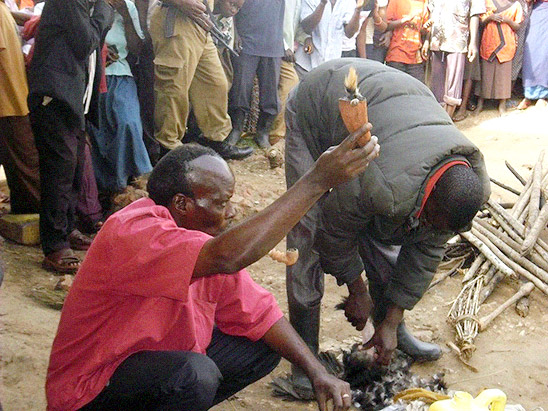
The healer reveals a witchcraft item “found” in the accused man’s house to the crowd. It probably came from the pockets of his assistant’s padded jacket.
In the small Ugandan village near the capital city of Kampala, a man named Ronald Kapungu had been accused of practicing witchcraft or hiring witch doctors to curse a nearby family. In this week’s eSkeptic, freelance reporter and travel writer, Justin Chapman, describes his experience at the witchcraft ceremony that he witnessed while covering the story with local journalist Luke Kagiri.
Justin Chapman is an author, poet, actor, and journalist. At age 19 he was elected to the Altadena Town Council and chaired its Education Committee. He has written for numerous publications, including the Pasadena Weekly, L.A. Weekly, Patch.com, and Berkeley Political Review. He received his degree in Media Studies from University of California, Berkeley.
All photos by Justin Chapman. Used with permission.
BY JUSTIN CHAPMAN, SKEPTIC MAGAZINE, 4/17/2013
I’m a freelance reporter and travel writer. Over the course of three months in 2012 I traveled by myself by buses and trains from Cape Town, South Africa to Mityana, Uganda. One of the things that struck me was the apparent contradiction of the practice of witchcraft, especially in East Africa. As I reached Zambia I started to hear about the history of witchcraft. I was surprised to find out in Uganda that the practice is still very much alive, even among otherwise intelligent people.
The Ugandan constitution allows all kinds of worship, but has a (very weak) provision from 1957 called the “Witchcraft Act” setting forth punishments for those who practice it. However, a court later voided the sections about witchcraft for having vague definitions. You are not allowed to threaten someone with witchcraft, but proving that someone has practiced it, let alone succeeded in utilizing evil spirits, is impossible at best.
Unfortunately, the villagers are wary of modern hospitals and doctors, and once they are convinced witchcraft is being practiced, the sick will not visit a hospital because they think the doctors will not be able to find, let alone cure, the problem. This really is a tragedy because if someone has malaria, for instance, obviously the hospital is the place to go. But if they believe witchcraft is the source, they won’t go, leaving themselves open to sickness and death.
While in Uganda I traveled around with a local journalist named Luke Kagiri and helped him cover his various assignments. One day we rode on a boda-boda (motorcycle taxi) about halfway between Mityana and the capital city of Kampala, about an hour’s ride, for a witchcraft ceremony. The driver turned off the highway onto a walking path that led us deep into the bush to the village where a man named Ronald Kapungu had been accused of practicing witchcraft or hiring witch doctors to curse a nearby family. As proof of Ronald’s wrongdoing, the afflicted family claimed that a male relative had died, the husband was supposedly acting crazy like he was possessed, and the wife was ill.
Several villagers had attacked Ronald’s house the week before and he fled the village, hundreds of miles away. Riot police had to come and shoot tear gas into the crowd to disperse them. So the villagers called a “traditional healer” to come and use his “powers” to confirm or deny whether Ronald had in fact been practicing witchcraft.
When Luke and I arrived, there were about 200 people from the surrounding small villages to witness the ceremony. I was the only mzungu (white person) there. Of course everyone was staring at me, but they knew I was with Luke and that we were filming the ceremony for Bukedde TV, the local news station. This gave us access that the crowd didn’t have.
Under the Ugandan constitution, large gatherings of people are not allowed without permission from the police and without police presence. Indeed, there were several uniformed officers, who stood in front of the crowd (which was compacted together on a small hill 20 feet from Ronald’s battered house, people watching among the trees, cows, pigs, and chickens in the bush) while riot police, automatic rifles at the ready, stood at various points in a circle about 40 feet from and around the crowd.
The traditional healer, a well-dressed man in his late 50s wearing an expensive watch (not what you would picture a witchcraft healer would look like or be wearing), had to get clearance from the local police as well as the chiefs of the village before he arrived.
The healer took his time, walking around the square house, tapping at various things with his black walking stick that curved near the top like a handle and continued up another foot (supposedly the source of his “powers”), and finally entering the house to look around. He didn’t bring a bag, but two men came with him and one of them had a thick black rain jacket on with many pockets. The healer exited the house and the three of them took a canister filled with local brew and walked around the perimeter of the house, splashing the alcohol against the outside walls of the house. They did the same thing with a canister of milk, then one of the guys tossed small stones up to hit the tin awning that stretched out beyond the roof.

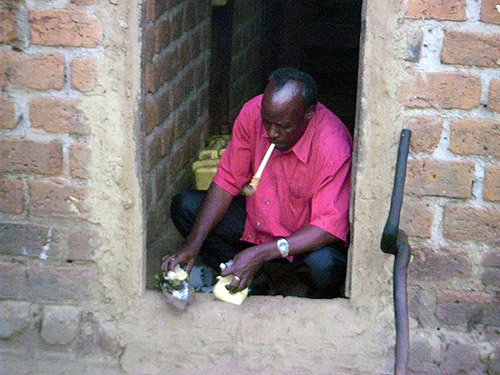
A “traditional healer” performs a ceremony in the doorway of the house of an accused witch. The walking stick outside the door is the source of his power.
The healer then placed a bag of flour and a wooden bowl filled with an unknown substance at the foot of the door. He lit his pipe, smoked slowly, answered his expensive cell phone and talked for a minute or so, looked around like he didn’t care, and used his stick to mix the substance in the bowl. After smoking for a few minutes, he went back into the house. Luke motioned for me to follow him. We walked into the house in time to see the healer’s associate, the one wearing the black rain coat, slip a curved, cone-shaped wooden handle with herbs sticking out of the top into a soft, weathered briefcase on the ground.
We went outside and the healer emerged with the bag, which he informed the crowd he suspected contained the witchcraft items.
After another few minutes he opened the bag and pulled out the wooden handle. He held it up to show the crowd (see photo at top of this article), which went wild with excitement, for this was supposed to be the witchcraft item used by Ronald to bewitch the family. I already knew the whole thing was baloney, of course, but when I saw what the healer did, I realized the scam. The man who was wearing the black raincoat had the cone-shaped handle hidden in his jacket pocket the entire time.
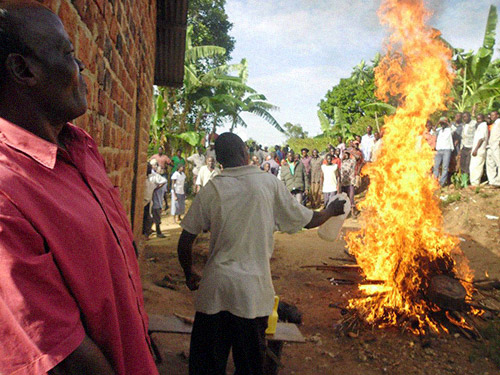
Their suspicions confirmed, the villagers began throwing large pieces of wood into a pile in front of the house to make a fire. They brought two chickens over and removed the feathers from their necks, then sliced the heads off right in front of me and threw them into the pile. A guy doused the wood with kerosene and lit the fire. The healer threw the bags in as well as the witchcraft item, which supposedly contained all the evil spirits. People grabbed whatever they could and threw the stuff into the fire. More gas was splashed on, and it became the tallest, hottest bonfire I’d ever seen. Everyone had to back away about 20 feet because it was so hot.

As about 200 people watch, gasoline is poured on a bonfire and the alleged witchcraft items are burned to destroy the evil spirits.
Then the already elated, besotted crowd marched behind the healer down a path to the victim family’s home, about 100 yards down the hill. Luke and I ran in front to get pictures and film the single file hikers. When we got there, the healer approached the sick woman and rubbed the curve of his stick around her head, muttered a few words, and gently lifted his hands to the air, as if to say, “Evil spirits be gone.”
I followed the healer into the victim family’s home, which he inspected thoroughly but still with an uninterested attitude. I saw the room where the family members slept, on thin mats on a hard floor.
The crowd was angry. They wanted vengeance. Everyone marched back to Ronald’s house with the intention of destroying it. The police were there to stop them, and Luke told me, “If there is violence, stand behind the police, because they will shoot in front of them into the crowd, not behind.” So we stayed behind the police who stood between the crowd and the house. Ronald’s father, a very old, frail man on crutches, claimed that his son was innocent. The police told the crowd to disperse. The crowd timidly backed off, but would surely be back later to demolish the house.
The police told Luke and me that they were leaving and that we should leave as well, because if something happened they would not be able to protect us. I wanted to see some mob violence, but it’s probably better that we got back on the boda-boda and booked it out of there, following the healer who also rode on a boda-boda. I didn’t think we were in danger but Luke told me that the crowd knew they could be identified on television and so when the police left they could potentially attack us.
The villagers will go looking for Ronald, and if they find him or if he ever returns to the village, he will be killed. Many people die this way. Even if Ronald was practicing witchcraft or had hired a witch doctor to put a curse on the family, so what? This stuff isn’t real. The only thing he is allegedly guilty of is sending bad vibes. The accused are the victims, not the “bewitched.” People practice witchcraft in Africa for various reasons, but usually because they are jealous of someone for having more money, allegedly having an affair, having beautiful children…anything. And people are killed and their homes destroyed because of it.
Meanwhile, the traditional healer is paid between 500,000 and 1,000,000 Ugandan shillings (about $200–$400 U.S.) for his “services,” which is a lot of money for villagers to cough up. He’s ripping them off, and he also adds to the confusion by spreading rumors about certain people practicing witchcraft.
According to the Ugandan constitution, in order for the police or a traditional healer or anyone to search your home, they must have a search warrant, like in America. At this ceremony, they had no search warrant and yet the healer and others were allowed to enter Ronald’s home, search it, seize items from it, burn them, probably destroy the house, and later most likely murder him. If Ronald knew the law, which he doesn’t, he could sue the police, the healer, and others. He could say his name and image were tarnished and be compensated 2,000,000 shillings for that as well as for the destruction of his home and property, such as the bags. The chances that he would win the case are extremely high, because how can anyone prove in court that evil spirits were the cause of the victim family’s illnesses and death? I told Luke I wanted to help Ronald, to give him the pictures and footage we took of the ceremony so he could use them in court to prove he was not served with a search warrant.
“Ronald could only use the footage and pictures if we published them in the newspaper or broadcast them on TV,” Luke told me. “If we supply him with the raw clips and photos, the villagers would think we were spies trying to help him the whole time, instead of attending the ceremony to write and shoot a legitimate journalism story about it.”
We would be outcasts in the community, and since Luke lived there and people knew who he was, he couldn’t do that for Ronald. The fact remains that if these people really want to hold onto this outdated belief system, fine. But why not try a healer and a real doctor in a real hospital? What have they got to lose? They just think it’s a waste of time, because the real reason for unexplainable things is invisible spirits and powers that can’t be proved. The fact that Ugandans are mostly Christian doesn’t dissuade uneducated segments of the population from letting go of their superstitious beliefs regarding witchcraft.
How interesting. How bizarre. ![]()
‘An island in the sea of madness’
South Pas strives to maintain its small-town feel as Caltrans pushes freeway tunnel option
By Justin Chapman, Pasadena Weekly, 2/28/2013
On Saturday, the city of South Pasadena will be celebrating its 125th anniversary with a litany of free events. The library will host authors Mary Ames Mitchell tonight and Jim Gallo and Dan Rice tomorrow night, accompanied by the local band Cottage Industry.
Then, from 5 to 9 p.m. Saturday, the city’s actual birthday, a “Neighborhood Night on the Town,” sponsored by the Chamber of Commerce, will feature open houses, art exhibits and live music throughout South Pasadena.
But while the city certainly has reason to celebrate, residents and community leaders are all too aware of the lingering threat that is the Long Beach (710) Freeway extension.
For one thing, the freeway problem has not gone away; it has just moved underground. Caltrans is now considering five alternative options to an overland connector route: build nothing, increase bus rapid transit lines, build light rail lines under Fair Oaks Avenue, improve traffic management, and build the tunnel.
Citizens are equally opposed to the tunnel connector plan as they were to the surface route, which Caltrans has said is off the table, though the agency still refuses to sell the homes it bought up through eminent domain as surplus properties.
“We think the tunnel is too harmful,” said 710 opponent Joanne Nuckols, who served as chair of the city’s Transportation Commission. “We don’t like the no-build option either, because we think something needs to be done to resolve the stub ends of the freeways, which is something they do not have in any of the plans. We think the combination of the [bus rapid transit option], surface improvements and resolution of the stub ends of the freeways, and extension of the Gold Line as opposed to the rail line they’re proposing, would do a long way to improve the traffic flow in the [freeway extension] corridor,” Nuckols said.
“The combination of the non-tunnel alternatives would be a lot less expensive than the tunnel and, cost effectiveness-wise, would move a lot more people and solve a lot more of the transportation problems,” Nuckols said.
Former Mayor Harry Knapp agrees that something needs to be done to improve traffic flow in the corridor.
“Let’s say this whole freeway thing goes away. You still have to do something,” Knapp said. “One of the major ways we proposed to improve traffic on Fair Oaks [Avenue] was to eliminate the two northbound lanes that turn left onto the 110 Freeway just before State Street, and instead extend the defunct exit ramp on the right. But Caltrans owns that ramp and doesn’t want to pay for it. If Fair Oaks moved a little bit better, a lot of people would use Huntington [Drive] and go up Fair Oaks.”
Other issues that face the city in the coming years include balancing preservation needs with economic growth.
“There’s some growth desired, but we just want to keep the mom and pop stuff here and keep out the big box stores,” said Knapp. “Downtown development is one concern. In the original plan, the Rialto Theater was going to be an anchor. But Landmark owns the building and they don’t want to do anything with it, so it’s kind of demolition by decay right now.”
Preservation and self-protection will continue to play a big role in shaping the city for years to come, with strict laws on the books limiting the trimming and removal of trees, as well as a 45-foot height restriction for buildings.
“South Pasadena is much more preservationist than just about any community in Southern California,” said City Librarian Steve Fjeldsted. “It’s surrounded by much larger more populated communities, which have, in part, lost a lot of their identity with development and so forth. South Pasadena has been threatened by the 710 Freeway, and it’s really galvanized the community. Pridefully and stubbornly so, South Pasadena has strived to retain its own identity because it’s like an island in the sea of madness.”
South Pasadena has come to be defined by ‘The Fight’ against the 710
By Justin Chapman, Pasadena Weekly, 2/28/2013
At the turn of the last century, there were few other places that anyone would rather be than sunny Southern California. And one of the best, if not also one of the most exciting places to be was South Pasadena, home of a widowed first lady, Lucretia Garfield, and visited by diplomats, industrialists, even President Theodore Roosevelt, who stopped here once on his way back from Panama, staying at the luxurious Raymond Hotel.
While Fair Oaks Avenue and Fremont and Mission streets were still dirt roads, the Raymond dominated the landscape for miles in every direction and drew wealthy clientele from the East Coast.
“The Raymond Hotel actually attracted rich visitors to the sunny skies and warm climate of South Pasadena,” said South Pasadena City Librarian Steve Fjeldsted. “It was a world class luxury hotel that attracted well-to-do tourists from back East for the most part and put South Pasadena on the map in the minds of lots of people. It burned down twice and, after the second time, it was never rebuilt. By that time, this area had grown up quite a bit and it had done its job to attract a lot of people and a lot of attention to this area.”
Another major draw to the area in the early part of the last century was Edwin Cawston’s world famous ostrich farm, which at the time was located right next to the Arroyo Seco. According to local historian Rick Thomas, ostrich feathers symbolized wealth and upper-class refinement and remained popular in America for nearly 50 years.
“It really was for the feathers and the fashion,” said Thomas. “Cawston made a whole entertainment element to it. Eventually, it went out of business because women’s fashion changed.”
However, with economic growth came the need for increased mobility. With the area’s population growing, and the advent of the automobile, South Pasadena quickly found itself sandwiched between the Long Beach (710) and Foothill (210) freeways, which the California Department of Transportation, Caltrans, has tried to connect for more than 50 years.
In 1949 the city of South Pasadena passed its first resolution against the proposed route, and by the 1950s Caltrans had begun the seizure of hundreds of homes in South Pasadena, Pasadena and El Sereno through eminent domain and hardship sales.
If any single thing has come to characterize South Pasadena over the past five decades, it has been the dogged resistance of this little city to the state, and ultimately winning … so far.
The struggle to stop the state from connecting the freeways, or, “The Fight,” as Thomas calls it in his Images of America book, “South Pasadena,” has been going on for more than five decades.
“In the ’70s, it got shelved and nothing happened for about 10 years,” said veteran freeway fighter Joanne Nuckols, who has served as chair of the city’s Transportation Commission. “Then, all of a sudden, Caltrans decided to pull it off the shelf in the mid-’80s and everything started up again. That pretty much lit a fire under everybody that we really needed to look at this.”
The cities of Los Angeles, La Cañada-Flintridge, Sierra Madre, Glendale and South Pasadena all have passed formal resolutions against the proposed route, but cities like San Marino and Alhambra continue to support Caltrans’ proposal. Pasadena has expressed strong concerns about the project, but it has stopped short of formally opposing it because they believe their hands are tied by the voter approved Measure A. That proposition called for completing the extension between the two freeways. However, it did not specify how the extension should be completed.
“South Pasadena fiercely protects its small town environment,” said Thomas. “Unfortunately, this town is so uniquely positioned to be the travel point from Los Angeles to the San Gabriel Valley, so it just gets in the way of transportation corridors. The whole city was considered endangered early on. We don’t even need that designation anymore because we have so much clout.”
While The Fight has been the source of much controversy over the years, it has also contributed to defining South Pasadena in other ways.
“The preservation movement and The Fight kept the small-town atmosphere,” said former Mayor Harry Knapp, another longtime freeway opponent. “The freeway fight gave some uncertainty to developers, even now, and preserved that small town feel that we’re really trying to keep.”
Today, even with an overland connector route permanently off the table, The Fight continues, with city leaders now opposed to plans to connect the two freeways with two giant 4.5-mile-long tunnels.
Self-protection lies at the heart of South Pasadena’s very beginnings as a city
By Justin Chapman, Pasadena Weekly, 2/28/2013
Centuries before white settlers inhabited the southern portion of the San Gabriel Valley, the city we now call South Pasadena was home to members of the Hahamongna branch of the Tongva tribe of Native Americans.
Also known as Gabrielinos, tribe members built thatched dome structures along the banks of the seasonal Arroyo Seco. There they lived and worked the land and streams and traded with other Tongva tribe members who lived throughout modern-day Los Angeles. When South Pasadena incorporated in 1888, very few Native American people were allowed to own land.
“The Arroyo Seco was really the cradle of civilization for Indians that inhabited Pasadena and South Pasadena,” said South Pasadena City Librarian Steve Fjeldsted. “It not only gave them their water, but was also part of their trade and travel routes. Of course, later it became one of the first routes between Pasadena and Los Angeles.”
When Spanish explorers began colonizing the area in the 18th century, Indian culture was absorbed by the missionaries. California became a Mexican province when Mexico won independence from Spain. According to the definitive historical text by Jane Apostol, “South Pasadena: A Centennial History,” very few Indians received shares of land “when the property once controlled by the missions was given away in huge land grants on which ranchos were established.” Most of present-day Altadena, Pasadena, San Marino and South Pasadena formed the boundaries of Rancho San Pasqual.
What is now known as the Flores Adobe, the oldest house in South Pasadena, served as headquarters for Mexican Gen. José MarÃa Flores during the Mexican-American War in the 1840s. The adobe, which is still around today, is the place where Mexican commanders drew up their plan of surrender to the United States.
In the 1870s, members of the California Colony of Indiana began moving to the area and started purchasing property. San Gabriel Orange Grove Association members Calvin Fletcher and Benjamin Eaton were among those who invested in land at the southern end of the colony, south of Columbia Street.
“They started subletting it, more people came out, and South Pasadena has remained independent and small to this day,” said Fjeldsted, “but that’s part of its earliest beginnings.”
According to Fjeldsted, it is a common misconception that South Pasadena split off from Pasadena’s historic Indiana Colony to form its own city. In fact, residents of what used to be Rancho San Pasqual always thought of themselves as a separate entity from Pasadena, and petitioned for their own school district and post office a decade before incorporation.
“I think part of the misconception comes from its name, which makes it sound like it’s the southern part of Pasadena or Pasadena junior. But despite the name, South Pasadena is its own community,” said Fjeldsted.
One of the reasons residents of South Pasadena decided to incorporate was to keep Pasadena’s seedy elements away from its borders.
“There was a lot of wildness taking place in Pasadena: saloons, ladies of the night and other forms of wild behavior,” said Fjeldsted. “In order to stop it, Pasadena incorporated and had its own ordinances forbidding those things, but then it all moved down to the other side of Columbia Street. The settlers here didn’t want Pasadena’s riff raff and bad behavior coming to South Pasadena, so it incorporated on March 2, 1888, and passed the same ordinance that Pasadena had passed. That just moved some of those things farther south to Los Angeles, but that’s what solidified the entire community into being incorporated.”
Self-protection, which continues to be a strong trait of the community to this day, was at the heart of South Pasadena’s very beginnings as an official entity. Apostol noted that a leader of the temperance and anti-saloon movement of the day, Dr. Hiram Reid, said South Pasadenans had to incorporate in order to have “police control over their territory … and thus they were compelled by sheer necessity for self-protection to incur the expense and trouble of forming a city corporation.”
Upward bound
Eagle Rock teacher goes the extra mile to get more students enrolled in college
By Justin Chapman, Pasadena Weekly, 2/21/2013
Thirst for knowledge
Local geniuses teach gifted students in need of a challenge at South Pasadena's Institute for Educational Advancement
By Justin Chapman, Pasadena Weekly, 2/21/2013
While some mentoring programs meet the needs of students who are struggling through school, the Institute for Educational Advancement serves a very different need. For gifted students who may not be challenged by a traditional classroom setting, the Institute's Academy in South Pasadena fills that gap.
Students from greater Pasadena and throughout Southern California take advanced classes year round at the Institute (IEA) to feed their hunger for learning. During the school year classes are held on Saturdays, and during summer they are held all day. Currently, classes include chemistry, astronomy, calculus, self-paced math, ecology and humanities, with fun classes like Games and Theory, Playwriting and the Female Hero in Myth and Literature.
IEA was founded in 1998 by Elizabeth Jones, former associate director of The Johns Hopkins Center for Talented Youth, and Jim Davis, former Superintendent of La Canada Unified School District. The nonprofit organization receives funding from individual donors, corporations and foundations.
"IEA is dedicated to supporting our nation's brightest students in pursuing their full academic and personal potential," says program coordinator Jen Mounday, adding that the Academy provides "programs that help gifted children balance intellectual ability with social, emotional, physical and spiritual growth."
Mounday said students accepted into the Academy do not necessarily need to be identified as a GATE (Gifted and Talented Education) student. Their application takes into account an array of factors to determine a child's ability, including extracurricular activities, test scores, parent feedback and the student's own interest.
"It's a completely different dynamic, because it's for kids who actually want to be here, who are capable of taking in more than what's given to them at school," says Tony Travouillon, who teaches astronomy and self-paced math at IEA and has a doctorate in astrophysics from Caltech. "In terms of social and intellectual skills, there's such a spectrum, so it makes it tough because you have to reach everyone in different ways. You want them to keep coming back each week. Enjoyment is important," he says.
According to Mounday, IEA began after-school and weekend enrichment classes for gifted youth in response to funding cuts for gifted education in California public schools.
"Our brightest students weren't being challenged in school and were looking for alternative education," says Mounday. "Based on a gifted education concept called 'telescoping'--taking an advanced class and compressing it into a short-term experiential unit of study--IEA built its program. Many of our students admit to being bored in school and enjoy coming to a small, focused classroom setting where they can learn creatively at an accelerated pace with other exceptional minds."
The Academy also provides an outlet for gifted students struggling to make friends with like-minded peers. As Mounday pointed out, many students develop lasting relationships at the Academy, bonding over topics like neuro-energy and chemistry. It's also a place where professors from such institutions as Caltech and UCLA can do some extra teaching.
"It's a good way for me to do more education, which I like," says Travouillon. "And the kids are amazing, because they're very proactive. They're here because they want to know more, so they're always pushing me. I have to come up with the right pace and keep up with as much as they're willing and capable of learning. And with most kids here, it's a lot."
IEA also offers scholarships for Pasadena-area students. For more information about the Academy and to learn how to apply, visit educationaladvancement.org, or call (626) 403-8900.