Commerce Secretary Gutierrez: Resolve NAFTA, Focus on China

MAY 8, 2018
By: Justin Chapman, Pacific Council

In a discussion with Pacific Council members, former U.S. Commerce Secretary Carlos Gutierrez urged the Trump administration to resolve the NAFTA negotiations soon in a mutually beneficial way and to focus on trade negotiations with China.

The discussion was moderated by Ms. Anne-Catherine Briand-Fortin, director of public affairs and government relations at the Quebec Government Office in Los Angeles. Gutierrez is also chair of the Albright Stonebridge Group. 

In light of President Trump’s recent announcements of tariffs on imported steel and aluminum, and as his administration more broadly pursues economic protectionist policies, Gutierrez has remained a vociferous defender of free trade. He argued that U.S. actions such as pulling out of the Trans-Pacific Partnership (TPP) trade deal allows China to fill the void in the region. 

"It seems to me that Trump’s decision—which was huge—to withdraw from TPP was made too easily," he said. "The good news is that Japan stepped up and said, ‘TPP is not gone.’ Ironically, Japan had to be convinced to join TPP, and now Japan is leading it. There’s a carve-out, if the United States eventually decides to come back in. The problem with being out of TPP is that unless U.S. companies have a plant in one of the TPP countries, they’re going to be shut out. We’re woefully underrepresented in the fastest growing, largest region in the world."

"What makes China believe that the United States will abide by a deal in 10 years? Look at what happened to Iran."

Carlos Gutierrez

At the same time, Gutierrez pointed out that China is now taking the lead in trade efforts in the region with the Regional Comprehensive Economic Partnership (RCEP) by building roads through Asia, investing in the "One Belt, One Road" initiative, and getting ready for the regionalization of Asia over the next decade.

The United States recently sent five administration officials—Commerce Secretary Wilbur Ross, Treasury Secretary Steve Mnuchin, National Economic Council Director Larry Kudlow, National Trade Council Director Peter Navarro, and Trade Representative Robert Lighthizer—to negotiate with China on trade issues.

"There are two factions that we’re sending: one is the hardliners-on-trade faction (Lighthizer, Navarro, and Ross) and the other is the internationalist faction (Kudlow and Mnuchin)," said Gutierrez. "China is not easy to negotiate with. They just said they’re not excited about these meetings and their expectations are very low. How is the U.S. team going to go about this? Are they going to negotiate tariffs as punishment for intellectual property rights violations? Or are they going to try to get China to abandon their 2025 Plan and shut down state-owned enterprises? China has already said, ‘Don’t even try it. We’re not negotiating our model, we’re negotiating trade.’"

Gutierrez said a short-term deal over tariffs is not likely, and that "there’s a very high possibility of trade friction with China getting worse. What makes China believe that the United States will abide by a deal in 10 years? Look at what happened to Iran. I don’t think this distrust of the United States is irreversible, but it’s out there."

"We can't be fighting on all fronts. Let’s get NAFTA done and focus on the real goal, which is China."

Carlos Gutierrez

On NAFTA, Gutierrez said he hopes and believes that a mutually beneficial deal can be worked out among the United States, Canada, and Mexico.

"There is optimism that we can come to an agreed upon solution in the NAFTA negotiations, which I think the Trump administration wants because we can’t be fighting on all fronts," he said. "Let’s get NAFTA done and focus on the real goal, which is China."

He also expressed concern that a trade war with China could be difficult to wind down and will result in reduced U.S. influence around the world.

"If you start this trade war, how do you end it? What will the world look like? My sense is that there will have to be a recognition that there are different systems, and that those other systems are as valid as any other," he said. "We’re going to have to learn how to coexist with state-owned enterprises. The idea of remaking the world in our image will be a lot tougher. We’ve been lecturing countries for decades about how to do things and what not to do and to stay away from protectionism. Some countries are saying, ‘Well, if the United States is pulling back, this is the time for us to push forward.’"

_______________________

Justin Chapman is the Communications Officer at the Pacific Council on International Policy.

The views and opinions expressed here are those of the speaker and do not necessarily reflect the official policy or position of the Pacific Council.
Roth: U.S. Should Promise Not to Invade North Korea

MAY 3, 2018
By: Justin Chapman, Pacific Council

Two weeks before North Korean leader Kim Jong-un made the same offer, Stanley Roth told Pacific Council members in a teleconference that the United States should promise not to invade North Korea as a bargaining chip to get the country to abandon its nuclear weapons. Roth is the former Assistant Secretary in the State Department’s Bureau of East Asian and Pacific Affairs. The discussion was moderated by Ms. Jean H. Lee, director of the Hyundai Motor-Korea Foundation Center for Korean History and Public Policy and global fellow at the North Korea Documentation Project in the Wilson Center’s Asia Program.

The teleconference took place the week before Kim made history by crossing the Demilitarized Zone into South Korea for a summit with South Korean President Moon Jae-in. The two leaders signed a pledge to "cease all hostile acts" amid a "new era of peace," and agreed to work toward a complete denuclearization of the peninsula and a formal end to the Korean War this year. Kim and President Trump are still working out the details of their highly anticipated meeting, expected to take place soon. Then-CIA Director and current Secretary of State Mike Pompeo met with Kim in person in early April.

"What will come out of the meeting between Trump and Kim? It’s unrealistic to expect some peace agreement to come out of this meeting," said Roth. "But will there be a joint statement? And will that statement be substantive or more consisting of platitudes?"

"From the U.S. perspective, what do we want to get out of this summit? Hopefully not a one-off: they have a meeting and take a picture. That won’t change anything."

Stanley Roth

As to why North Korea is seemingly finally coming around to negotiations, Roth said the sanctions on North Korea have had "considerable bite. Their economy is hurting, and it’s harder to hide what’s happening outside North Korea from its people. So the sanctions are probably a major incentive for them to talk to the United States, but not the only one."

Roth pointed out that the international community still does not know much about Kim.

"He just met his first world leader in March when he went to Beijing," he said. "This is a learning curve for him, too. From the U.S. perspective, what do we want to get out of this summit? Hopefully not a one-off: they have a meeting and take a picture. That won’t change anything."

Roth also pointed out that North Korea has said they’ll denuclearize before, so he urged observers to temper their expectations.

"The devil is in the details," he said. "What are their expectations? What does North Korea mean by denuclearization? The simplest definition of denuclearization is that the North gives up its nuclear weapons. It wouldn’t involve the United States doing anything. The problem with that premise is the North is unlikely to do so."

"The United States needs to make clear that it’s not going to attack North Korea and will respect its sovereignty."

Stanley Roth

Roth said that the United States also has to factor in the expectations of the other players in the region, namely Japan, South Korea, and China.

"China, South Korea, and Japan are probably pleased that talks between the United States and North Korea are starting up again, which they’ve advocated for years," he said. "But this has the potential to take off without them. Beijing is used to being in the driver seat."

He added that China is not comfortable in any way with the idea of North Korea having nuclear weapons, because it adds a whole new level of danger to the region. But he also doesn’t see China agreeing to security assurances such as stationing troops in North Korea.

"Instead, the United States needs to make clear that it’s not going to attack North Korea and will respect its sovereignty," said Roth. 

Fittingly, two weeks after the teleconference, Kim said he was willing to get rid of his nuclear weapons if the United States promises not to invade North Korea.

Listen to the full conversation below:

_______________________

Justin Chapman is the Communications Officer at the Pacific Council on International Policy.

The views and opinions expressed here are those of the speakers and do not necessarily reflect the official policy or position of the Pacific Council.

Global LA Summit Insights: Drones, Hollywood, and More

MAY 1, 2018
By: Justin Chapman, Robert Dunbar, Pacific Council

This year’s Global LA Summit featured panel discussions about issues related to Los Angeles' position as a global city, keynote interviews, and a Global Community Expo featuring LA-based organizations with engagement opportunities for members.

The sessions topics included the future of drones, the path to a renewable LA, the Sustainable Development Goals, NAFTA, Olympic lessons from Barcelona, water conflict, immigration lessons from Canada, the shifting global entertainment market, and more. 

What follows are just a few of the many notable insights from the conference. Read more insights here.

____________________

The Future of Drones

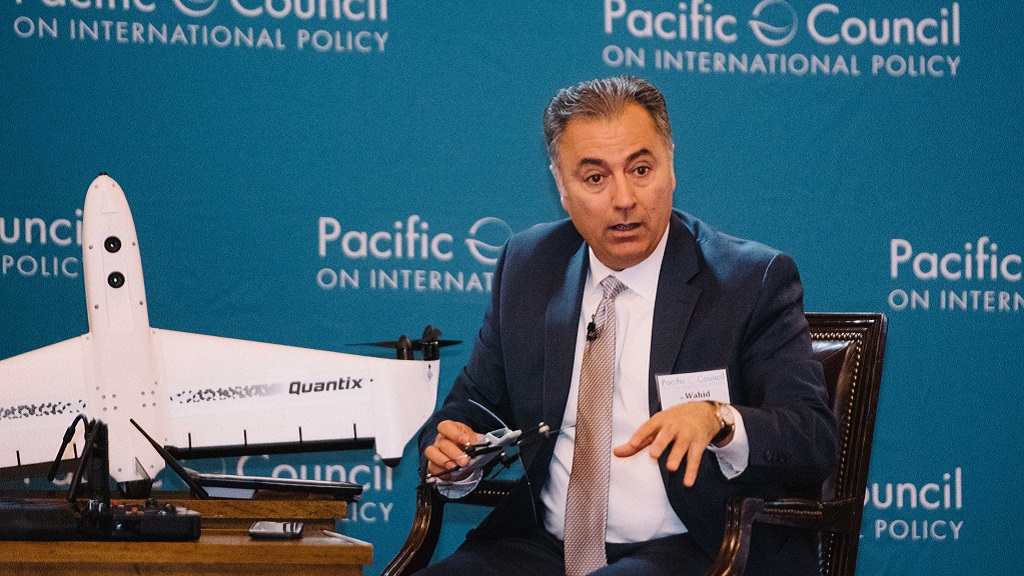
Moderated by Dr. Stephanie Young, political scientist at the RAND Corporation, this "The Future of Drones: Promise and Uncertainty" session featured Mr. Wahid Nawabi, president and CEO of AeroVironment.

"Drones have dramatically changed how our troops protect themselves and engage with the enemy on the battlefield," said Nawabi. "They provide actionable intelligence and save lives."

He explained that the military first researched and used drones in their work, which then allowed private entities to expand drones into the commercial space.

"Now we need the right set of regulations to allow this industry to grow and remain safe," he said. "The innovation of analytics from these drones is transformative, and we’re just at the beginning. There’s much more to come in terms of what we can do with this data. Of course, drones can be misused by people, just like any technology, but with proper training and regulations they can change our lives for the better. As a company, we feel strongly about our role in ensuring the security of our drones. We must and do take privacy and security very seriously."

He showed off a new drone that has benefits in the agriculture space, such as allowing farmers to completely and remotely map their farms so they can make informed decisions. He said the cost per hour of operating one of his company’s drones is much cheaper than using helicopters and boats to monitor and track oil spills. 

When asked about the prospect of drones delivering packages, he said that is still a long way off.

"We still have a lot of work to do to prove the track record of drones before that goes mainstream," he said.

Implications for Southern California from the NAFTA Negotiations

Moderated by Ms. Anne Hilsabeck, principal and founder of AMH Customs Consultants, this "A New NAFTA? Implications for Southern California" session featured Ms. Farhanaz Kermalli, senior analyst of international affairs and trade at the U.S. Government Accountability Office; Mr. Carlos Valderrama, president of the Center for Global Trade and Foreign Investment at the Los Angeles Area Chamber of Commerce; and Mr. James Villeneuve, Consul General of Canada in Los Angeles.

"There’s never been uncertainty in trade like there is today," said Hilsabeck. "If the United States pulls out of NAFTA, it would be such a disruptive event for our trade in North America."

Valderrama agreed and called for everyone to "convince our elected officials to more vocally support NAFTA before it’s too late."

"We need to make an argument that pulling out of NAFTA will do more than impact people’s wallets. This is about more than trade statistics."

Michael Camuñez

Villeneuve said Canadian officials at the consulate in Los Angeles are doing just that by advising all interested CEOs and business owners to lobby their elected officials to get a NAFTA deal done. Villeneuve believes that Canada has put together the strongest trade negotiation team they have ever had for these NAFTA negotiations, including business, labor, and environmental interests.

The Honorable Michael Camuñez, a Pacific Council Director and president and CEO of Monarch Global Strategies LLC, pointed out that should the NAFTA negotiations fail, the consequences will be negative and far-reaching, beyond just an economic impact.

"We need to make an argument that pulling out of NAFTA will do more than impact people’s wallets," he said. "This is about more than trade statistics."

The Shifting Global Entertainment Market

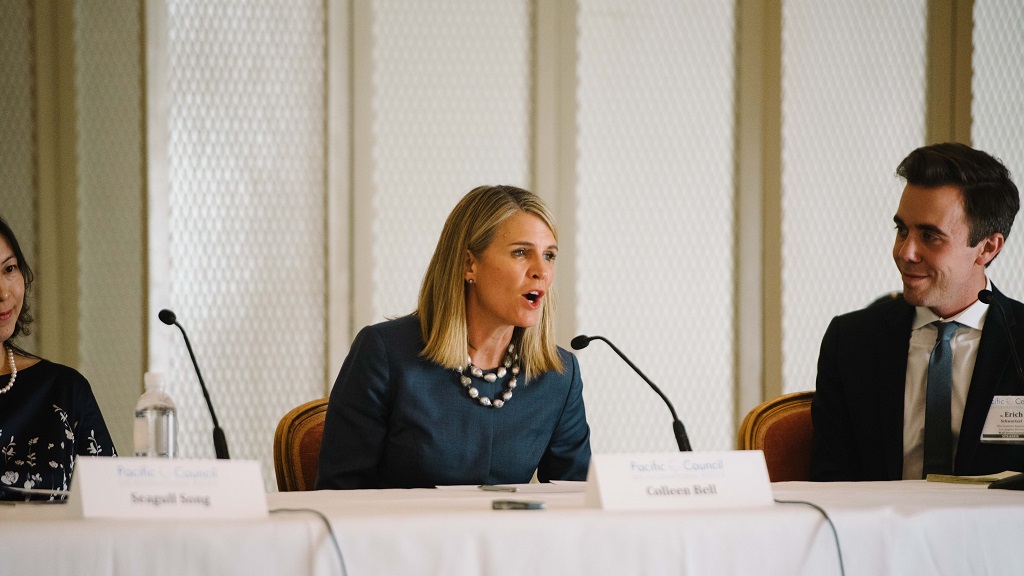
Moderated by Mr. Erich Schwartzel of The Wall Street Journal, this "Bollywood, Nollywood, and Beyond: The Shifting Global Entertainment Market" session featured the Honorable Colleen Bell, former U.S. Ambassador to Hungary and television producer; Dr. Seagull Song, professor at Loyola Marymount Law and advisor to Chinese film clients coming to the United States and U.S. studios going to China; and Ms. Xian Li, a producer and studio executive at 20th Century Fox where she manages development and production for Fox’s Asia division.

Bell spoke about her time in Hungary and countering disinformation coming into Eastern Europe from Russia, which "is anti-American in nature." She spoke to countering this disinformation by using the vast library of U.S. movies and television shows in a public diplomacy effort to show U.S. culture for what it is.

"We have this huge library of content that we can flood into a geographic location," she said. "These are shows that allow people the opportunity to see our culture. The soft power of entertainment can be used for social change—fictional storylines about refugees can make a difference."

Song spoke about internet piracy in China, and how the restriction on importing films drives that activity, because "there is only very limited content that is allowed to be imported into China." There are only three types of ways non-Chinese movies can go into China, she added: quota film or revenue-sharing quota film, flat-fee film, or co-production films, which are "treated as a Chinese production because the creator has to be Chinese or Chinese and American, it has to be financed by Chinese and American money, and photography has to be Chinese and American."

Li spoke about the other markets in Asia that studios are looking at expanding into or are already in. Japan is the third largest market for consuming media in the world, and South Kore is number five, according to Li.

"The Korean market, similar to the Japanese market, is half and half: 50 percent local films, 50 percent Hollywood," she said. "The other emerging markets that we are keeping a close eye on are Indonesia, Vietnam, and Thailand. They have been producing very good small budget productions, including streaming services, but their infrastructure is not quite there yet."

Immigration Lessons from Canada

Moderated by Ms. Colleen Thouez of the UN Institute for Training and Research, this "The Making of the Mosaic: Immigration Lessons from Canada" session featured Mr. Terry Brown, consul and migration program manager at the Canadian Consulate in Los Angeles; and Dr. Linda Lopez, chief of the Office of Immigrant Affairs in the office of the Mayor of Los Angeles.

Lopez spoke to the role Los Angeles and other major cities play in international migration.

"Cities are going to be increasingly the centers or the places where we’re going to have to address those different challenges, such as housing and employment," she said. "We’re seeing networks emerge that have to do with how we address these challenges when all of a sudden we have migration flows that perhaps cities don’t have the capacity to respond to."

"We don’t have any anti-immigration political parties in Canada. The difference is that in Canada the right focuses on economic immigration and the left focuses on humanitarian immigration."

Terry Brown

Brown spoke about Canada’s immigration system and how it compares to the U.S. model.

"We don’t have any anti-immigration political parties in Canada," he said. "The difference is that in Canada the right focuses on economic immigration and the left focuses on humanitarian immigration."

Brown said Canada implemented a program highlighting rules-based openness, which allows international university students to stay and work in Canada upon completion of their degree.

"We looked at our system about 15 years ago and said, ‘We have all these smart, young kids. Why are we making them go home?’" he said. "Now when you get a degree in Canada, you get a three-year, no conditions, open work permit at the end of it. That gives you Canadian experience and extra points in our merit-based system."

Still, Brown added, Canada needs to "make it easier for people to integrate into our country and realize their economic potential."

____________________

Justin Chapman is the Communications Officer at the Pacific Council on International Policy.

Learn more about the Global Los Angeles Summit. See photos from the summit here.

Read a summary of our keynote interviews with Dr. Liam Fox and Senator Christopher Coons. Check out photos from the summit on our Flickr page.

The views and opinions expressed here are those of the speakers and do not necessarily reflect the official policy or position of the Pacific Council.

Global LA Summit Insights: Sustainability, LA2028, and More

MAY 1, 2018
By: Justin Chapman, Robert Dunbar, Pacific Council

This year’s Global LA Summit featured panel discussions about issues related to Los Angeles' position as a global city, keynote interviews, and a Global Community Expo featuring LA-based organizations with engagement opportunities for members.

The sessions topics included the future of drones, the path to a renewable LA, the Sustainable Development Goals, NAFTA, Olympic lessons from Barcelona, water conflict, immigration lessons from Canada, the shifting global entertainment market, and more. 

What follows are just a few of the many notable insights from the conference. Read more insights here.

____________________

The Path to a Renewable LA

Moderated by Ms. Alice Hill, research fellow at the Hoover Institution, this "Clean & Green: The Path to a Renewable LA" session featured Mr. Ronald Nichols, president of Southern California Edison.

"We believe that we need to reduce California’s emissions by 40 percent below the 1990 level by 2030, and 80 percent by 2050," said Nichols. "This is ambitious, but we need to switch California’s energy to non-carbon-producing sources."

He praised both the Port of LA and the Port of Long Beach as the lifeblood of LA’s economy, but pointed out that they’ve also historically been an enormous source of emissions. However, that presents a huge opportunity for emission reduction, as well, he added.

"We at Southern California Edison strongly support the Paris Accord on Climate Change. The United States needs to lead by example."

Ronald Nichols

Nichols also touted the Paris Climate Accord.

"We at Southern California Edison strongly support the Paris Accord on Climate Change," he said. "The United States needs to lead by example."

The consequences of climate change can have real world impacts on utility systems, he added.

"The volatility of LA’s weather—from severe drought to extended fire season—means we have to be ready for a new normal," he said. "Utilities need to harden their systems."

He added that utility systems are vulnerable in other ways as well.

"In 2017, there were 7 million attempts to hack our systems," he said. "They didn’t get in, but we must remain vigilant and strengthen our cybersecurity by investing in the Internet of Things and distribute our systems. The grid we have today is not equipped to handle the coming disruption of electric vehicles. The system has to be modified to meet that demand."

Megacities and the Sustainable Development Goals

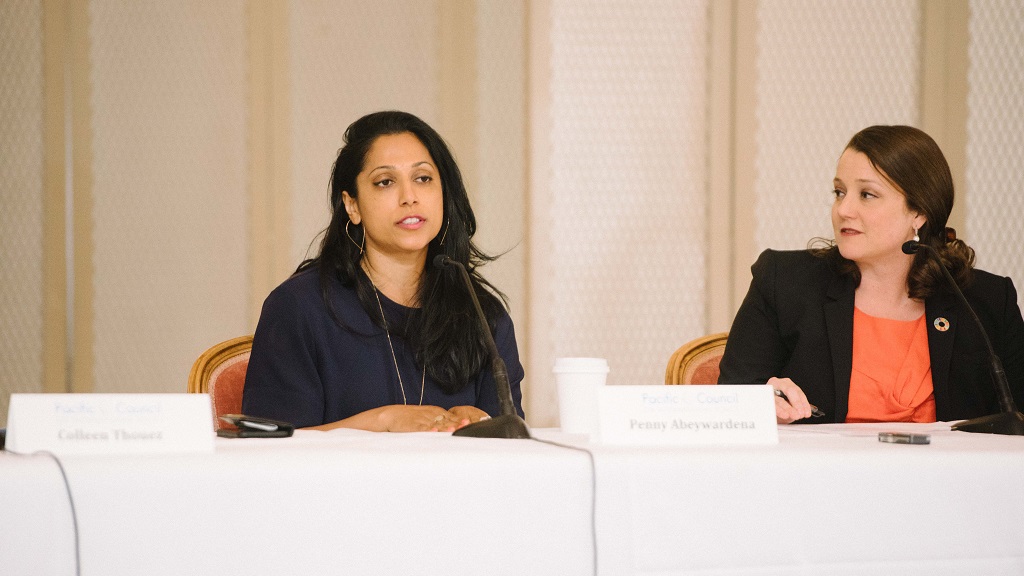
Moderated by Ms. Erin Bromaghim of the Conrad N. Hilton Foundation and LA Mayor’s Office of International Affairs, this "Making the Global Local: Megacities and the Sustainable Development Goals" session featured Mr. Tony Pipa, senior fellow for global economy and development at the Brookings Institution; Ms. Colleen Thouez, senior advisor at the UN Institute for Training and Research; and Ms. Penny Abeywardena, New York City’s Commissioner for International Affairs.

"The Sustainable Development Goals are essentially a list of goals that the global community, through the UN as a vehicle, has come together to figure out how we address inequity around the world," said Abeywardena. "They are an agenda for the entire world. We all have a role to play to achieve these global goals."

Pipa said the SDGs are important because they allow for new ways of measuring progress.

"We measure progress by economic growth—we use GDP," he said. "Yet we know that doesn’t capture a whole bunch of dimensions for well-being that cities are trying to achieve for their citizens. Human dimensions like poverty, health, hunger, education, decent jobs, gender equality and equity, protection of human rights, and ensuring climate and environmental sustainability. We ought to act in global solidarity, and that’s what the SDGs represent."

Bromaghim discussed how the city of Los Angeles is taking action to help achieve the SDGs.

"LA has been in awareness-raising mode for the SDGs," she said. "Now we’re moving into the implementation phase."

Thouez added that states need to get creative about how they fund and approach their SDG efforts.

Olympic Lessons from Barcelona

Moderated by Dr. John Gleaves of California State University at Fullerton’s Center for Sociocultural Sport and Olympic Research, this "Branding an Olympic City: Lessons from Barcelona" session featured Ms. Anita DeFrantz, vice president of the International Olympic Committee’s Executive Committee and president emeritus of the LA84 Foundation.

"Barcelona and Los Angeles are in very similar spots when Barcelona began to prepare for their 1992 Olympic Games and where we are at today when we are preparing for the LA 2028 Olympics," he said. "Essentially, the city of Barcelona looked at bidding for and hosting the Games as a way to drive through the major urban redevelopment aims the city had planned and developed in 1976."

"A legacy foundation like the LA84 Foundation is the best thing an Olympic Games can do. The Games can’t fix the city, but it can make a huge difference in how people feel about their city."

Anita DeFrantz

DeFrantz, who has been on the International Olympic Committee since 1986 and was the vice president of the organizing committee for the 1984 Olympics, spoke about how the 1984 Olympics helped Los Angeles, and what we should expect from the Games in 2028.

"A legacy foundation like the LA84 Foundation is the best thing an Olympic Games can do," she said. "If we’re going to have a strong Olympic Games, it is really going to be felt by underserved communities. Sixty percent of the $270 million surplus from the LA84 Games went to the U.S. Olympic Committee, and 40 percent went to the LA84 Foundation. The Games can’t fix the city, but it can make a huge difference in how people feel about their city and can show that we can live in peace together."

Both speakers made sure to point out that not commissioning new housing for the 2028 Olympics is a missed opportunity for the city of Los Angeles and the future of its urban development.

Conflict and Water

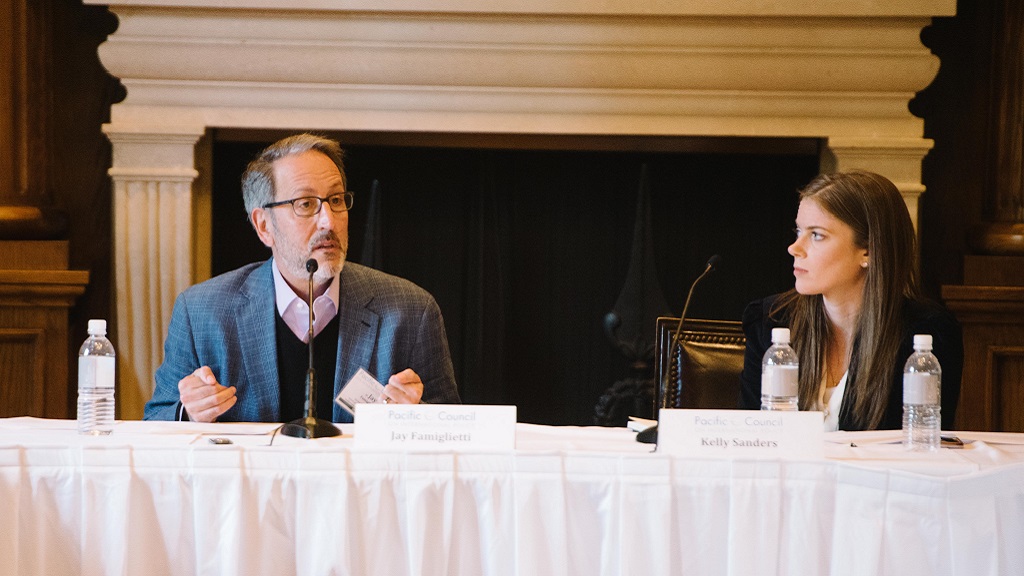
Moderated by Dr. Kelly Sanders of USC’s Sonny Astani Department of Civil and Environmental Engineering, this "Water Conflict: What Can Southern California Learn from Cape Town?" session featured Dr. Jay Famiglietti, senior water scientist at NASA’s Jet Propulsion Laboratory.

Sanders discussed how conflict relates to water rights and resource management.

"We look at conflict through the lens of political regimes, but a lot of times there are resource issues underlying those conflicts," she said. "The war in Syria, in some ways, was the outcome of decades of poor groundwater management. In the 20th century we fought wars over energy, and in the 21st century we are going to move because of water, because water underpins food production and energy production. We look at it through the lens of other things that aren’t necessarily resource tension."

She added that water is a human right, and called for conservation structures that don’t have a negative impact on the poor.

"Californians were committed to water conservation during the drought—until it rained again one time. How do we get people to realize that we’re in this for the long haul?"

Jay Famiglietti

Famiglietti talked about how heavily contaminated the groundwater is in the United States.

"It takes a long time and a lot of money to clean up," he said. "The cleanup of perchlorate under JPL has been ongoing for three decades. When you combine the water quality issues globally with groundwater contamination issues and changing water availability that we can now see with satellites, it’s a pretty grim picture. We can’t solve the global water crisis, we can only address it and try to manage our way through it."

Famiglietti spoke about the difficulty in getting people to adopt water conservation as a lifestyle.

"Californians were committed to water conservation during the drought—until it rained again one time," he said. "How do we get people to realize that we’re in this for the long haul?"

One suggestion was to make water bills simpler and much easier to understand.

____________________

Justin Chapman is the Communications Officer at the Pacific Council on International Policy.

Robert Dunbar was the Communications and Programs Fellow at the Pacific Council on International Policy.

Learn more about the Global Los Angeles Summit. See more photos from the summit here.

Read a summary of our keynote interviews with Dr. Liam Fox and Senator Christopher Coons. Check out photos from the summit on our Flickr page.

The views and opinions expressed here are those of the speakers and do not necessarily reflect the official policy or position of the Pacific Council.

Fox: UK Will Remain a Global Financial Leader After Brexit

APRIL 27, 2018
By: Justin Chapman, Pacific Council

Despite what critics have said about Brexit, the United Kingdom’s Secretary of State for International Trade Dr. Liam Fox argued that better trade deals await the UK after they leave the European Union next year in a discussion with Pacific Council members at the Global Los Angeles Summit. The discussion was moderated by Ambassador Nina Hachigian, deputy mayor for international affairs for the city of Los Angeles.

"As we leave the EU, we have the potential to negotiate better trade deals for the UK," said Fox. "Those opportunities are still out there. Whether we take full advantage of that remains to be seen. There’s a big world outside the European Union. We better be where the markets are going."

He cited the United States as one potential example, adding that the UK’s trade and investment relationship with Los Angeles—which he called a "great and very important relationship"—is a microcosm of their relationship with the United States.

Watch the full conversation below:

Fox also argued that the single market has been much less beneficial for the UK than any other EU country, and that claims that the UK would suffer financially after leaving the EU were overblown.

"I was a Leaver in the Brexit campaign because look at it this way: would the United States want to join a North American Union where the central government was controlled in Mexico City?" he said. "People were worried the UK would become more insular, but it’s actually become more global. Claims of economic Armageddon after Brexit haven’t played out. I’m more confident than ever that London will retain its preeminence as a global financial leader. That said, we will need new border and immigration systems by the time the UK leaves the EU next March."

One of the biggest challenges in the Brexit negotiations is the border between Ireland and Northern Ireland, the only land border between the UK and the EU. Observers worry that a return to a hard border with customs and passport checks could reignite violence in the region. Northern Ireland voted to remain in the EU. But Fox said that that challenge, too, has been overstated.

"Ireland doesn’t have open borders with the rest of the EU, so that makes the border issue with the UK easier," he said. "We think it’s in both of our best interests to have open and liberal movement across the Ireland-Northern Ireland border."

"People were worried the UK would become more insular, but it’s actually become more global. Claims of economic Armageddon after Brexit haven’t played out. I’m more confident than ever that London will retain its preeminence as a global financial leader."

Liam Fox

Fox is likewise not concerned about a renewed push for Scottish independence, even though Scotland also voted to remain in the EU.

"Many people said Brexit will result in Scotland leaving the UK, but I said exactly the opposite will be true," he said. "We’re a bigger trade partner for them than the EU."

Fox also argued that the idea of a unified Europe has failed, citing the rising trend of far right populism.

"The concept of an ever closer union in Europe—how many bits of evidence do you need to see that's not working?" he said.

When asked if there is any chance that Brexit will be canceled, Fox emphatically stated, "No. It was a binding democratic referendum."

____________________

Justin Chapman is the Communications Officer at the Pacific Council on International Policy.

Learn more about the Global Los Angeles Summit. Read a summary of Senator Christopher Coons' remarks, as well as more insights from the summit here and here. See more photos from the summit here.

The views and opinions expressed here are those of the speaker and do not necessarily reflect the official policy or position of the Pacific Council.
Senator Coons on Syria, LA, Bipartisanship, Mueller and More

APRIL 24, 2018
By: Justin Chapman, Pacific Council

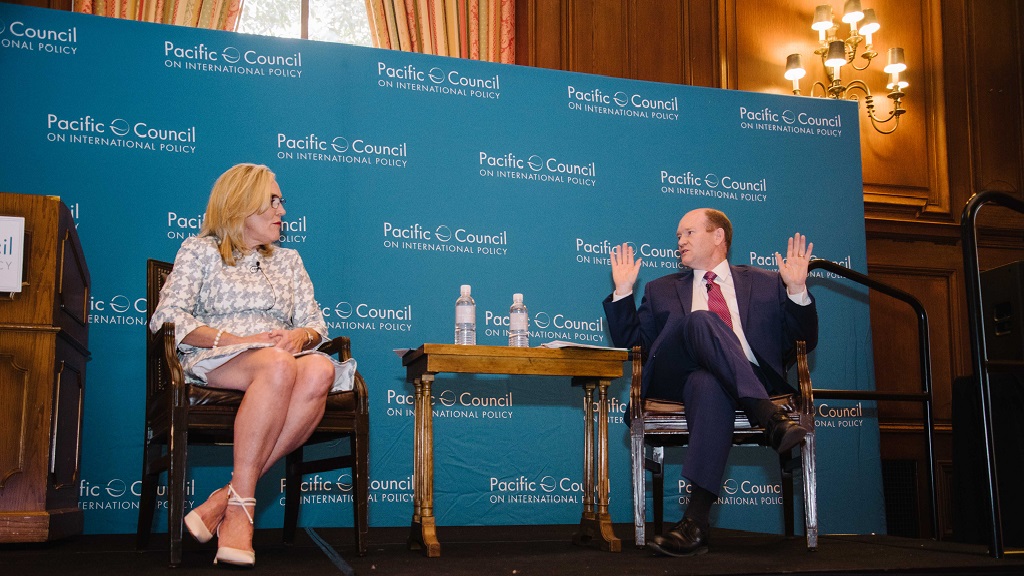
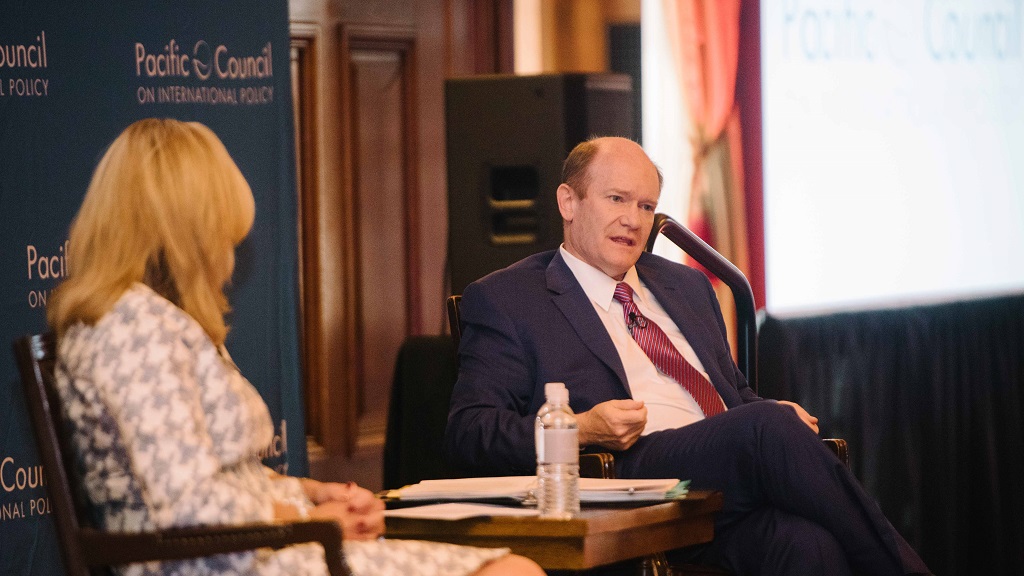
Senator Christopher Coons (D-DE) discussed Syria, bipartisanship, Robert Mueller, religion, and more with Pacific Council members at the Global Los Angeles Summit. The discussion was moderated by LA County Supervisor Kathryn Barger.

"In the next few years we as Americans need to work out our view of the United States’ role in the world," said Coons. "Are we an optimistic nation that has open arms and rather than walls builds bridges and welcomes in immigrants and trade, or are we a retrenching and isolationist nation whose view of our engagement with the world is that we’ve been had? That all these trade arrangements like NAFTA and TPP, all these multilateral organizations like NATO and the UN, are frankly just an excuse to overextend and weaken America? These are two sharply different views."

Coons said that he believes the very people that populism says it represents and will save are in fact better served by globalization.

"They are better served by embracing the opportunities of the 21st century and by not being misled into thinking that NAFTA is what destroyed manufacturing," he said, "but instead having a clear-eyed view that at the end of the day when the United States has embraced change and leaned into it, we are better situated to win than any society on earth."

"The city of Los Angeles is the exemplar and role model for our nation: outward-looking, optimistic, creative, and confident that it does better when we are connected to the world."

Christopher Coons

Coons also touted Los Angeles as the "main city driving America’s connection to the rest of the world," a city that will a play a defining role in determining what kind of country the United States will be in the 21st century.

"LA has everything from financial services to a creative community to a manufacturing community to hospitals to universities," he said. "The city of Los Angeles is the exemplar and role model for our nation: outward-looking, optimistic, creative, and confident that it does better when we are connected to the world."

On foreign aid and the Sustainable Development Goals

Coons said the Sustainable Development Goals are important because they represent a global consensus on what the international community wants to achieve and why. He also discussed why U.S. foreign aid is so important, and how much of a difference that aid makes around the world.

"There’s a large number of Americans who believe that we spend a huge amount of our budget—like 40 or 50 percent—on foreign aid. It’s actually less than 1 percent," he said. "There are a lot of Americans who think that our aid doesn’t have an impact. The difference we make in Africa through foreign aid, PEPFAR, and other programs is huge. That used to be a bipartisan effort."

Coons pointed out that President George W. Bush’s PEPFAR program has saved millions of lives in Africa and changed the trajectory of a global pandemic, and that the program is measured, accountable, and delivering. He pointed out that the Millennium Challenge Corporation (MCC) is a development initiative that also has measurable outcomes and requires governments to improve on transparency, corruption, and free press in order to be a U.S. partner.

"How do you sustain bipartisanship? You have to be willing to take some risks yourself first, and compromise, compromise, compromise."

Christopher Coons

"As soon as Obama became president, he supported and sustained PEPFAR and MCC," he said. "What will be the Trump administration’s most remembered and most important initiative with regard to Africa? The Build Act, a bipartisan bill which is designed to meet one of the SDGs, the delivery of private finance and the pursuit of development. We’re modernizing OPEC by doubling its authorization at 20 years, allowing it to take equity position for the first time, issue loans in local currency for the first time, and have non-U.S. national investors for the first time. Through this new development finance tool, there can be an aggravated investment by the diaspora community of a certain country in the United States. We need to match China’s biggest tool in the developing world: development finance and concessional loans."

On bipartisanship and Robert Mueller

Coons lamented how difficult it has become in today’s political climate to pass bipartisan bills. Ultimately, he argued, it can be done, but only by being respectful and not questioning the motives of the other side. He cited a recent bill—designed to protect Special Counsel Robert S. Mueller III and his investigation—that Coons co-sponsored with Senator Thom Tillis (R-NC).

"Senator Tillis and I disagree on 90 percent of the issues," said Coons, "but by being respectful, by never questioning his motives even when disagreeing with him on policy, I created an opening, such that last fall when our president was unexpectedly harassing the attorney general on Twitter and undermining Robert Mueller, Tillis is the one who came to me and said, ‘I think we need to do something to protect the special counsel and his investigation.’ I said, ‘Well, great. Do you want us to get our lawyers together over the next couple of weeks and explore some options?’ He said, ‘No, damnit, now.’ We introduced a bill the next day. That kind of window only opens when you extend your hand and keep your heart open to the reality that the person on the other side of the aisle is a complex, flawed, graceful person who is capable of leadership every bit as much as you are."

Coons added that the way Americans can find a way forward is through humility, persistence, bipartisanship, and a willingness to compromise.

"That means a willingness to disappoint and even upset my own home state base," he said. "Because if I really want Thom Tillis to do something that no other member of his caucus except Senator Lindsey Graham has done, which is stick his neck out and get yelled at by the president, then I’ve got to be willing to do it, too. For example, if in my gut I think we should be in the Trans-Pacific Partnership, even though it’s unpopular in my caucus and it gets me in lots of trouble at home, I should stand up and say, ‘At the end of the day, free trade is the right thing to do.’ I shouldn’t just say it in LA, I should say it at home. How do you sustain bipartisanship? You have to be willing to take some risks yourself first, and compromise, compromise, compromise. Our citizenry needs to hear what compromise requires, more than we’ve told them."

In practice, he said this means he has had to make compromises of his own in an effort to garner Republican support for the special counsel.

"I recognize that in asking a Republican senator to take direct action against their party’s president, I’m asking a lot," said Coons. "But it is exactly what I’m asking, urgently, privately, every day. I’m saying, ‘Do you think firing Bob Mueller or Rod Rosenstein is a bad idea?’ ‘Yes, absolutely,’ they say. There isn’t a single Republican senator who believes that Mueller, a Republican’s Republican, a United States Marine Corps-decorated combat veteran, former FBI director appointed by a Republican president, is somehow not a principled law enforcement leader."

"What will you do to save our democracy? Does it matter to you? Is it more than just another tweet? Is it more than just a distraction? What are you willing to do? I’m hoping we’re all going to pay attention to that question in the coming weeks."

Christopher Coons

Coons added that it’s possible Mueller may not find evidence of collusion between the Trump campaign and Russia in the 2016 election, a result that he would accept as long as Mueller’s investigation is allowed to continue to its natural conclusion. He pointed out that right now Americans have diametrically opposed views about an ongoing federal investigation, which he added is risky for the entire nation and its future.

"So I urgently beg my Republican colleagues to join our bill to protect Mueller and his investigation," he said. "What will you do to save our democracy? Does it matter to you? Is it more than just another tweet? Is it more than just a distraction? What are you willing to do? I’m hoping we’re all going to pay attention to that question in the coming weeks."

On Syria

Coons said that the crisis in Syria is a tragedy for which the United States bears some responsibility, even culpability.

"When Assad first used chemical weapons, I voted for an authorization for the use of military force," he said. "Why President Obama did not use that tool at that time is a long discussion. But I think great powers don’t bluff. When you draw a line in the sand and don’t act, you encourage our enemies and you confuse our allies. The only shouting match I ever had with President Obama, with whom I’m otherwise very close and worked well with on a lot of things, was over that one decision. Now, he has access to more intelligence and details than I do, so I should know better than to second guess. But over the ensuing years, we failed to engage and stand up and as a result the Russians took advantage of the vacuum, the Iranians have flooded in, and the situation right now is an unholy mess."

"The American people are sick of war in southeast Asia and the Middle East. I’m very clear on that. But Iran and Russia are not our allies or friends, and we have emboldened them in unforgivable ways by leaving open this tragic space [in Syria]."

Christopher Coons

Coons said he was deeply confused three weeks ago when President Trump said he wanted to pull U.S. troops out of Syria.

"I thought, as did many in the Senate, having put U.S. troops into Syria, having allied ourselves with the Kurds, having watched them fight bravely as they took over much of what was ISIL ground, why would we now leave? Because the only resolution in Syria is going to be at a negotiating table, and the only way we have any leverage at that table is to be on the ground, engaged, and a partner," he said. "The American people are sick of war in southeast Asia and the Middle East. I’m very clear on that. I think every day about the cost of these incredible, long wars. But Iran and Russia are not our allies or friends, and we have emboldened them in unforgivable ways by leaving open this tragic space. It is a mark on who we are as a people. When we reengage, even though messy, costly, and dangerous, we will earn our place in leadership in the world again. If we don’t, then shame on us."

As Coons was discussing the potential of a U.S. strike on Syria, President Trump announced in an address broadcast live to the nation that he had ordered missile strikes against specific targets in Syria. The move came in response to accusations that the Syrian government conducted another chemical weapons attack on civilians.

On tolerance

After being asked about Americans’ misunderstanding of Islam, Coons called for all Americans to be more aware of other people’s beliefs, customs, and cultures.

"We need to fight bigotry and ignorance where we can and speak respectfully about a religion that is about peace, not war, and understand what Islam is and isn’t," he said.

He added that he was concerned with comments about Islam made by CIA Director Mike Pompeo—who is currently undergoing confirmation hearings in the Senate to be the next U.S. Secretary of State—during his campaign and as a congressman after 9/11 and the Boston bombing. Coons later announced his opposition to Pompeo as Secretary of State.

"While he has apologized for what were some unmeasured and overreaching comments, the damage of that is lasting, in the sense of difference and disconnect that it creates around the world," said Coons. "We need to be bold, loving, and forgiving. Approaches such as President Trump’s travel ban will not make America safer."

Coons pointed out that all three of the "great Abrahamic faiths have strands that are moving in directions that are driving us farther apart, that marginalize us from each other, and that build walls. The only way to undo this is to embrace what really is the core message of these three faiths, which is that justice is only achieved when the stranger and the foreigner is welcomed and loved, that we are only living by our faith when we love others as ourselves, and that our definition of family has to be expanded to include not just neighbors but those who scare us and those who are different from us until we see them truly as our own family."

____________________

Justin Chapman is the Communications Officer at the Pacific Council on International Policy.

Learn more about the Global Los Angeles Summit. Read a summary of Dr. Liam Fox's remarks, as well as more insights from the summit here and here. See more photos from the summit here.

The views and opinions expressed here are those of the speaker and do not necessarily reflect the official policy or position of the Pacific Council.