Flowing forward

Rally looks to demonstrate grassroots support for alternative of LA River restoration

By Justin Chapman, Pasadena Weekly, 9/26/2013

The Los Angeles River will soon be getting a makeover, according to a study released by the U.S. Army Corps of Engineers last week. The group is looking at five alternatives to restore 11 miles of the river from Griffith Park to downtown LA while maintaining existing levels of flood risk management, including a “no action” option.   

In response to the Draft Integrated Feasibility Report for the LA River Ecosystem Restoration Feasibility Study, Tim Brick of the Arroyo Seco Foundation announced a “River Rally” to demonstrate and mobilize support for Alternative 20, which he says will result in the most expansive ecosystem restoration. The rally will be held at noon Saturday at the LA State Historic Park.

Along with the Verdugo Wash Confluence, Taylor Yard, Cornfields LA State Historic Park and Piggyback Yard, Alternative 20 would also include more restoration measures than any of the other alternatives to the Arroyo Seco Confluence, where the LA River meets the Arroyo Seco.
“It is crucial at this time to gather together the supporters of Los Angeles River restoration to demonstrate grassroots support for the best alternative that can be achieved,” said Brick, who organized the rally.

Along with the Arroyo Seco Foundation, the rally will include a litany of community groups and political leaders such as LAUSD board member Bennett Keyser, LA city councilman Gilbert Cedillo, LA River Revitalization Corporation, Northeast Los Angeles Riverfront Collaborative, North East Trees, Anahuak Youth Soccer, Environment Now, Save LA River Open Space and Urban Rivers Institute.

“The Army Corps LA River Study is a tremendous step in the right direction and the Corps deserves to be lauded for its detailed analysis,” said Meredith McKenzie of the Urban River Institute. “Nonetheless, the study does not go far enough. True long-term restoration of the LA River cannot be achieved without the inclusion of both the Arroyo Seco and Verdugo Wash confluences as well as the Cornfields Historic State Park. The only plan that addresses complete restoration along the LA River corridor is Alternative 20.”

According to the study, restoration measures considered include “creation and reestablishment of historic riparian strand and freshwater marsh habitat to support increased populations of wildlife and enhance habitat connectivity; to provide opportunities for connectivity to ecological zones, such as the Santa Monica Mountains, Verdugo Hills, Elysian Hills and San Gabriel Mountains; the reintroduction of ecological and physical processes, such as a more natural hydrologic and hydraulic regime that reconnects the river to historic floodplains and tributaries; reduced flow velocities; increased infiltration; improved natural sediment processes; and improved water quality. The study also evaluates opportunities for passive recreation that is compatible with the restored environment.”

A formal public comment period for the study began Friday and will be open until Nov. 5. Submit your comments to comments.lariverstudy@usace.army.mil.

Homes on the horizon

Liu’s bill ‘gets Caltrans out of the landlord business’ after a half-century

By Justin Chapman, Pasadena Weekly, 9/19/2013

Tenants renting homes once earmarked for destruction by Caltrans are one step closer to owning those properties following the unanimous passage of a bill now awaiting Gov. Jerry Brown’s signature.
Introduced by state Sen. Carol Liu (D-La Canada Flintridge) and co-authored by Democratic Assembly members Chris Holden of Pasadena and Mike Gatto of Burbank, Senate Bill 416 expedites the sale of more than 500 state-owned houses which were acquired by Caltrans through eminent domain and hardship sales more than 50 years ago. The state seized the properties in order to construct a road through the Los Angeles neighborhood of El Sereno, South Pasadena and western Pasadena to connect the 710 (Long Beach) and 210 (Foothill) freeways. The so-called “footprint” of the road, which includes the homes, is known as the 710 Corridor.
The bill, which passed the Assembly by a vote of 77-0 and the Senate by 38-0 margin, gives current tenants in good standing the first right of refusal to purchase their homes at fair market value. Brown has until Oct. 10 to sign or veto the bill.
 
The houses are no longer needed for a surface route connector freeway, making them surplus properties. Caltrans is currently studying other ways to connect the two freeways, including plans for a 4.5-mile tunnel from where the 710 ends in Alhambra through Pasadena.
Caltrans is the landlord to tenants residing in about 400 of those houses, the rest of which have been vacant for years and have fallen into disrepair. According to Robert Oakes, Liu’s legislative director, Caltrans wants to relinquish its role as landlord.
“The agency has told us that they want to get out of the real estate business,” said Oakes. “They’ve been quite clear. This bill helps them do that.”
One of the ways it helps them in that regard is by removing the requirement that Caltrans make any needed repairs before selling the homes. If the bill is signed into law, Caltrans would be able to sell the houses at “fair market value,” redefined to reflect the “as is” condition of the properties. Current law, known as the Roberti Bill, named for former Democratic state Sen. David Roberti, makes Caltrans responsible for repairs.
“If you own a house and it needs repairs, as a private seller you can opt to sell as is,” said Oakes. “Right now, Caltrans can’t do that. They face a hurdle that a private seller doesn’t. There’s an artificial barrier. Some houses need a lot of work. (SB416) levels the playing field.”
In August 2012, the California State Auditor found that between July 2007 and December 2011 Caltrans, which did not verify the eligibility of tenants to be charged below-market rate rents, collected $12.8 million in rent but lost $22 million due to underpayment by ineligible tenants. During most of that period, Caltrans reportedly paid out another $22.5 million for questionable repairs.
The audit also found that Caltrans:
* Spent an average of $6.4 million per year on property repairs but could not demonstrate that repairs for 18 of the 30 projects reviewed by auditors were reasonable or even necessary. 
* Authorized repairs that far exceeded the potential rental income of the property. For 20 of the 30 properties reviewed, Caltrans authorized repairs for which it will take more than three years worth of rental income to recover the costs, according to the report.
* Transferred an average of $4.7 million annually since fiscal year 2005-06 to the state Department of General Services for property maintenance, despite the fact that the two departments had been operating without an interagency agreement. In some instances, Caltrans was unable to provide records to substantiate its approval of General Services’ work either before or after the work was performed.
* Possibly inappropriately charged 330 hours of labor to projects related to the properties.
* Estimated that the market value of all the parcels was $279 million, when the actual sale price for many or potentially all of the residential parcels could be roughly 80 percent less than the estimated market value, in part because of restrictions contained in the Roberti Bill.
Six months after the audit’s release, Caltrans began increasing rents by 10 percent every six months, until people are paying market-value rents on the homes. The first increase went into effect on March 1. However, questions remain regarding whether all the tenants in the 710 Corridor would benefit from the bill and when Caltrans would start offering the homes for sale.
Joe Cano, a resident of El Sereno and an organizer with the group No on 710, isn’t sure that relieving Caltrans of the requirement to make costly repairs is such a good idea. Under the Roberti Bill and SB416, all single-family residences must first be offered to present occupants who fall into either low- or moderate-income categories at an affordable price.
“This is a quandary,” Cano said. “Do these people really have the money to fix the houses? Would these houses qualify for a mortgage or are they in such ill repair that the banks won’t even touch them? It still puts the tenants between a rock and a hard place. Either way, they’re being mistreated. It’s a real complex situation.”
Roberto Flores, a Caltrans tenant and a member of the United Caltrans Tenants group, is also unclear on whether there are disparities between the Roberti Bill and SB416.
 
“The biggest question we have is whether we’re going to have to, as individual tenants, give up our rights under the Roberti Bill,” he said. “It’s going to be kind of strange for them to offer these houses without waiving these rights. If we’re not covered by the Roberti Bill, are we covered by Liu’s bill? Many people have stayed in these houses for nearly 40 years for the dream of one day owning these houses under the Roberti Bill.”
 
Oakes said that all existing law would stay in place, including the requirement that Caltrans offer replacement dwellings to those who are unable to afford the price offered for the residential property.
“The point is Sen. Liu does not want Caltrans to continue being a landlord for six decades,” said Oakes. “It has now been five. The properties need to be sold. The housing market is finally getting better, prices are increasing; it’s a good time to sell.”
 
However, there is no timeline in SB416. It does not require Caltrans to begin selling the properties by a certain date, though the law would go into effect Jan. 1 should the governor sign it. Kelly Markham, a spokesperson for Caltrans, did not have a comment on Liu’s bill or what it would mean to the agency if approved. “We’re not going to speculate at this time,” said Markham. “Call us back when the governor signs the bill.”
Oakes said that while there is not a specific timeline, “The direction of the bill is to start selling. It clarifies and accelerates the process.”
In an email to constituents outlining his legislative victories during his first term, Holden wrote that SB416 “ensures the timely sale of surplus homes currently owned by Caltrans in the now-obsolete 710 Corridor. This bill is a critical first step to restoring peace and security to neighborhoods long threatened by Caltrans’ poor property management and an ill-advised surface extension of the 710.”
Flores said the United Caltrans Tenants group is currently reviewing the bill to see how it affects tenants and will be asking Liu’s office to break down the bill’s language at an upcoming workshop. 
Cano said members of his group are looking at their legal options, but in the meantime, “everything’s pretty much in stasis.” 
“The governor looks on it positively, so Sen. Liu hopes he will sign it,” said Oakes. “We’ve had good conversations with Caltrans’ director and the agency’s secretary.”
“This bill gets Caltrans out of the real estate management business, generates revenues for local transportation projects and returns these properties to our local tax rolls,” said Liu in a press release announcing the Senate’s passage of the bill on Sept. 10. 

Road to tomorrow

Officials and preservationists team up to make historic bridge safe for generations to come

By Justin Chapman, Pasadena Weekly, 6/20/2013

Before the historic Colorado Street Bridge was built over the Arroyo Seco shortly after the turn of the last century, crossing the deep canyon that the seasonal river bisected was an extremely difficult task.  
 
“Horses and wagons had to descend the steep eastern slope, cross the stream over a smaller bridge, and then climb up the west bank through Eagle Rock Pass,” writes Frank Wilkins with the Dallas-Forth Worth Film Critics Association, who pens stories about the Hollywood movie industry and other Los Angeles County points of interest.
First designed by John Alexander Low Waddell of the firm Waddell & Harrington and built by the Mercereau Bridge and Construction Co. in 1913, the 149-foot high, 1,468-foot-long structure faced an epic battle for survival following 1989’s magnitude 6.9 Loma Prieta Earthquake in Northern California. 
 
The bridge was closed for more than three years following the quake, after engineers warned Pasadena officials the structure could collapse if Southern California experienced an earthquake of the same magnitude. 
 
A $27.4-million reconstruction project was soon launched and the Colorado Street Bridge (given its moniker before the street was renamed Colorado Boulevard) reopened to great fanfare in 1993.
 
“Back then, it got a lot of attention and time,” said Cynthia Kurtz, formerly Pasadena’s city manager, and before that public works director. “We had to go through a lot as a city to justify why the bridge should be repaired instead of replaced, because it was expensive. It doesn’t sound like a lot of money today, but it was back then.”
 
Most of the money came from Federal Highway Bridge Repair and Replacement Act funds, with Los Angeles County and the city of Pasadena forking over the remaining $6 million. Since then, the bridge has come to serve as a beacon of civic pride and a reminder that government and community can work together to accomplish a shared vision.
 
However, the bridge would look quite different today from its original design if the local preservationist watchdog group Pasadena Heritage hadn’t stepped in during the design review process. They successfully nominated and had the bridge listed on the National Register of Historic Places.
 
“It was important to do that because back in the ’80s when they first started planning to upgrade the bridge and increase its seismic strength, the early plans called for changing it much more significantly, simplifying it and removing some of its architectural features,” said Sue Mossman, Pasadena Heritage executive director. “Because it was on the Register [of Historic Places] and people love it and it became a symbol of the city, we were able to work with the planners to make sure all of those historic elements were saved and, in some cases, restored. It was Pasadena Heritage that over and over again lobbied to save it and keep it functional and usable as a transportation link. That’s what we do. That’s why we’re here.”
 
The bridge has also been designated a National Historic Civil Engineering Landmark.
 
City Engineer Dan Rix said the structure is currently seismically sound and in great condition, thanks to the 1993 repairs. Unlike many bridges in the United States that are in dire need of infrastructural upkeep, Pasadena’s iconic landmark is good to go for the foreseeable future.
 
Kurtz pointed out that in order to get to this point the repairs involved first weakening the bridge by taking away all the old concrete, steel and its other structural supports. “There were lots of nervous days,” laughed Kurtz. “Like when the engineers came and said to me, ‘If we have an earthquake today, I don’t think it will hold.’”
 
Rix pointed out that it is expected the bridge can withstand a lot, even another earthquake. “Right now,” Rix said, the Public Works Department doesn’t spend a lot of money on the bridge, “because it’s in such good condition at this time.”


‘Heart of the city’

The beloved 100-year-old Colorado Street Bridge has come to define the essence of Pasadena

By Justin Chapman, Pasadena Weekly, 6/20/2013

What makes the Colorado Street Bridge so special?  
Why does it still attract national, even worldwide attention?
 
As everyone from these parts knows, the bridge has become infamous for the more than 150 people jumping from it to their deaths since the 149-foot tall and more than 1,400-foot long concrete curvilinear structure — the first bridge of its kind in the nation — was built in 1913.
 
But perhaps what is even better known is what people who use it see every day — a beautifully crafted work of functional architectural art, one that has inspired the works of painters, poets, writers and photographers for a full century.
 
Despite the history of tragedy associated with the bridge, there is also much to celebrate about the beloved landmark.
In anticipation of the Colorado Street Bridge Centennial and the city of Pasadena’s 127th anniversary celebration on Saturday, titled “Happy Birthday Pasadena: Celebrating Bridges,” the Pasadena Museum of History has teamed up with photographer Tavo Olmos, who documented the $27.4 million restoration project in 1993. Those repairs involved stripping the bridge of its old deck and deteriorated concrete and exposing its old ribs before restoring it to its former glory. 
 
The photographs will be featured at the museum on Saturday as “a catalyst to explore organizations that ‘bridge’ aspects of Pasadena’s vibrant community and culture,” according to a press release from the Pasadena Central Library.
A collectable book of Olmos’ photographs, featuring contributions by the principals who guided the restoration project to fruition, will be published by Balcony Press and available this summer, the release continued. In addition, a major exhibition on the Colorado Street Bridge — including these images and many more photographs, artwork and bridge-related objects — will open in November at the Pasadena Museum of History.
 
While expressing concerns about the darker side of the bridge’s reputation, City Councilman Steve Madison, whose district includes the bridge, pointed out that the bridge has operated over all this time as a road from which riches flow to Pasadena’s shopping and entertainment district, and beyond.
“It’s enhanced our community a great deal,” said Madison. “Its beauty has been the subject of a lot of paintings, and it’s a working bridge, not just a piece of art.”
 
Perhaps that is what is so attractive and special about the Colorado Street Bridge: Its simplistic functionality coupled with its singular example of grandiose beauty. 
 
With its graceful Beaux Arts arches, it is at once a marvel of great engineering and a landscape painter’s pinnacle of desire. For those not so artistically inclined, it is also a lot of fun to drive, bicycle or walk over.
 
“It’s a local transportation link, but also a regional link,” said Sue Mossman, executive director of Pasadena Heritage, an organization that has played a pivotal role in the bridge’s preservation and upkeep. “It’s all part of the atmosphere and announces that you’re entering the historic part of the city,” she said of the Old Pasadena business district, located a few blocks from the bridge’s eastern entrance. “It shows that we care about that and you’re in a unique place.”
 
Terry LeMonchek, executive director of the Pasadena Arts Council, said she sees the bridge as both timeless and a symbol of hope.
 
“The thing that’s really wonderful about the bridge is that it’s an elegant statement about Pasadena’s past, both architecturally and historically,” LeMonchek said. By the same token, however, “You can stand on the bridge and see [Jet Propulsion Laboratory], which is like looking into the future,” she said. “That, to me, is Pasadena in its essence.”
“We’re very fortunate in Pasadena,” said former Pasadena City Manager Cynthia Kurtz. “We have some great historical structures and buildings. The bridge is really kind of the heart of the city. It’s known all over the world, and it just makes you so proud to know something in Pasadena is that important worldwide. It creates our culture, even our soul, as a city.” 


Environmental Ennui

More people than ever rank the environment low among their concerns

By Justin Chapman, Pasadena Weekly, 4/18/2013

A Gallup Poll released last week indicates public concern in the United States over global warming has risen slightly after several years of skepticism, but also found that Americans are less than alarmed about what it will mean to them.
A solid 64 percent of those surveyed believe global warming will not pose a serious threat to them in their lifetimes. In its final analysis, Gallup researchers concluded that while most people think global warming is real, a higher number do not think it will affect them, and “these could be the attitudes that matter most when it comes to Americans’ support for public policies designed to address the issue.”
Meanwhile, findings from an annual poll conducted by GlobeScan and released in February show that global concern about the environment is also waning. A total of 22,812 people in 22 countries were asked how seriously they take air pollution, water pollution, species loss, automobile emissions, fresh water shortages and climate change. Fewer people said “very serious” than in any year since tracking began 20 years ago.
“Scientists report that evidence of environmental damage is stronger than ever, but our data shows that economic crisis and a lack of political leadership mean that the public is starting to tune out,” GlobeScan chairman Doug Miller said of the poll’s results. “Those who care about mobilizing public opinion on the environment need to find new messages in order to reinvigorate a stalled debate.”

Opinion vs. Fact
Scientists at Caltech pointed out that whatever may be the trends of public opinion on global warming and other environmental concerns, those issues remain very real.
“One thing that hasn’t changed is the facts,” said Jess Adkins, a Caltech professor of geochemistry and global environmental sciences. “We’re still putting [carbon dioxide] into the atmosphere at a rate that’s higher than we’ve ever seen, certainly for the last 65 million years, and maybe longer. Regardless of people’s attitudes, the facts have not changed.”
Paul Wennberg, an R. Stanton Avery Professor of Atmospheric Chemistry and Environmental Science and Engineering at Caltech, warned against putting too much stock into public opinion polls.
“At one point in time, public opinion goes one way or the other,” he said. “I wouldn’t read much into it. You can get all bent out of shape that way. If we have another hot summer — and we will — people will come back and express concern. The bigger question is from a perspective of global action necessary to address carbon emissions. That’s a political problem.”
If people were asked today if they want to live in a clean environment, there would essentially be universal support for that, said Wennberg, who believes that, in the end, people will make the right choices going forward.
“When scientists are able to clearly illuminate the underlying chemistry and physics that drive problems, such as air quality in Los Angeles, and can provide policymakers with adequate understanding of those underlying processes and show that there are solutions that exist, people do, in the end, make good choices,” he said. “Politicians have made good choices in the last 40 years. Climate change is going to become more and more apparent over time. I suspect it will receive more and more attention, including from those who can and will do something about it.”
Environment vs. Economy
One telling sign that environmental issues are no longer uppermost in the minds of most Americans came during the last presidential election. Neither President Obama nor Republican nominee and former Massachusetts Gov. Mitt Romney talked about the environment in any substantive manner in any of their three debates. That omission was the first time the subject went unmentioned since 1988, the year NASA climate scientist James Hansen raised the issue’s profile by testifying before Congress.
“The past presidential election was very interesting in its approach to global warming and climate change, because no one said anything about it, which was a change from previous elections and public discussions,” said Adkins. “I don’t think that means anything is in decline, but I do think both candidates made a political choice that they couldn’t make a lot of hay off this subject. What I think is interesting about the political reaction to climate change is it’s in a crippled state right now.”
If climate change went unmentioned, the state of the economy came up a number of times, remaining an issue people still worry about a great deal, even nearly five years after the initial financial collapse of 2008. However, as Adkins pointed out, it’s a spurious argument to say that people are worried about the economy and, therefore, less concerned about the environment.
He believes the president is concerned about the environment, and, he said, “I think Obama actually is right about this. It could be a green jobs revolution. We can develop a whole new sector to the economy, but, in terms of alternative energies, we’re behind the curve right now. We really have an important decision to make in terms of whether we’re going to cede that to other countries or jump in with both feet.”
“The challenge is climate change is a long-term and global problem,” said Wennberg. “It is an important problem, but it’s difficult to engage the public in the sense of the long-term commitments that are required to make progress. We’re all busy people. We all have a hundred other things we’re interested in.”
Alternatives vs. Status Quo
Ultimately, the approach taken toward addressing increasingly important environmental issues needs to change on many fronts, as GlobeScan’s Sam Mountford pointed out. In an analysis of that organization’s annual Radar poll, he wrote, “The challenge for the environmental movement is to articulate an alternative to our current economic model that empowers people rather than constrains them and is politically achievable in difficult times. It’s time, in other words, for a real alternative.”
The two sides of the debate tend to present phenomena like climate change and global warming in extreme terms: The left adopting doomsday scenarios and discouraging hope, and the right undermining established science by insisting neither is real, moving the debate absolutely nowhere.
“The left is telling itself some lies, just like the right,” said Adkins. “What has really mattered in moments like that is leadership. I support Obama, but I think he has failed on this front. If climate change is important to him, he should lead. One of the things that would create jobs is if we reconfigured how we distribute power around the country by investing in a smart grid or redoing the country’s interstate highway system. The costs for this are about the same amount as the increased defense budget of the Iraq War. It’s not a number that’s beyond the capacity of the country. That’s what I mean when I say leadership matters. I think the American public is capable of making smart decisions.”
Whatever the case may be when it comes to the public’s understanding of environmental issues and how people will be affected, the consequences of climate change — as well as air quality, water pollution, global warming and greenhouse gas emissions, among many other concerns — need to be dealt with. 
Public opinion may be changing, but the facts have not. Where opinion matters most is holding the feet of our political leaders to the fire in order to ensure that effective policy is enacted and enforced to help turn the tide against the monstrous environmental conditions that man has created. 


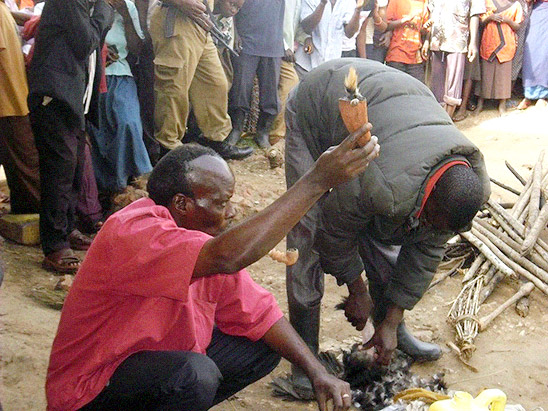
The healer reveals a witchcraft item “found” in the accused man’s house to the crowd. It probably came from the pockets of his assistant’s padded jacket.

About this week’s eSkeptic

In the small Ugandan village near the capital city of Kampala, a man named Ronald Kapungu had been accused of practicing witchcraft or hiring witch doctors to curse a nearby family. In this week’s eSkeptic, freelance reporter and travel writer, Justin Chapman, describes his experience at the witchcraft ceremony that he witnessed while covering the story with local journalist Luke Kagiri.

Justin Chapman is an author, poet, actor, and journalist. At age 19 he was elected to the Altadena Town Council and chaired its Education Committee. He has written for numerous publications, including the Pasadena WeeklyL.A. Weekly, Patch.com, and Berkeley Political Review. He received his degree in Media Studies from University of California, Berkeley.

All photos by Justin Chapman. Used with permission.

Witch Doctors and Con Artists
A First-Hand Account of Witchcraft in Africa

BY JUSTIN CHAPMAN, SKEPTIC MAGAZINE, 4/17/2013

I’m a freelance reporter and travel writer. Over the course of three months in 2012 I traveled by myself by buses and trains from Cape Town, South Africa to Mityana, Uganda. One of the things that struck me was the apparent contradiction of the practice of witchcraft, especially in East Africa. As I reached Zambia I started to hear about the history of witchcraft. I was surprised to find out in Uganda that the practice is still very much alive, even among otherwise intelligent people.

The Ugandan constitution allows all kinds of worship, but has a (very weak) provision from 1957 called the “Witchcraft Act” setting forth punishments for those who practice it. However, a court later voided the sections about witchcraft for having vague definitions. You are not allowed to threaten someone with witchcraft, but proving that someone has practiced it, let alone succeeded in utilizing evil spirits, is impossible at best.

Unfortunately, the villagers are wary of modern hospitals and doctors, and once they are convinced witchcraft is being practiced, the sick will not visit a hospital because they think the doctors will not be able to find, let alone cure, the problem. This really is a tragedy because if someone has malaria, for instance, obviously the hospital is the place to go. But if they believe witchcraft is the source, they won’t go, leaving themselves open to sickness and death.

While in Uganda I traveled around with a local journalist named Luke Kagiri and helped him cover his various assignments. One day we rode on a boda-boda (motorcycle taxi) about halfway between Mityana and the capital city of Kampala, about an hour’s ride, for a witchcraft ceremony. The driver turned off the highway onto a walking path that led us deep into the bush to the village where a man named Ronald Kapungu had been accused of practicing witchcraft or hiring witch doctors to curse a nearby family. As proof of Ronald’s wrongdoing, the afflicted family claimed that a male relative had died, the husband was supposedly acting crazy like he was possessed, and the wife was ill.

Several villagers had attacked Ronald’s house the week before and he fled the village, hundreds of miles away. Riot police had to come and shoot tear gas into the crowd to disperse them. So the villagers called a “traditional healer” to come and use his “powers” to confirm or deny whether Ronald had in fact been practicing witchcraft.

When Luke and I arrived, there were about 200 people from the surrounding small villages to witness the ceremony. I was the only mzungu (white person) there. Of course everyone was staring at me, but they knew I was with Luke and that we were filming the ceremony for Bukedde TV, the local news station. This gave us access that the crowd didn’t have.

Under the Ugandan constitution, large gatherings of people are not allowed without permission from the police and without police presence. Indeed, there were several uniformed officers, who stood in front of the crowd (which was compacted together on a small hill 20 feet from Ronald’s battered house, people watching among the trees, cows, pigs, and chickens in the bush) while riot police, automatic rifles at the ready, stood at various points in a circle about 40 feet from and around the crowd.

The traditional healer, a well-dressed man in his late 50s wearing an expensive watch (not what you would picture a witchcraft healer would look like or be wearing), had to get clearance from the local police as well as the chiefs of the village before he arrived.

The healer took his time, walking around the square house, tapping at various things with his black walking stick that curved near the top like a handle and continued up another foot (supposedly the source of his “powers”), and finally entering the house to look around. He didn’t bring a bag, but two men came with him and one of them had a thick black rain jacket on with many pockets. The healer exited the house and the three of them took a canister filled with local brew and walked around the perimeter of the house, splashing the alcohol against the outside walls of the house. They did the same thing with a canister of milk, then one of the guys tossed small stones up to hit the tin awning that stretched out beyond the roof.
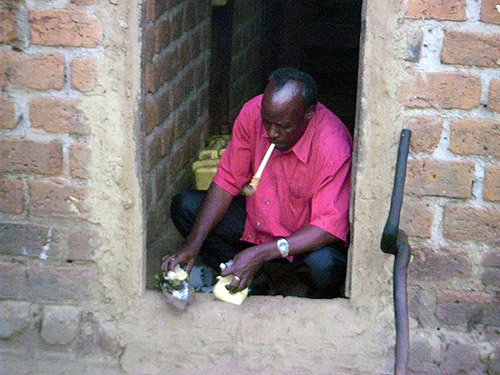
A 'traditional healer' performs a ceremony in the doorway of the house of an accused witch. The walking stick outside the door is the source of his power.

A “traditional healer” performs a ceremony in the doorway of the house of an accused witch. The walking stick outside the door is the source of his power.

The healer then placed a bag of flour and a wooden bowl filled with an unknown substance at the foot of the door. He lit his pipe, smoked slowly, answered his expensive cell phone and talked for a minute or so, looked around like he didn’t care, and used his stick to mix the substance in the bowl. After smoking for a few minutes, he went back into the house. Luke motioned for me to follow him. We walked into the house in time to see the healer’s associate, the one wearing the black rain coat, slip a curved, cone-shaped wooden handle with herbs sticking out of the top into a soft, weathered briefcase on the ground.

We went outside and the healer emerged with the bag, which he informed the crowd he suspected contained the witchcraft items.

After another few minutes he opened the bag and pulled out the wooden handle. He held it up to show the crowd (see photo at top of this article), which went wild with excitement, for this was supposed to be the witchcraft item used by Ronald to bewitch the family. I already knew the whole thing was baloney, of course, but when I saw what the healer did, I realized the scam. The man who was wearing the black raincoat had the cone-shaped handle hidden in his jacket pocket the entire time.

Their suspicions confirmed, the villagers began throwing large pieces of wood into a pile in front of the house to make a fire. They brought two chickens over and removed the feathers from their necks, then sliced the heads off right in front of me and threw them into the pile. A guy doused the wood with kerosene and lit the fire. The healer threw the bags in as well as the witchcraft item, which supposedly contained all the evil spirits. People grabbed whatever they could and threw the stuff into the fire. More gas was splashed on, and it became the tallest, hottest bonfire I’d ever seen. Everyone had to back away about 20 feet because it was so hot.
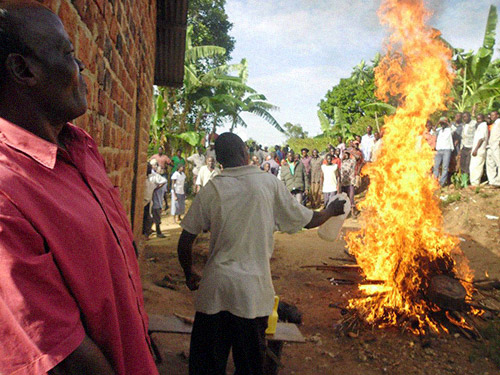
As about 200 people watch, gasoline is poured on a bonfire and the alleged witchcraft items are burned to destroy the evil spirits.

As about 200 people watch, gasoline is poured on a bonfire and the alleged witchcraft items are burned to destroy the evil spirits.

Then the already elated, besotted crowd marched behind the healer down a path to the victim family’s home, about 100 yards down the hill. Luke and I ran in front to get pictures and film the single file hikers. When we got there, the healer approached the sick woman and rubbed the curve of his stick around her head, muttered a few words, and gently lifted his hands to the air, as if to say, “Evil spirits be gone.”

I followed the healer into the victim family’s home, which he inspected thoroughly but still with an uninterested attitude. I saw the room where the family members slept, on thin mats on a hard floor.

The crowd was angry. They wanted vengeance. Everyone marched back to Ronald’s house with the intention of destroying it. The police were there to stop them, and Luke told me, “If there is violence, stand behind the police, because they will shoot in front of them into the crowd, not behind.” So we stayed behind the police who stood between the crowd and the house. Ronald’s father, a very old, frail man on crutches, claimed that his son was innocent. The police told the crowd to disperse. The crowd timidly backed off, but would surely be back later to demolish the house.

The police told Luke and me that they were leaving and that we should leave as well, because if something happened they would not be able to protect us. I wanted to see some mob violence, but it’s probably better that we got back on the boda-boda and booked it out of there, following the healer who also rode on a boda-boda. I didn’t think we were in danger but Luke told me that the crowd knew they could be identified on television and so when the police left they could potentially attack us.

The villagers will go looking for Ronald, and if they find him or if he ever returns to the village, he will be killed. Many people die this way. Even if Ronald was practicing witchcraft or had hired a witch doctor to put a curse on the family, so what? This stuff isn’t real. The only thing he is allegedly guilty of is sending bad vibes. The accused are the victims, not the “bewitched.” People practice witchcraft in Africa for various reasons, but usually because they are jealous of someone for having more money, allegedly having an affair, having beautiful children…anything. And people are killed and their homes destroyed because of it.

Meanwhile, the traditional healer is paid between 500,000 and 1,000,000 Ugandan shillings (about $200–$400 U.S.) for his “services,” which is a lot of money for villagers to cough up. He’s ripping them off, and he also adds to the confusion by spreading rumors about certain people practicing witchcraft.

According to the Ugandan constitution, in order for the police or a traditional healer or anyone to search your home, they must have a search warrant, like in America. At this ceremony, they had no search warrant and yet the healer and others were allowed to enter Ronald’s home, search it, seize items from it, burn them, probably destroy the house, and later most likely murder him. If Ronald knew the law, which he doesn’t, he could sue the police, the healer, and others. He could say his name and image were tarnished and be compensated 2,000,000 shillings for that as well as for the destruction of his home and property, such as the bags. The chances that he would win the case are extremely high, because how can anyone prove in court that evil spirits were the cause of the victim family’s illnesses and death? I told Luke I wanted to help Ronald, to give him the pictures and footage we took of the ceremony so he could use them in court to prove he was not served with a search warrant.

“Ronald could only use the footage and pictures if we published them in the newspaper or broadcast them on TV,” Luke told me. “If we supply him with the raw clips and photos, the villagers would think we were spies trying to help him the whole time, instead of attending the ceremony to write and shoot a legitimate journalism story about it.”

We would be outcasts in the community, and since Luke lived there and people knew who he was, he couldn’t do that for Ronald. The fact remains that if these people really want to hold onto this outdated belief system, fine. But why not try a healer and a real doctor in a real hospital? What have they got to lose? They just think it’s a waste of time, because the real reason for unexplainable things is invisible spirits and powers that can’t be proved. The fact that Ugandans are mostly Christian doesn’t dissuade uneducated segments of the population from letting go of their superstitious beliefs regarding witchcraft.

How interesting. How bizarre. END