Read the April 2022 issue of Justin Chapman's Newsletter, featuring the latest "NewsRap Local" episode with with retiring Rose Bowl Stadium CEO and General Manager Darryl Dunn, the latest Pasadena Now articles a new documentary about local revolutionary activist Michael Zinzun and about iconic journalist Bob Woodward’s talk at the Pasadena Distinguished Speaker Series, some recommendations for good reads, news to keep an eye on, and more!


Read the March 2022 issue of Justin Chapman's Newsletter, featuring “NewsRap Local with Justin Chapman”'s selection as a finalist in the Alliance for Community Media West’s WAVE Awards, the latest "NewsRap Local" episode with Caltech grad student Roman Korol who is collecting aid to send to his native Ukraine, some recommendations for good reads, news to keep an eye on, and more!

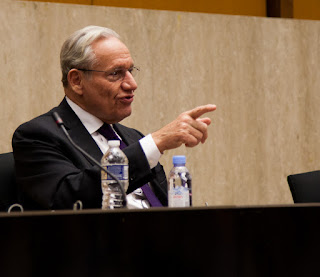
Iconic Journalist Bob Woodward Talks Journalism, Trump and Watergate in Virtual Installment of Pasadena Distinguished Speaker Series

By Justin Chapman, Pasadena Now, 3/18/2022

Bob Woodward, the legendary Washington Post journalist who broke the Watergate scandal along with his colleague Carl Bernstein, was scheduled to speak Jan. 26 in Pasadena as part of the Distinguished Speaker Series. Due to the Omicron variant of COVID-19, that event went virtual instead.

The Distinguished Speaker Series team traveled to Washington, D.C., to film a wide-ranging interview with Woodward that covered Watergate, dealing with Deepthroat, his working relationship with Carl Bernstein, the Trump administration, the coup attempt on January 6, the pandemic, journalism and more.

Five wars of Watergate

“It turned out there were five wars of Watergate, all led, instigated, supported and funded by Nixon or the government,” Woodward said. “The first was a war against the anti-Vietnam War movement. The second was a war against the news media, [including] covert wiretaps on reporters and White House aides. The third was spying and sabotaging the Democrats. Then when they were caught with the burglary [in the Watergate Hotel], they had to cover it up and so that was the war against the system of justice. And then even after Nixon resigned, the fifth war was the war against history, to say it really was inconsequential and not that meaningful.”

He pointed out that Senator Sam Ervin, who was the head of the Senate Watergate Committee called Watergate “an effort to destroy the process of nominating and electing a president.” Woodward added that it actually worked.

“For about $200,000 in dirty money, Nixon and his people launched a campaign of espionage and sabotage against the Democratic frontrunner in 1972, Senator Ed Muskie—totally derailed him with dirty tricks and spying,” Woodward said. “They got a nominee, Senator George McGovern, who they believed—and they turned out to be correct—that they would be able to beat much more easily, and so Nixon won in ‘72. Nixon found the soft spot in the system we have of nominating and electing presidents.”

As it turned out, the Washington Post almost didn’t hire Woodward before the Watergate story broke. Seeing that he had no journalism experience when he applied, they gave him a two-week trial period, during which he wrote a dozen stories that they didn’t publish. Harry Rosenfeld, who was the Metropolitan editor at the time, told Woodward, “You don’t know how to do this.”

Woodward thanked him, and Rosenfeld said, “Why are you thanking me? You’re not hired, you’re finished.” Woodward replied, “Because I know this is what I want to do.” Rosenfeld helped him get a job at a weekly paper in a Washington suburb, where he worked for a year before the Post took the plunge and hired him in fall 1971. He was the lowest paid reporter in the newsroom. Nine months later, Woodward was assigned to cover a burglary that would change the course of American history.

“I was always available for the dreary assignments, and [Watergate originally] looked like one,” Woodward said. “It was a beautiful Saturday, June 17, 1972. Who would be dumb enough to come in and work? They immediately thought of me. The city editor called me and said, ‘Come in, there’s been a burglary.’ They thought it was kind of a routine assignment. I was covering night police and they sent me to the courthouse.”

Deep background from Deep Throat

It was the first story on which Woodward and Bernstein worked together. Woodward had, however, already met the man who would become known to the world as Deep Throat, W. Mark Felt, second in command at the FBI. The secret informant was given the lewd moniker by Post managing editor Howard Simons, a reference to the 1972 porn movie of the same name starring Linda Lovelace as well as to the source offering information on what is known as “deep background” in the journalism industry, in which the reporter can use the information without attribution to the source.

Woodward was serving as a lieutenant in the Navy when he first met Felt. He was asked by an admiral to deliver papers to the White House, and while waiting outside the Oval Office, he struck up a conversation with a gray-haired man wearing a white shirt.

“We were like two strangers on a long airplane flight,” Woodward said. “ He said he worked at the FBI, had a senior position, had gone to law school. We talked and I got his number and called him a couple of times about career questions, whether to go to law school and so forth. And then I wound up working at the Washington Post and realized, ‘Oh my god, this is the guy who’s in charge of the Watergate investigation.’ I called him, he didn’t want to talk much, so we arranged for secret meetings in a parking garage. Which I thought was kind of normal. Turned out it was not normal, but he was very secretive.”

Deep Throat was not forthcoming with everything he knew, but guided Woodward and gave him leads and clues that helped unravel the case all the way to the Resolute Desk and eventually led to the first resignation of a president in U.S. history. Felt was appalled at how the White House was trying to control and limit the Watergate investigation.

“His sheer presence in an underground parking garage at 2 a.m. said to me, ‘Hey, something’s going on here that’s very important and very hidden,’” Woodward said. “I don’t think he wanted to help me, he wanted to help himself.”

Woodward, of course, kept Felt’s identity a secret for decades, until 2005 when Felt revealed himself. He died three years later. Woodward did, however, tell someone back in the 1980s—his date.

“Elsa Wolf, who’s now my wife, asked me when we were just dating who Deep Throat was,” Woodward said. “We had a love affair built on trust and I told her. But frankly, in a practical sense, it helped me as a journalist [to keep the name secret], because people would know I’d protect somebody. It set a climate of disclosure that I think did not naturally exist.”

Because his reporting took down a Republican president, some may accuse him of being partisan, but he doesn’t see it that way at all.

“I’m interested in the facts, I don’t have a partisan view,” he said. “I think partisan views get in the way of obtaining the facts.”

‘A failure of leadership’

Pasadena Star-News columnist Doug McIntyre, who conducted the Distinguished Speaker Series interview with Woodward, asked him how history will remember the pandemic. Woodward co-wrote the book Peril with Post reporter Robert Costa, which broke news about former President Donald Trump’s early reaction to the COVID-19 pandemic when it was released last year.

“We don’t know the outcome, that’s the beauty of journalism,” Woodward said. “You look back, not ahead, and you can predict and you can guess, but the future is not known. But happily the past is, and that’s why most journalistic efforts should go to the past.”

McIntyre also asked the level of Trump’s culpability as it relates to the pandemic.

“Turns out, his responsibility is absolute,” Woodward said. “He disclosed what he knew in a way that was criminal, actually, to say he knew all of this so early.”

Woodward sat down with Trump in the Oval Office in February 2020 for an interview for Peril, in which Trump said the virus was airborne and serious before most people understood that about COVID-19. And in late January, Trump had received a top secret briefing from then-National Security Adviser and Pasadena resident Robert O’Brien, who told him the virus was going to be the biggest national security threat during his presidency.

“It was a full ringing of the alarm bell, that this was going to be a pandemic, much worse than the SARS pandemic, which really didn’t strike the United States,” Woodward said. “Imagine you’re the president of the United States, and you’re sitting in this top secret briefing and [then-Deputy National Security Advisor] Matt Pottinger, who’d been a Wall Street Journal reporter in China, a real expert on China, says, ‘I have contacts who tell me that 650,000 people are going to die in the United States from this.’ And that’s precisely what happened. Trump told me what he learned but didn’t tell the public and kept on this course of denial.”

Trump told Woodward he didn’t want to panic people, and that’s why he painted a rosier picture just before the pandemic essentially forced the shutdown of the whole world.

“This is the failure of leadership, because leadership has to tell the truth,” Woodward said. “Trump could have mobilized the public and said, ‘I’ve been warned, I’m going to share that warning with you.’ But he failed to do that.”

McIntyre asked why Trump would want to talk to Woodward, knowing that the result likely would not be flattering to Trump.

“Certainly he was trying to get his point of view across, but one of the things you learn in journalism is that you’re better off not trying to speculate on people’s motives,” Woodward said. “You can only describe somebody’s behavior in actions and statements.”

‘Zero’ evidence

Regarding the insurrection at the Capitol Building on January 6, Woodward speculated that there was more coordination of the attack than is currently known, which is part of what the House Select Committee on the January 6 Attack is investigating.

“Whether they’re going to find it or whether it’s going to be one of these historical mysteries, like the Reichstag fire in Germany in the 1930s, we’ll see,” Woodward said. “What binds Nixon and Trump is that capacity to see weakness in a system, this great democracy that’s functioned for a long time. It had its moments of failure historically, but it never failed as greatly as it did under Nixon in 1972 and potentially under Trump in the certification process on January 6.”

In Peril, Woodward and Costa broke the story that conservative lawyer John Eastman—who recently featured in a lawsuit between the Pasadena Republican Club and the city of Pasadena that was decided in favor of the latter—wrote a memo in which he “laid out a coup scenario for Trump and met with Trump to go over it,” Woodward said.

Woodward and Costa reported that Republican senators Lindsey Graham and Mike Lee read the Eastman memo and investigated some of Rudy Giuliani’s claims about election fraud, and subsequently determined that there was no evidence that the 2020 election was stolen.

“Zero,” Woodward said. “Now, if you go back to Watergate, suppose two of Nixon’s biggest supporters investigated and concluded Nixon was behind it—it would have had immense credibility. I’ve gone on national television repeatedly and said, ‘Call me, here’s my phone number. Give me some evidence that this election was stolen.’ Never heard from anyone because there’s no evidence. They call it ‘the big lie.’ I don’t call it the big lie. There’s no evidence, no case at all. A big lie often has a little bit of truth in it. This has no truth.”

Upcoming talks in the Distinguished Speaker Series include Jay Leno and Malala Yousafzai. Learn more at speakersla.com.


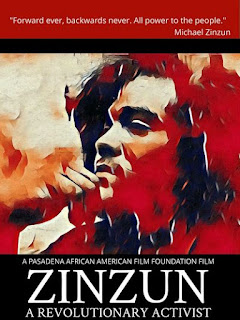
New Film Highlights the Legacy of Local Revolutionary Activist Michael Zinzun

By Justin Chapman, Pasadena Now, 2/27/2022

Decades before a Civilian Police Oversight Commission came to fruition last year, a Pasadena activist named Michael Zinzun dedicated his life to fighting police brutality. Local filmmaker Dennis Haywood released a new 52-minute film about the firebrand this week called “Zinzun: A Revolutionary Activist,” available on Vimeo.

The film, produced by Nancy Buchanan, Derrick Dancer, James Farr and Rochele Jones, features interviews with family members, friends and community members who knew and were inspired by Zinzun, and tells his remarkable life story.

Forward ever, backward never

Zinzun was born on Feb. 14, 1949, in Chicago. When his Apache father died when he was eight, his Black mother sent him to live with an aunt in Pasadena. He graduated from Blair High School in 1967 (some reports say 1965) and became a mechanic with a small repair shop in Altadena, until he was evicted by a major oil company.

He joined the Black Panther Party in 1970, which was an educational experience for him, but he left after 18 months because he found it “politically stifling,” he told the Los Angeles Times. He thought the group focused too much on idolizing its iconic leaders and not enough time training up-and-coming activists to rise through the ranks and organize in their communities. So he set out to organize on his own.

“I started to see a guy that was morphing away, and Pasadena was starting to be small,” said classmate Gary Moody, former president of the Pasadena NAACP, in the film. “His likeness was starting to spread. That brother was international. He was way beyond Pasadena. His impact was touching bases all over the world. If it wasn’t for his activism, there would be no Black Lives Matter [movement]. He took it to the nth degree in regards to, not only did it matter, [but] let’s go and do something about our Black lives so we can move forward and have a better life.”

Indeed, Zinzun worked hard to better his community. He supported at-risk youth. He started a free breakfast program to feed kids in Pasadena before they went to school. He launched a free pest control program called “Off the Roach” for poor families who were displaced by the construction of the Foothill (210) Freeway in Northwest Pasadena. The program sprayed over 10,000 houses. 

“There were roaches and rats everywhere,” Zinzun told the Pasadena Weekly in 2005. “We were trying to keep them out of the city because they carry disease, and while we were spraying the city government was treating us just like the roaches. They were trying to keep us out.”

Against police brutality

Zinzun was also an early and major figure in the anti-police brutality movement. In 1974, he co-founded Citizens Against Police Abuse (CAPA) along with activists Anthony Thigpenn in Pacoima and B. Kwaku Duren in Long Beach. The organization investigated allegations of police abuse, provided support to victims and families and called for cities across LA County to establish civilian police review boards.

The LAPD swiftly infiltrated the organization and put it under surveillance with J. Edgar Hoover-esque tactics. CAPA and the ACLU sued in 1983, resulting in the disbandment of the LAPD’s Public Disorder Intelligence Division and a $1.8 million settlement.

Shortly after 1 a.m. on June 22, 1986, hearing police arresting a man named Steve Rivers on suspicion of burglary in Pasadena’s Community Arms housing projects, Zinzun and a crowd of 30 people rushed to the scene. They thought the officers were trying to drag Rivers behind a building to beat him, so they called on the officers to stop and show their badge numbers.

Police claimed Zinzun struck an officer, which he adamantly denied. Although he was arrested that night, he was never charged with a crime. As Zinzun was trying to walk away, he was “attacked from behind by five to seven officers who sprayed him with tear gas, placed him in a chokehold, beat him and struck him in the face with a flashlight,” according to the LA Times.

Zinzun suffered a fractured skull and a severed optic nerve in his left eye, resulting in permanent vision loss. He sometimes wore a patch after that, including one monogrammed with his initials. The Police Department released a statement in which they claimed that the damage to Zinzun’s eye occurred when he fell onto the sidewalk during the scuffle.

“Michael was responding to a situation in the community where the police were just going hands off, very heavy handed, and using excessive force,” Farr said in the film.

Prosecutors declined to charge the two officers involved, Jim Ballestero and Chris Vicino, so Zinzun sued the city of Pasadena, which awarded him a $1.2 million settlement.

“I’m more determined than ever,” Zinzun told a Times reporter a month after the incident. “I’ve got my designer patch. I’d rather lose an eye fighting against injustice than live as a quiet slave. I just can’t see myself standing back. I will continue what I am doing. I am not going to stop.”

He established the Michael Zinzun Defense Committee to help defend others who experienced police abuse.

“Many people think that my father hated the police, but that’s such a big misunderstanding,” Michael Zinzun Jr. told Pasadena Black Pages. “He didn’t hate the police, he hated the abuse of authority. The slave-master mentality that the police force attracted.”

Vote Zinzun

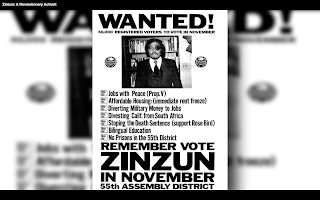
Also in 1986, Zinzun ran for California state Assembly in the 55th District on the Peace and Freedom Party ticket. He polled higher than 10 percent in the primary that year, but Democrat Richard Polanco went on to win in the general election. Zinzun’s platform included “jobs with peace, affordable housing (immediate rent freeze), diverting military money to jobs, divesting California from [apartheid] South Africa, stopping the death penalty, bilingual education and no prisons in the 55th District.” Politically, he called himself a “radical Socialist.”

In 1989, Zinzun ran for a third time for a seat on the Pasadena City Council, then called the City Board of Directors. 

During that campaign, LAPD Assistant Police Chief Robert Vernon, a Christian fundamentalist who lived in Pasadena’s Linda Vista neighborhood near the Rose Bowl, took files from the LAPD’s Anti-Terrorism Division and leaked them to the press, which gave the public the false impression that Zinzun was under investigation for terrorism. Zinzun sued Vernon and the city of Los Angeles for defamation and a jury awarded him $3.8 million from the city and $10,000 from Vernon personally. In 1991, that ruling was overturned on procedural grounds. On appeal, Zinzun was ultimately awarded $512,500.

Vernon argued at the trial that he only used the LAPD’s computer to obtain newspaper articles about Zinzun which he then gave to his neighbor, former Pasadena Mayor John Crowley. Either way, the damage was done when the Anti-Terrorism Division became known as the source.

Zinzun said the settlement didn’t “make up for the fact that they chose to violate my civil rights. Right in the middle of my campaign, I was labeled a terrorist. This may have hurt me in one way, but in some [other] ways I do believe [it resulted in] the community becoming more and more aware of how the police can manipulate or attempt to manipulate public opinion.”

Also during the Pasadena campaign, Councilman Bill Paparian endorsed Zinzun over Chris Holden, son of then-LA City Councilman Nate Holden, who would go on to become a state Senator. Chris Holden ultimately won the Pasadena race, went on to become mayor of Pasadena when it was a rotating position on the council and has served in the Assembly since 2012. Zinzun was just 48 votes short of a runoff in that 1989 election.

“The late Loretta Glickman, the first African American mayor of Pasadena, was retiring, and Michael [Zinzun] announced his candidacy,” Paparian said. “I announced I was going to support Michael. I knew of him, I knew of his work regarding police misconduct and police reform. I knew of his involvement in the lawsuit that had been filed against the intelligence division of the LAPD that resulted in a settlement. I knew of his history with the Black Panther Party, and I knew of his work in Northwest Pasadena. He was an important person in the community.”

After the election, Paparian nominated Zinzun to Pasadena’s Northwest Commission in 1990, but the other members of the City Council refused to support his appointment.

“What is it about someone having been associated — in Michael’s case, for a brief period of time in the 70s — with the Black Panther Party that would be cause for them not to be considered for appointment to an advisory post for the city of Pasadena, when it’s someone who was currently active in the community, who was doing all kind of things for the community in a positive way?” Paparian said in the film.

In 1999, Zinzun, Paparian, Holden and several others ran for mayor of Pasadena, according to the Weekly, a race ultimately won by Bill Bogaard. Holden appointed Zinzun to the Pasadena Community Access Corporation’s (PCAC) Board of Directors in 2000.

‘Message to the Grassroots’

In the early 1990s, Zinzun launched his own hour-long, monthly TV talk show called “Message to the Grassroots,” which he hosted for nearly 10 years and co-produced with artist and activist Nancy Buchanan, who also produced the film. The show aired on Pasadena Media, the local public access channel, then called KPAS on Channel 56.

“Michael was a big proponent of cable access and fought hard to bring it to Pasadena,” Buchanan said in the film. “If there was going to be cable, [Zinzun lobbied] to have public access be required. He always understood how important media was.”

Farr said the film’s producers pored through more than 100 hours of Zinzun’s show. In one episode, Zinzun organized one of the first ever face-to-face truce meetings between members of the warring Bloods and Crips in the same studio. He was a major proponent of a truce between the rival gangs. In another episode, he provided analysis of the video of the beating of Altadena resident Rodney King by four LAPD officers, and talked to John Burton, a Pasadena lawyer specializing in police misconduct cases, just days before the LA Riots in April 1992. Zinzun also debuted footage of the beating from a second camera.

Zinzun served as the grand marshal of Pasadena’s Black History Parade twice, the only person to do so. And his activism extended beyond Southern California as well. He called for California to divest from South Africa during apartheid, spoke out on behalf of Namibians fighting for freedom and called attention to human rights abuses in Haiti.  His most lasting legacy, however, remains his impact on the movement for civilian oversight of the police, a dream partly realized with the establishment of Pasadena’s Civilian Police Oversight Commission last year.

Haywood released another film last year about tensions between Pasadena police and Pasadena’s African American community called “Thorns on the Rose: Black Abuse, Corruption & the Pasadena Police,” which was also produced by Farr and Jones. Funds raised from donations and proceeds from that film were awarded to local student Noah Griffin of Muir High School as part of the Anthony McClain Social Justice Scholarship.

‘An extraordinary force for justice’

In his later years, Zinzun was planning to become a chef. He had enrolled in a course at Pasadena’s Le Cordon Bleu culinary school. He passed away in his sleep on July 6, 2006, at age 57. He and his wife Florence, prominently featured in the film, had six children and 19 grandchildren, in addition to a seventh child he had with his first wife in 1968, Zinzun Jr.

“He was just an extraordinary force for justice and the civil rights movements,” Barry Gordon, who served on the PCAC board with Zinzun, told the Weekly. “He matched his passions with the principles.”

“Zinzun: A Revolutionary Activist” may be rented or purchased for limitless views at https://vimeo.com/ondemand/zinzun/677444909