Mayor Garcetti: The State of Global LA is Growing Stronger

MARCH 28, 2018
By: Justin Chapman, Pacific Council

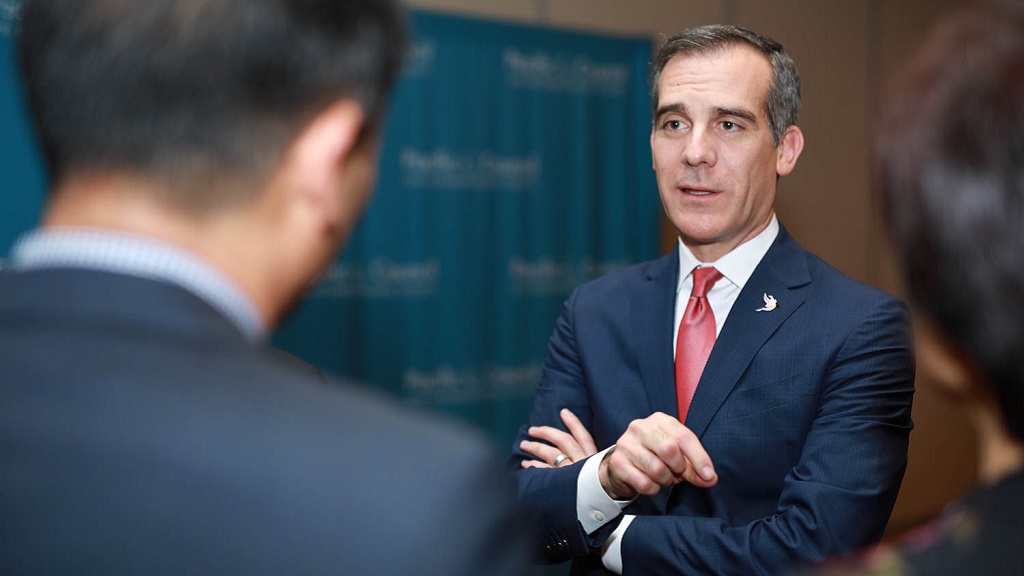
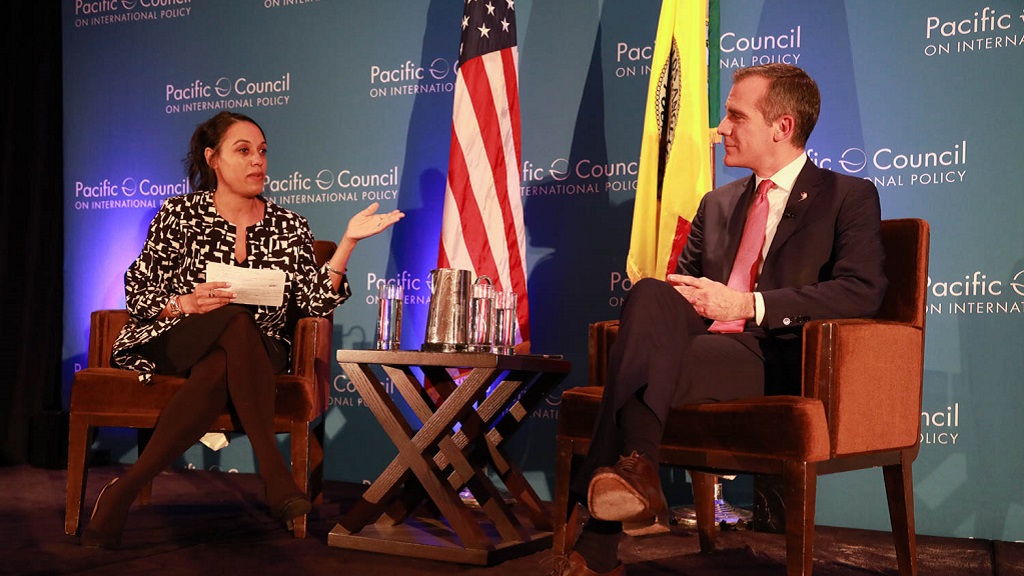
Los Angeles’ leadership in global affairs is growing stronger at a time when the federal government’s role is diminishing, Los Angeles Mayor Eric Garcetti told Pacific Council members in his 2nd annual State of the Global City address in downtown LA. The discussion was made possible by the generous support of the RM Liu Foundation and was moderated by Ms. Karen Richardson, former deputy assistant secretary of public affairs at the U.S. State Department.

Watch the full address and conversation below:

"Fourteen months ago, I came before you for the first ever State of the Global City address," said Garcetti. "I was full of both unabashed hope locally and confronting a growing uncertainty nationally and globally. I talked about the progress we are making in international trade and jobs, in our Olympic bid, in our aspirations in the world. I came and spoke to you three days after the inauguration of our new president. I spoke to you about the growing divides between people, cultural, economic, geographic fissures, not unique to just our country but around the world, that threaten the peace, social unity, and security of our world."

This year, he added, his assessment of the State of the Global City is the same as last year, but even stronger.

"Locally, I can share even more positive news than we had last year," he said. "On the flip side, nationally and globally, there is even more negative news that threaten our collective progress."

"Our city won the largest cultural and athletic prize a city can win in the world, and we will in 2028 host our third Olympiad in the city of Angels. LA will be a game changer in 2028."

Eric Garcetti

Garcetti laid out the progress made in Los Angeles since his address last year.

"Locally, it’s an extraordinary picture," he said. "In this past year, we set new trade, tourism, and foreign investment records. We are the third largest municipal economy in the world now, with Tokyo being first and New York second. We’re nearly a trillion dollars in gross municipal product. It puts in perspective just what a huge presence Southern California is on the world stage. Our arts scene is exploding. Our city won the largest cultural and athletic prize a city can win in the world, and we will in 2028 host our third Olympiad in the city of Angels. LA will be a game changer in 2028."

Garcetti also delivered a rebuke of the Trump administration’s policies, without pointing fingers or naming names.

"The bad news is that the state of the globe and our nation’s foreign policy is described at best ‘in flux’ and at worst ‘quickly disintegrating,’" he said. "We’re unclear on our policies, from trade to security, multilateralism and our defense commitments. We’re unpredictable in our stances, from the Korean Peninsula to Europe and toward our adversaries. And we’re undependable in our friendships. One day we’re fascinated and friendly with you, the next day we’re not. We seem obsessed with strongmen more than our long-time relationships. We’ve taken sides from the Middle East to the Philippines in ways that often undercut the values that America has stood for, for a long time."

"I am so excited to see the next generation of Angelenos strengthen global ties at a time when it feels like our country is withdrawing into itself."

Eric Garcetti

Garcetti said that the question many people are asking is, "Who are we as Americans?"

"We must continue to show the world who America is, which is never defined by one person or even single political administration, but by an entire nation," he said. "At the same time, we must prepare for a rapidly changing world and our role in ensuring that there is peace and prosperity in that world for our people and the people of all nations."

On Los Angeles as a global city

He argued that the past decade has resulted in a successful expansion of Los Angeles as a global city, pointing out that foreign investment has created hundreds of thousands of jobs in Southern California; tourism has decreased nationally but increased in LA with 50 million visitors because of the city’s open and inclusive values; LAX became the fourth busiest airport in the world with 70 new nonstop international flights added since Garcetti was first elected; and the Port of LA is the busiest in the Western Hemisphere with 9.3 million TEUs, the equivalent to about $470 billion of goods.

Culturally, Garcetti pointed out that LA’s art and museum scene is thriving, with The Broad, LACMA, and others setting attendance records. The city recently broke ground on the largest single cultural gift in American history, the Lucas Museum of Narrative Art. LA’s entertainment industry and food scene are also second to none in the world, he said.
With the 2028 Olympics secured, Garcetti said it was the right time to add a deputy mayor of international affairs to his team. In August 2017, he named Pacific Council Director and former U.S. Ambassador to ASEAN Nina Hachigian to the new position.

"Nina oversees this city’s first office of international affairs, with trade, diplomacy, and the Olympics under her portfolio," he said. "We are also working to make sure the next generation of Angelenos feels those ties, not just on the streets of LA, but in their opportunities to actually visit and be a part of cultures globally. In collaboration with the Pacific Council and with support from the RM Liu Foundation, College Promise students will join some of the Pacific Council’s trips over the next five years, which will enrich their lives. I am so excited to see the next generation of Angelenos strengthen global ties at a time when it feels like our country is withdrawing into itself."

On U.S. foreign policy

Garcetti laid out his vision for U.S. foreign policy and argued that America needs to focus on three A’s with its global interactions: aspirations, allies, and actions.

"I believe we should aspire to have a shared culture internationally, in terms of how we act and care for one another," he said, adding that that means having faith in the global family, ensuring economic freedom, and investing in the future to mitigate some of the disruptive changes on the way. "We have to build a network of allies. Friendship matters, in life and in international relations. We know that in Los Angeles. We have the most sister cities, leading to investment, cultural exchange, educational collaboration, and environmental action. And our actions, ultimately, are what we should be judged by."

He said that the foundation of post-WWII and post-Cold War global relations faces its toughest challenge yet, both domestically and internationally. Those challenges include the existential threat of climate change, which he called perhaps the greatest threat humanity has ever faced, as well as the rise of nostalgic nationalism and, in some parts of the world, a new authoritarianism.

"Instead of realism, I would say what we see coming out of Washington is what can best be described as ‘American surrealism.’ We can only keep a leadership deficit at bay for so long before we actually start to weaken this country and the world itself."

Eric Garcetti

"Those threats and changes have resulted in some real dislocation for workers and in new conflicts in what we thought were previously stable regions," he said. "Unlike what we hear from Washington these days, there is no dichotomy between patriotism on one hand, and global purpose on the other. Just as America can lead the world for a common good and deliver for its people, so can LA be a global city and do well for ourselves."

He further criticized current U.S. foreign policy as unfocused and unhelpful.

"Our response hasn’t been a strengthening of our idealistic realism," he said. "There isn’t even a zero sum game world of strict realism coming out of Washington. Instead of realism, I would say what we see coming out of Washington is what can best be described as ‘American surrealism.’ The only rule is there are no rules. We can only keep a leadership deficit at bay for so long before we actually start to weaken this country and the world itself."

Garcetti argued that no matter who was elected president in 2016, his work and that of the city of Los Angeles would have continued.

"I spend 95 percent of my time on transportation and housing issues in LA, both of which are an articulation that this is still a city that people want to be in."

Eric Garcetti

"It’s nicer when the city is congruent with the national government, but whether it was going to be President Trump or President Clinton, most of the work I’ve described we’d still need to be engaged in," he said. "When Trump pulled out of the Paris Accord, I worked to get nearly 400 cities to commit to implementing it locally. Americans do care about climate change and we are moving forward. Mayors and cities—nationally and internationally—are getting together and communicating in ways they never have before."

He also argued for the return of a strong State Department.

"From a security standpoint, diplomacy is critical and can save lives," he said. "I hope our next Secretary of State reinvests in State Department jobs. At its best, diplomacy transcends formal discussions and is really about human connections and friendships."

On transportation and homelessness

Garcetti also addressed the two major issues that he deals with as the mayor of a city like Los Angeles: transportation and homelessness.

"I spend 95 percent of my time on transportation and housing issues in LA, both of which are an articulation that this is still a city that people want to be in," he said. "It’s a failure of us to build the infrastructure to accommodate the amazing growth, investment, and popularity that we have here. I understand people’s impatience. We went to the voters with two 10-year initiatives: Measure H, a countywide sales tax, and Measure HHH, a $1.2 billion city bond aimed at building 10,000 units of supportive housing in the city. A lot of people say, ‘Why do we still have homelessness? Didn’t I vote for that last year?’ The money only started coming on October 1 from the county measure. We hired 1,000 outreach workers; there were only 25 homeless outreach workers when I became mayor. On the transportation front, we got Measure M passed, which is the largest transportation measure in this nation’s history. Now we finally have resources for both of these issues, which people will begin to see in the second half of 2018."

He pointed out that about 25-30 percent of the 99,000 people a year who are coming out of jail or prison into the city of LA are homeless. The city needs county, state, and federal help to intervene in the first few hours after their release to prevent homelessness.
A week before his speech, the city and the United Way of Greater Los Angeles launched the "Everyone In" campaign.

"We’re finding that two thirds of Angelenos say they want housing in their own neighborhoods for homeless folks," he said. "That’s a sea change from a decade ago. We have to house people where they are, where they know. We’re looking at every parking lot, every piece of surplus land that we have [as a possible location for more units]."

On public transportation, Garcetti said Metro moves 1.5 million people per day. He argued that bus and train lines are a critical piece of the city’s transportation puzzle, but that there still aren’t enough rail lines yet. There are now 15 rapid transit lines that will be expanded or built as a result of the recently passed Measure M. He also pointed out that affordable housing must be built alongside the new lines. 

"I feel more optimistic than I’ve ever been that those two things will radically change the look of the city," he said. "By 2028—and I want people to have realistic expectations—we can end homelessness on the streets of LA. It will require all of us stepping up. We need to ask ourselves the question now: ‘Who do we want to be in 2028? When the world comes to our city, what Los Angeles and what America will they find?’"

"Here in Los Angeles, we practice a municipal pragmatism that’s rooted in a Pacific optimism. In other words, we get things done and we know we still have a long way to go."

Eric Garcetti

He laid out his vision for the Los Angeles he would like to see in 2028.

"I want to see an LA that creates economic prosperity for all of our people," he said. "I want to see LA as a place where the world belongs. LA is the number one choice for people to visit, study, and invest. We need to keep that momentum going. I also want to see LA leading Pacific engagement. The Pacific Council is a huge part of that. Make no mistake, without this organization our leadership would be greatly diminished. The Pacific Council is fulfilling an absolutely critical role, not just in our world today but in our region as well. This organization continues to set the standard in a moment in which you are so badly needed. But we need to be hosting more gatherings such as G8, G20, and other multinational meetings right here in LA. And I want to see LA as a place that is busy solving the world’s problems, such as urban infrastructure, health concerns, global warming, air pollution, and more. Our engagement as a city has been a conscious city foreign policy."

He concluded with a message based in his signature optimism.

"Here in Los Angeles, we practice a municipal pragmatism that’s rooted in a Pacific optimism," he said. "In other words, we get things done and we know we still have a long way to go, but we are seeing the turning of a page, a great decade of investment in the physical and human infrastructure of our proud city. In LA, we build tunnels, bridges, and terminals while others pursue their surrealist fantasies of impenetrable border walls. In LA, we protect our citizens while others divide and denigrate them. In LA, we fight fires and drought brought on by climate change while others deny that it’s even happening. We see the world as it is, and we seek to make it better."

_____________________

Justin Chapman is the Communications Officer at the Pacific Council on International Policy.

Check out photos from this event on our Flickr page.

Read about and watch Mayor Garcetti’s inaugural address to the Pacific Council in 2017, and read the article he wrote for our Newsroom on LA’s leadership in the Pacific Century.

Learn more about the Pacific Council’s Global LA initiative.

The views and opinions expressed here are those of the speaker and do not necessarily reflect the official policy or position of the Pacific Council.

Malley: Reinvest in Diplomacy to Avoid Future Conflict

MARCH 6, 2018
By: Justin Chapman, Pacific Council

From nuclear war on the Korean Peninsula to the dissolution of the Iran nuclear deal for political reasons, there are several major hotspots around the world where conflict has the potential to break out. International Crisis Group President and CEO Dr. Robert Malley wrote about 10 such conflicts to watch in 2018 and recently discussed them with Pacific Council members. The discussion was moderated by Ms. Marissa Moran, senior communications officer at the Pacific Council.

"Historically speaking, this is far from being the most violent era that we have experienced in history, but our position at the International Crisis Group is that one death from conflict is too many," said Malley. "That said, we have noticed several things of late, including more conflicts and a more militaristic approach to them, which means we are likely to see more of them develop in the future unless we reinvest in diplomacy and reinvest in the kind of efforts that will prevent conflicts from emerging in the first place."

He added that the United States has recently withdrawn from diplomacy while the presence of U.S. troops around the world has increased. He stressed the need for understanding other points of view in order to better negotiate peace.

"We can’t neglect the long-term tools to fight terrorism, including economic and diplomatic tools. Military strikes without these tools are not as effective."

Robert Malley

"We believe first and foremost we must know what the people who are fighting are thinking," he said. "If we don’t know how they are thinking, how will we ever resolve these conflicts?"

Malley also explored the question of whether the money on counterterrorism efforts has been well spent.

"Are we overly focused on the question of terrorism, and are we excessively militaristic in our response to it? The answer is yes," he said. "The United States needs to understand the impact of the counterterrorism measures in the country where they are being applied. Things like drone strikes risk alienating communities the United States is trying to help. We can’t neglect the long-term tools to fight terrorism, including economic and diplomatic tools. Military strikes without these tools are not as effective."

On China and North Korea

Malley said that China’s rise was inevitable, and that the United States must now think about dealing with another global superpower as it has done before.

"The good thing is, the more involved China is in the world, the more they will care about how the world is governed," he said.

That includes North Korea, which he said China will help put pressure on as long as it doesn’t lead to conflict or regime change.

"The North Korea situation is like two freight trains headed toward each other with no brakes at this point," he said. "The human cost of conflict will be unthinkable if this is not resolved."

He added that China can help the United States broker a deal on the Korean Peninsula, but that China may not be interested in seeing a reunified Korea because it would inevitably lean towards the South Korean model and could threaten Chinese power and influence in the region.

"North Korea is not acting irrationally," he said. "From a North Korean perspective, this is self-defense. They feel that the Korean War never ended. They feel threatened by the United States. They look around the world and they see what happened to Muammar Gaddafi in Libya, who had no nuclear weapons and was overthrown and then killed. They look at Saddam Hussein in Iraq with what happened there. They had no WMD program. The regime was toppled and he was killed."

"The more the North Koreans develop their program, the more the United States sticks to its 'red line,' the more confrontation becomes possible."

Robert Malley

From their perspective, he said, developing nuclear weapons makes perfect sense.

"From the United States point of view, which is equally not irrational, is that if they allow North Korea to develop the ability to strike the continental United States with a nuclear missile, that also is unacceptable," he said.

The most important thing that is lacking in the North Korea situation is time, Malley said.

"The more the North Koreans develop their program, the more the United States sticks to its 'red line,' the more confrontation becomes possible," he said. "Let’s put some time on the clock for the chance of diplomacy to negotiate first a shorter term outcome, where we make sure the rules of the game are understood, and a longer term outcome, which might have to involve the world accepting North Korea as a nuclear state. I don’t think it’s going to be easy to wind that clock back. But with limitations, security guarantees for all sides, and some assurance for North Korea that we’re not out to change their regime, but also assurances for the United States and others that North Korea is not going to use its nuclear weapons either by deploying them or using them to blackmail South Korea or Japan to get the concessions it wants."

On the Sahel

Malley said that conflict areas like the Sahel in Africa need more media coverage. Right now most observers only look at the region through the lens of terrorism, which misses a huge part of the story, namely conflict over resources, corruption, and a lack of good governance.

"There are other countries who have the blessing or the curse, in these cases the curse, of being less of an international state," he said. "Fewer people are focused on Africa, yet the fact that people don’t look at them and don’t always focus on them means that they are neglected when it comes to diplomacy and conflict resolution because what you don’t see or hear about, you don’t care about."

Malley argued that the focus needs to be on "spreading the wealth, power, and resources" in the region, which is easier said than done.

"We need to take local grievances in the Sahel into account and get the U.S. government, the European Union, and the African Union to work together to create global partnerships in order to help heal problems in Africa."

Robert Malley

One thing to watch in the near future, Malley said, is "climate change wars," which are conflicts caused by dwindling resources including water.

"We need to take local grievances in the Sahel into account and get the U.S. government, the European Union, and the African Union to work together to create global partnerships in order to help heal problems in Africa," he said. "There’s huge potential for success in this area."

He added that conflicts playing out in places like Yemen and Syria make it clear that the lack of water is one of the sources of the unrest.

"Countries need to develop better ways of distributing and conserving water resources," he said.

On Russia

Malley said it is important that western powers understand Russian complaints about the West meddling in their election and government, not just the other way around.

"This isn’t ‘what-about-ism,’ but we need to know what complaints they will bring to the table to better prepare for negotiations," he said. "Russia thinks the United States took advantage of them after the Cold War and then expanded NATO. This also resonates with average Russians. They point to Vietnam and Iraq as counterarguments when the United States accuses them of aggression."

_______________________

Justin Chapman is the Communications Officer at the Pacific Council on International Policy.

The views and opinions expressed here are those of the speakers and do not necessarily reflect the official policy or position of the Pacific Council.

John Stamper on the al-Nashiri Proceedings at Guantánamo Bay

MARCH 5, 2018
By: Justin Chapman, Pacific Council

The Pacific Council is one of a select group of organizations that hold official NGO observer status with the Office of Military Commissions at Guantánamo Bay, Cuba. Since 2013, members with relevant expertise have represented the Pacific Council by observing proceedings at GTMO.

Pacific Council member and retired O’Melveny & Myers litigation partner John Stamper observed the Abd al-Rahim al-Nashiri proceedings in September 2016 and October 2017. Al-Nashiri is a Saudi man alleged to be the mastermind of the USS Cole bombing in 2000 that killed 17 sailors.

Stamper recently spoke with the Pacific Council about his experiences and observations at Guantánamo Bay.

_______________________

What is your most memorable experience from your visits to Guantánamo Bay?

John Stamper: Undoubtedly the hearing in which the Marine general in charge of all of the defense teams in Guantánamo, John Baker, was held in contempt and taken out of the courtroom by guards. That was clearly the most dramatic thing that I saw. Shortly before the hearings we attended, all of the civilian defense counsel for al-Nashiri asked to be allowed to withdraw because they had learned that attorney-client communications in Guantánamo had been monitored by the government, and they couldn’t assure themselves that they could communicate with their client. Baker approved that request.

The judge, on hearing that, took the position that only he could approve such a request and ordered Baker to rescind his approval and order the civilian counsel to come back to Guantánamo. Baker refused, saying he couldn’t ethically do that. The judge ordered him to take the stand and testify about his decision to approve the withdrawal. Baker said he also couldn’t do that because that decision was based on attorney-client privilege to information. The judge held Baker in contempt and told him to come back the next day for sentencing.

The next day, Baker stood up and tried to make his argument why he shouldn’t be held in contempt, and the judge said, "Sit down, you can’t speak." Baker said, "Let me be clear, am I being denied an opportunity to be heard?" And the judge said, "Yes, you’re not a party to this proceeding, you have no right to be heard," and proceeded to sentence him for contempt of court.

"In my mind there is no question whatsoever that it was a denial of due process to sentence [Marine Brigadier General John Baker] without giving him an opportunity to be heard. For the judge to hold the general in contempt for disagreeing with him was clearly an abuse of discretion."

John Stamper

The next day, the lawyers on behalf of Baker filed a habeas petition in federal court in D.C. Before the judge could rule, the commission released Baker. They didn’t overturn the contempt conviction, so that’s still out there hanging over his head, but they released him and said that his confinement would be postponed, so nobody knows exactly what that means.

In my mind there is no question whatsoever that it was a denial of due process to sentence him without giving him an opportunity to be heard. It’s a much tougher question as to whether the judge is right that he had the authority to make that original decision rather than Baker. That would be true in a federal court, but the military commission is such a strange creature unto itself. It is not at all clear under those rules, but for the judge to hold the general in contempt for disagreeing with him was clearly, in my mind, an abuse of discretion. So that was the most dramatic, and it’s an example of the very interesting legal issues that are presented because of this unique structure that was created just for these purposes.

Did you have any experience or interest in Guantánamo before this observer program? What would your advice be to future Pacific Council members who go on this program?

No, the Pacific Council’s program originally prompted me to go. My advice would be to oneself with the current issues in the particular case you will be attending and to review the papers that have been filed on the hearings in order to appreciate the legal issues, understand what’s going on, and form opinions about it. You really need to inform yourself in advance. A lot of these are not everyday issues for most of us: extraterritorial application of U.S. laws and the extent to which the hearsay rule will apply in this type of proceeding as opposed to how it applies in the federal rules of criminal procedure. Things like that require a little bit of work to understand.

Do you have any policy recommendations that might improve these proceedings? Do you think these cases are ever going to get resolved?

That last question is really uncertain. In the al-Nashiri case, the judge has apparently said he wants to start picking a jury in December. But considering that al-Nashiri is currently represented solely by a young lawyer with no capital case experience, it seems to me impossible. If that case does go to trial under those circumstances within the next year, any result will certainly be reversed. And if they want to get, as the law requires, experienced counsel or what they called "learned" counsel—a lawyer experienced in capital cases—that’ll take at least a year to get the lawyer, and who knows how long to get that lawyer up to speed. So that case, at least, in my view is either going to be a failure, a total waste of years and years of effort, or it’s not going to trial anytime soon.

The judge in the 9/11 cases, at least the last I knew, has not indicated when he intends to set a trial date. And the document issues continue to be a problem. There is currently an issue about destruction of evidence by the government. The president just ordered Defense Secretary James Mattis to review U.S. policies of detention, and Mattis just discharged the official in charge of Guantánamo and his chief of staff. So there is going to be shake up of some kind there in terms of how things are run. Whether that will lead to pressure to move things along more expeditiously, I don’t know, but it could mean that. The Pacific Council’s suggestion to replace the Guantánamo military judges with federal judges was clearly a good one and would have made a huge difference.

"The government is making a big mistake in pushing to do everything it’s arguably entitled to do under these peculiar commission rules, because it’s jeopardizing their chances of ultimately getting convictions that are sustainable."

John Stamper

The government is making a big mistake in pushing to do everything it’s arguably entitled to do under these peculiar commission rules, because it’s unfair to the defendants, and it is probably jeopardizing the government’s chances of ultimately getting convictions that are sustainable. The government would do very well to reexamine some of its policies. They should: 1) allow the defense to have control over its own case instead of the rules that basically let the prosecution govern the defense case, and 2) be more relaxed in terms of the military’s usual tour of duty rotations of counsel out of the cases and let them keep lawyers for a sustained period of time without jeopardizing their careers. There are a number of procedural things like that that would make things fairer and better for both sides.

Did you have a chance to speak with any U.S. service members while you were there? What were their impressions of the situation?

I spoke with both prosecution and defense teams, including with both of the generals in charge of the respective teams for the defense and the prosecution, with the civilian lawyers in charge of the defense, and with all members of the defense team out at the defense team barbecue. The chief lawyer for defense in the al-Nashiri case makes his view of the proceedings clear by wearing a kangaroo pin on his lapel to all of the hearings, and he basically says these proceedings have no relationship to a real trial in the U.S. system, they’re completely unfair, and he has no question that his client will ultimately be found guilty no matter what.

In fact, he says the only thing keeping his client alive is Congress because, by refusing to let him be taken to the United States, they prevented him from being tried, convicted, and executed in the federal system. The general in charge of the prosecution is an impressive man and probably trying to do the right thing. But he is too rigid in his taking advantage of all the commission rules, such as deciding whether they will take a hard line on all of these things or whether they’re going to try to simulate a fair trial in our system. So I fault him for not doing that.

Did you hear anything about defense lawyers not being able to ask the CIA for information on the black sites used for interrogation?

We don’t really know exactly what they have and haven’t been allowed to do. But certainly, we know from some of the hearings that the court allowed the prosecution to dismantle and destroy one of the black sites without notice to the defense, which was contrary to an order the judge had issued earlier that all such evidence be preserved. The defense had not yet had an opportunity to examine the site, but it was being preserved in case there was ultimately a determination that they were entitled to examine it. And just recently, in the 9/11 case, they learned that one of those sites that they were trying to visit in the 9/11 case has been dismantled, and it is no longer there, so there will not be an opportunity for them to obtain that evidence.

Now that you’ve been there and you know much more about the process and what’s going on there, how well informed is the public, and how well does the media portray what’s going on there?

The U.S. media basically has ignored Guantánamo for the last many years. Only Carol Rosenberg of the Miami Herald has continued to follow it and I think her reporting—although clearly favoring the defense—is still the best source of information that people have. She’s very much tied into the system and gets a lot of inside information. She learns things as soon as they happen, and if you read her reports you’d be pretty well informed about Guantánamo. But probably not a very large portion of people read her reports. Occasionally, The New York Times or another wide publication picks up what she reports, or as we saw recently they reported when the president decided to rescind the order to close Guantánamo.

"Foreign press continues to pay more attention than U.S. press and they paint an absolutely horrible picture of the United States as a result. The public overall probably doesn’t have much of a notion at all of what’s going on down there."

John Stamper

Foreign press continues to pay more attention than U.S. press and they paint an absolutely horrible picture of the United States as a result. An Argentine journalist said to me when we were down there for one set of hearings, "When we disappeared people and had governmental torture in Argentina we used to look at the United States as the model of what a country could be. Now we see you’re just like us." That’s a very, very bad thing. The public overall probably doesn’t have much of a notion at all of what’s going on down there: what the proceedings are or this fact that they’ve been pending for 15 years without ever approaching a trial date. I doubt that the American public, or a very, very small percentage of the public, has any awareness.

_______________________

Justin Chapman is the Communications Officer at the Pacific Council on International Policy.

Learn more about the Pacific Council’s Guantánamo Bay Observer Program, and read John Stamper’s GTMO observer dispatches from September 2016 and October 2017.

The views and opinions expressed here are those of the speaker and do not necessarily reflect the official policy or position of the Pacific Council.

Japan’s Case for Multilateral Trade Agreements

FEBRUARY 27, 2018
By: Justin Chapman, Pacific Council

Multilateral trade agreements such as the Trans-Pacific Partnership (TPP) are mutually beneficial for countries in the Asia-Pacific, Keio University Professor Yorizumi Watanabe told Pacific Council members in a roundtable discussion. The conversation was presented in partnership with Japan House LA and moderated by Ms. Rachel Swanger, associate dean of the RAND Corporation’s Pardee Graduate School.

Watanabe argued that multilateral trade agreements and an international legal infrastructure are necessary in order to forge strong trade and investment partnerships.

"There is a very dynamic production network across the Asia-Pacific," Watanabe said. "It’s not just bilateral: one country to another. The U.S. government is now interested in bilateral trade agreements, but a bilateral agreement between Japan and the United States cannot capture that dynamism."

"The NAFTA negotiations have been an important focus for Japan, because that will have enormous ramifications on bilateral economic talks between Japan and the United States."

Yorizumi Watanabe

He added that the United States is Japan’s closest ally in every sense of the term, particularly in trade.

"We are co-partners, so we have to work together," he said. "The United States was a sort of guarantor for Japan to become a member of the international trade club called the General Agreement on Tariffs and Trade. Because of a trade imbalance that Japan has with the EU and the United States, it became involved in trade disputes. My research has focused on how Japan can mitigate the negative aspects of international trade. In order to do that, a trade architecture had to be established, a legal infrastructure such as the World Trade Organization [WTO]."

He also pointed out that Japan is closely watching the NAFTA renegotiations between the United States, Canada, and Mexico because they could impact talks on the U.S.-Japan free trade agreement. Japan is particularly interested in the outcome of controversial issues such as rules of origin and dispute settlements.

"The NAFTA negotiations have been an important focus for Japan, because that will have enormous ramifications on bilateral economic talks between Japan and the United States," he said. "Japan’s auto industry has been building up its value chain production network in accordance with NAFTA’s rules of origin."

"Japan has had some domestic difficulties in terms of negotiating international trade deals, particularly related to agricultural protectionism."

Yorizumi Watanabe

Watanabe said that over the past 20 years, Japan’s agricultural sector was resistant to joining multilateral trade agreements, but that eventually it came around.

"Japan has had some domestic difficulties in terms of negotiating international trade deals, particularly related to agricultural protectionism," he said. "One of the important outcomes of the TPP trade deal negotiations is that it affected the mindset of the agricultural farming community. Before that there was a spirit of protectionism, which limited Japan’s international trade participation. They tried to protect themselves from international competition, but now with TPP more than 81 percent of all Japanese products are subject to duty elimination. Because of Japan’s domestic politics, this change took some time to be realized."

Watanabe explained that he was an early supporter of TPP, which he said was difficult because the trade deal was not originally popular in Japan.

"What I’ve learned from my Chinese colleagues is that China’s trade policy and TPP are not necessarily in confrontation."

Yorizumi Watanabe

"Before Japan joined TPP negotiations in 2013, whenever I went to various Japanese cities to talk about TPP, the audience shouted at me that I was a traitor," he said. "But this was an initiation of a national debate on TPP. In Japan, we’ve had a comprehensive national debate about whether it was good for national interests or not, which for the United States was maybe not the case. It was only during the [2016] presidential election that most Americans heard about TPP."

Watanabe said that he remains optimistic that the United States will eventually reenter the agreement, adding that President Trump’s Ambassador to Japan William Hagerty told him negotiations for the bilateral U.S.-Japan free trade agreement have been "frustrating."

"The United States will lose if they continue to stay outside of the TPP trade deal," said Watanabe.

Watanabe also argued that China should join TPP.

"What I’ve learned from my Chinese colleagues is that China’s trade policy and TPP are not necessarily in confrontation," he said. "China joining TPP might be their second instance of WTO accession. They acceded to the WTO in 2001, and since then they’ve had double digit growth of trade. China is looking for more trade opportunities. At the beginning of the TPP negotiations, they saw the agreement as a new containment policy against China. Now they see that TPP and RCEP [the China-led regional trade agreement called Regional Comprehensive Economic Partnership] are not in conflict with each other. They could be complementary."

"The United States and Japan should incorporate China into the new international trade framework. At the same time, we shouldn't antagonize China too much."

Yorizumi Watanabe

Watanabe said there are essentially two camps within China: a conservative one that wants to maintain the status quo of state-owned enterprises, and a progressive one that wants China to further develop and expand beyond being a middle-income country, which would require China to be exposed to more international competition.

"Japan and the United States should encourage that second group of people in China," said Watanabe. "Japan needed international pressure to change stubborn domestic trade policies. Similarly, China should be incorporated into this new international trade framework. At the same time, we shouldn’t antagonize China too much. We should use existing trade dispute settlements such as the WTO in order to get China to feel like it is internationally committed, legally. This is the best way to make a soft landing for China’s aggressive expansion."

_______________________

Justin Chapman is the Communications Officer at the Pacific Council on International Policy.

The views and opinions expressed here are those of the speaker and do not necessarily reflect the official policy or position of the Pacific Council.

The Intelligence Community is Vital in Age of Cyber Threats

FEBRUARY 21, 2018
By: Justin Chapman, Pacific Council

With the evolving danger of cyber-attacks, the U.S. intelligence community is more important than ever, Ms. Susan Gordon recently told Pacific Council members. Gordon is the principal deputy director of U.S. National Intelligence, making her the second highest ranking person and the highest ranking woman in the intelligence community. The discussion was moderated by Mr. Paul Rosen, former chief of staff at the U.S. Department of Homeland Security.

The Office of the Director of U.S National Intelligence (DNI) was established after the 9/11 attacks to provide oversight, coordination, and intelligence integration for the 16 agencies in the intelligence community. Its goal is to ensure that U.S. leaders have the best available information so they can make informed decisions with regards to national security issues.

"Intelligence is one of the great disciplines of all time," said Gordon. "Intelligence is knowing the truth as best we see it and presenting it in a clear and unequivocal fashion. Whether warfighter or legislator or policymaker, we want our leaders to have the best information so that they can make a good decision."

"When the president questions the veracity of our assessment, here’s the funny thing: we don’t mind that. Questioning the veracity of an assessment is an important part of the intelligence process."

Susan Gordon

Gordon pointed out that the work of the intelligence community is independent of the work of politicians and policy makers.

"Administrations change, world conditions change, but the work of intelligence remains the same: to see a bit beyond the horizon and to present that information to our leaders so that they can act before events force our hand. That work of gathering the information is independent of what the policy makers decide to do about the information," she said.

Responding to questions about the Trump administration’s accusations of politicization of intelligence agencies, Gordon said that intelligence officers know they have to be neutral about policy.

"When we talk about politicization, it is not about whether intelligence is relevant to policy making; my God, I hope intelligence is relevant to policy making," she said. "When the president questions the veracity of our assessment, here’s the funny thing: we don’t mind that. Questioning the veracity of an assessment is an important part of the intelligence process. What an intelligence officer knows is you can never say something or make decisions without the underlying intelligence to support it."

"Intelligence is a jigsaw puzzle where you don’t know what the picture is and you only have a quarter of the pieces and the president needs an answer in five minutes in order to make a decision."

Susan Gordon

In reference to the then-pending release of the "Nunes memo" regarding the Russia investigation, Gordon said she hopes "the people making these decisions understand the ramifications of what they’re doing, but it’s their memo. I think we have to tread lightly, as a nation, on this. I would counter-advise [releasing the Nunes memo], but their memorandum, their prerogative."

She added that the biggest lesson they learned from the intelligence community’s incorrect assessment that Iraq possessed nuclear weapons is that they must be much clearer to policy makers about the level of confidence they have in their assessments and the intelligence that goes into their assessments.

"Intelligence is a jigsaw puzzle where you don’t know what the picture is and you only have a quarter of the pieces and the president needs an answer in five minutes in order to make a decision," she said. "It’s an incredibly rigorous process."

Gordon said that the intelligence community is especially vital at a time when the biggest threat to the United States is cyber warfare.

"I know of no development that poses a greater threat to this nation than a massively, digitally connected world where every aspect of national interest can be affected through digital domain in a largely unconstrained way by anybody who has a few bucks in a manner that defies logic of geography and reach and investment against a target that is so distributed and still so connected," she said. "I have never seen anything like it. Our major adversaries have made significant advances in their cyber capabilities just in the last five years. We need to do a much better job on cybersecurity."

"I don’t want anyone to have to choose between doing what they love and being treated with respect at work. I need the intelligence community to be the model of perfect inclusion."

Susan Gordon

She added that it isn’t the government that needs protecting necessarily, but rather U.S. national infrastructure, intellectual property, critical military systems, and the ability to assess the truth, which was damaged during the 2016 presidential election.

"Russia’s interference in the election woke us all up," she said. "Elections are the thing that are most sacrosanct to democracy, and believing in our systems is the most important thing to us. The Russian actions were designed not only for a specific outcome, but to make Americans not trust our systems, to not believe what we know. The attempt to influence not only the United States but other nations is an attempt by the Russians to prepare for the actions that are in their interests."

Gordon also addressed the #MeToo movement and the ubiquitous nature of sexual harassment, even in the intelligence community.

"What disappoints me most about the recent revelations of sexual misconduct that inspired the #MeToo movement is that people are shocked that women could be mistreated," she said. "Every woman I know can tell you a story on a spectrum when they have been treated with something other than dignity and respect. I don’t want anyone to have to choose between doing what they love and being treated with respect at work. I need the intelligence community to be the model of perfect inclusion."

_______________________

Justin Chapman is the Communications Officer at the Pacific Council on International Policy.

The views and opinions expressed here are those of the speaker and do not necessarily reflect the official policy or position of the Pacific Council

Trudeau: Strengthening NAFTA is Key to U.S.-Canada Relations

FEBRUARY 12, 2018
By: Justin Chapman, Pacific Council

Canadian Prime Minister Justin Trudeau defended NAFTA and free trade in a recent speech at the Ronald Reagan Presidential Library.

Watch the full speech below:

"America has no better friend, ally, or partner than Canada," Trudeau told the audience, which included Pacific Council members. "We have the longest, most peaceful, and mutually beneficial relationship of any two countries in the history of the world. Simply put, if trade between Canada and the United States is a bad idea, then there are no good ideas. The sum of our trade is essentially balanced. This is and will continue to be ‘win-win.’"

While acknowledging that NAFTA can and should be modernized and updated, Trudeau argued that the free trade agreement has been beneficial for Canada, the United States, and Mexico, and that trade is not a zero sum game. The sixth round of NAFTA negotiations recently concluded in Montreal. The seventh round is scheduled for Mexico City at the end of February.

"With effort, hard work, and a willingness to compromise on all sides, updating NAFTA is eminently achievable," he said, adding that progress has indeed been made, despite some challenging issues facing the negotiations such as disagreements over rules of origin for the auto sector, investor-state dispute settlements, and a regular five-year review of the agreement.

"We need to make sure the benefits of trade are shared more broadly with more people. We must provide more help to people whose livelihoods are disrupted by global economic shifts."

Justin Trudeau

"It’s vitally important that we build on that progress," he said. "It is fundamentally in Canada’s and the United States’ interest that we do so. Trade is not a hockey game. The truth is, both Canada and the United States are winning. And so is Mexico. That’s exactly how we should keep it. When trade is working as it should, all partners win."

That said, he acknowledged that global trade has not helped everyone achieve prosperity.

"Income inequality is growing worldwide, and this is an urgent problem," he said. "A lot of people are doing well, but far too many are not. The status quo of NAFTA and also trade more broadly is not good enough. We need to make sure the benefits of trade are shared more broadly with more people. We must provide more help to people whose livelihoods are disrupted by global economic shifts, including automation and technological change, so they can reestablish themselves in new jobs with brighter futures."

This is an area where he and President Trump agree, despite popular opinion that the two administrations could not see eye-to-eye about anything because of their political differences.

"The truth is we agree about this: too many people have been left behind even as our economies surged," Trudeau said. "I was heartened to hear President Trump talk about the importance of skills training in his State of the Union address. We in Canada are seized with the same problem and have reached a similar conclusion: we cannot allow the technological wave to sweep working families aside. This is something we must address as we modernize and improve NAFTA."

"We can and must work tirelessly to find a pathway to prosperity for us all. This is among the greatest challenges of our time."

Justin Trudeau

Trudeau quoted Ronald Reagan in a speech the former U.S. president gave to Canadian parliament in 1987, highlighting the U.S.-Canadian relationship and promoting the U.S.-Canada Free Trade Agreement: "We look forward to the day when the free flow of trade, from the southern reaches of Tierra del Fuego to the northern reaches of the Arctic Circle, unites the people of the western hemisphere in a bond of mutually beneficial exchange. When all borders become what the U.S.-Canada border so long has been: a meeting place, rather than a dividing line."

He argued that both governments can and must do more to help the people who have been left behind by global trade.

"We can and must build bridges to new opportunities for the middle class, and people working hard to join the middle class," he said. "We can and must work tirelessly to find a pathway to prosperity for us all. This is among the greatest challenges of our time."

"President Reagan most famously declared, ‘It is morning in America.’ A generation later, it can be morning in North America. But that is up to us."

Justin Trudeau

Trudeau expressed confidence in the U.S.-Canada relationship, both historically and looking ahead to the future.

"The United States and Canada have stood shoulder to shoulder through thick and thin," he said. "Let’s not raise fresh barriers between our peoples. The nexus point for this all is NAFTA. Our task, surely, is to take what our parents’ generation built and transform it into a trade agreement fit for the 21st century. We in Canada, for our part, will devote every necessary effort, for as long as it takes, in a spirit of fairness and mutual compromise, to achieve this goal. President Reagan most famously declared, ‘It is morning in America.’ A generation later, it can be morning in North America. But that is up to us."

_______________________

Justin Chapman is the Communications Officer at the Pacific Council on International Policy.

The views and opinions expressed here are those of the speaker and do not necessarily reflect the official policy or position of the Pacific Council.