To run or not to run

Former Vice President Joe Biden doesn’t rule out another Presidential bid at launch of Distinguished Speaker Series

By Justin Chapman, Pasadena Weekly, 11/2/2017

Will former Vice President Joe Biden run again for the highest elected office in the land in 2020?

That was the question on many people’s minds last week, when the longtime US senator from Delaware stopped by Pasadena briefly to launch this season’s Distinguished Speaker Series at Ambassador Auditorium.

Long story short: He didn’t say no.

In fact, Biden did not actually mention a potential presidential run at all, although much had been written about the possibility in the week leading up to his talk. Nonetheless, his remarks at the Oct. 25 event sounded much like someone with the skills needed to reunite the country during these divisive times.

“The definition of America is ‘possibilities,’” said the physically fit 74-year-old Pennsylvania native.

“It is time for us to lead the world again. If there’s any time we need to maintain our alliances and engage in diplomacy to convince the world to tighten the screws on situations like North Korea, it’s now,” Biden said.

SILENCE IS COMPLICITY

Biden’s speech covered a wide range of domestic and foreign policy topics, including the use of diplomacy to mollify North Korea, the effects of the fourth Industrial Revolution on the labor market, the benefits of free community college and the rise of what he called “phony populism.”

“How many of you think we’ve increased our standing, security and respect in the world [during the current administration]?” he rhetorically queried the audience.

“We are living through a battle for the soul of this nation,” Biden told the packed house in West Pasadena. “Some of our fundamental values are being tested. I got involved in public life because of civil rights. I never thought I’d see neo-Nazis chanting in the streets of America wielding torches,” he said of the race riots in Charlottesville, Virgina, in August.

“Our children are listening,” said Biden. “I respectfully suggest that silence in the face of this is complicity.”

But one of the biggest concerns of this former politician known for bringing the two parties together on major issues is both the breakdown of the US political system and the lack of bipartisan consensus in Washington. He also lamented the disruption of the post-World War II liberal world order and the Trump administration’s fraying of relationships with traditional allies.

“We now group the world into ‘us’ and ‘them’” instead of rebuilding this shared narrative of freedom and democracy that inspires nations around the world,” he continued. “Populism is about breaking the barriers put up intentionally to prevent the abuse of power by the majority. Charlatans have long peddled this phony populism to erode the invisible moral fabric of society to create space for their selfishness. We can’t let this happen.”

Still, he remains optimistic that the political system can be repaired.

“The two political parties need to stop looking at each other as enemies,” he said. “They — and we as citizens — need to talk to each other again and re-establish personal relationships, because that makes it hard to hate ‘the enemy.’”

HUMBLE BEGINNINGS

Biden was born in 1942 in Scranton, Pennsylvania. At age 10, he moved with his family to Wilmington, Delaware. In 1969, he became a lawyer, and the following year a member of the New Castle County Council. In 1972, at age 30, he became a U.S. senator, serving 37 years until being sworn in as the 47th vice president of the United States under President Barack Obama. Many of his colleagues in Washington referred to him as “Middle Class Joe,” which was not, he said, meant as a compliment, although he sees it as one.

Biden ran for president in 1988 and 2008, and decided not to run in 2016 after the untimely death of his 46-year-old son Beau from a brain tumor. He has not, however, ruled out running for president in 2020.

“I haven’t decided to run,” he told Vanity Fair in a story posted one day before his appearance at the Ambassador. “But I’ve decided I’m not going to decide not to run. We’ll see what happens.”

Meanwhile, it certainly looks like he’s running. He established a political action committee (PAC) in June called American Possibilities. He has spoken at several Democratic Party fundraisers around the country, and he has been a vocal critic of the Trump administration, penning an op-ed for the Sept. 14 edition of The New York Times in which he argued that America needs to reclaim its democratic values. In The Atlantic in August he wrote about the fatal Charlottesville violence instigated by neo-Nazis and white supremacists.

At a University of Delaware forum with Republican Ohio Gov. John Kasich recently, Biden said Trump “doesn’t understand how the government functions,” and criticized the president’s social media habits.

In a Medium article launching his PAC in June, Biden wrote: “Thinking big is stamped into the DNA of the American soul. That’s why the negativity, the pettiness, the small-mindedness of our politics today drives me crazy. It’s time for big dreams and American possibilities.”

Despite Biden coming just short of announcing his intention to run, The New York Times has reported that Biden’s advisers are divided over whether he should do so.

SERVICE AND SACRIFICE

During his time in the Senate, Biden chaired the Foreign Relations Committee and the Judiciary Committee, where he received criticism for his handling of the contentious US Supreme Court confirmation hearings of Clarence Thomas. Anita Hill, a former Thomas employee, publicly accused the judge of sexual harassment and testified before Congress, but Thomas, a nominee of President George H. W. Bush, was still confirmed. Biden later championed the Violence Against Women Act and is now a leading voice in the struggle to change the culture of mistreating women.

The death of his son Beau in 2015 was not Biden’s first brush with tragedy. In 1972, shortly after his election to the Senate, Biden’s first wife and infant daughter were killed in a car crash. He said in Pasadena that he didn’t want to go to Washington after that, but a bipartisan group of senators convinced him to stay. He met his second and current wife, Jill, on a blind date in 1975. Biden’s new book, “Promise Me, Dad: A Year of Hope, Hardship, and Purpose,” a reflection on serving in office while mourning Beau’s death, will be released by Flatiron Books on Nov. 14. He will travel to 19 US cities starting Nov. 13 to promote the book and host panel discussions with local leaders.

As vice president, Biden oversaw US policy in Iraq and the Obama administration’s $787 billion economic stimulus package during the Great Recession, among many other projects. As one of his final acts as president, Obama awarded Biden the Presidential Medal of Freedom in January. Biden said the Obamas and his family have continued their close friendship after leaving office.

Biden is well known for his verbal gaffes and passionate, endearing “Bidenisms,” as his loose talk has been referred to. “If there were no gaffes, there’d be no Joe. He’s someone you can’t help but like,” said Republican Sen. Lindsey Graham.

After leaving the White House earlier this year, Biden was named the Benjamin Franklin Presidential Practice professor at the University of Pennsylvania. He and Jill also formed the Biden Foundation, which seeks to “protect and advance the rights and opportunities of all people through educational programming and public policy analysis,” according to the foundation’s website. The foundation focuses on advancing community colleges, ending violence against women, ensuring LGBTQ equality, protecting children, shaping foreign policy, strengthening the middle class and supporting military families.

“We are the only nation in the world organized around the notion that anything is possible,” Biden said in Pasadena. “We are an aspirational nation. It’s time for us to pick our heads up again. Stand up. Remember who in God’s name we are. We have a lot to lose but so much to gain if we start to pull together and treat each other with a little bit of decency in the political realm. Words matter and our children are listening.” 

The Distinguished Speaker Series continues with scientist Bill Nye on Nov. 29; journalist Ted Koppel on Jan. 24; former Australian Prime Minister Julia Gillard on Feb. 21; travel guru Rick Steves on March 14; and basketball star Kareem Abdul-Jabbar on May 9. Learn more at speakersla.com.


Xi Jinping is China's Most Powerful Leader Since Mao Zedong

NOVEMBER 3, 2017
By: Justin Chapman, Pacific Council

Chinese President Xi Jinping is being elevated to a status not seen since Mao Zedong and China is entering a third era since its 1949 revolution, Dr. Jeffrey Wasserstrom told Pacific Council members in a Situation Briefing teleconference on China’s 19th Communist Party Congress.

Wasserstrom is the Chancellor’s Professor of History at the University of California, Irvine.

China’s Communist Party Congress, a weeklong meeting held every five years, sets the tone and direction of China for the next five. This year’s Party Congress, which ended on October 24, formally granted President Xi Jinping a second term as the country’s leader but did not identify a successor. In his opening remarks, Xi laid out a vision of a reinvigorated Communist Party with total control of China’s economy, internet, culture, religion, and morals. Xi’s name and political ideology were incorporated into the constitution, an unprecedented honor belonging only to Xi and Mao Zedong.

"Xi is clearly the most powerful person in China," said Wasserstrom. "That’s one of the few things there is complete consensus on across the scholarly and policy world."

"There is more of a cult of personality in the way that Xi has ruled China than his two immediate predecessors."

Jeffrey Wasserstrom

The fact that the Party Congress did not indicate a clear successor has rekindled "speculation about whether Xi is actually planning to stay on beyond the traditional 10 years," Wasserstrom said, adding that "there is more of a cult of personality in the way that Xi has ruled China than his two immediate predecessors, Hu Jintao and Jiang Zemin. They were also president, but it’s more important to focus on them as head of the Communist Party, because that’s really where their power comes from. ‘President’ is a secondary role that they play."

Wasserstrom pointed out that even before this year’s Party Congress, Xi was known for breaking norms that previous Chinese leaders followed.

"One of those norms was that they didn’t put a lot of attention on the leader’s personality or writings until they stepped down," he said. "Whereas with Xi, books by and about him are the first thing you see when you walk into Chinese bookstores now. There has been talk of bringing Xi Jinping thought into classrooms by loudspeakers, including in Hong Kong. There has been intensive promotion by the Communist Party establishment of his slogans and writings and books, and that seems more of a throwback to the period before the last couple of leaders than a continuity."

Wasserstrom said that Xi may come up with a way to maintain power behind the scenes even if he relinquishes official titles after his two 5-year terms. He added that a third era of China has begun.

"We’ve seen signs of movement toward China opening up and we assume that they’ll somehow continue on to enormous openness and a liberal democratic system, and then that’s upended by shifts toward oppression and control."

Jeffrey Wasserstrom

"Whether it emerged in the wake of the Olympics or Xi’s rise or maybe it’s clearly emerging now, but there’s a good case to be made that we need to think of China in three periods post-1949," he said.

That said, Wasserstrom warned against making predictions about China, because most of the important decisions are made behind closed doors. He also said assuming that a trend line will continue is a big mistake.

"This has led us into being overly optimistic about the potential for liberalization within China," he said. "We’ve seen signs of movement toward opening up and we assume that they’ll somehow continue on to enormous openness and a liberal democratic system, and then that’s upended by shifts toward oppression and control."

Ironically, Wasserstrom pointed out, President Trump’s rhetoric about U.S. allies, free trade, and globalization has inadvertently helped Xi’s position.

"In many ways, Trump’s questioning of long-time U.S. alliances and speaking out with a skeptical tone about globalization has opened up all sorts of new possibilities for Xi Jinping at a moment when he wants to position himself as someone who is open to new alliances and is looking to have China make new connections around the world," said Wasserstrom. "At the same time, Xi has been speaking out against the flow of ideas from different parts of the world into China. He is being interpreted as someone who’s more open than in many ways he actually is."

"There’s no simple way that China can solve the North Korea situation because there’s nothing about it that’s simple."

Jeffrey Wasserstrom

Regarding Xi’s influence over North Korea, Wasserstrom said there are limitations that the United States does not seem to consider.

"It’s possible for a country to be very frustrated by some of the behavior of a weaker country that’s an ally, and yet not be able to completely control the behavior of that ally," he said. "That’s part of the situation between China and North Korea. There are limits to what Xi can do even if he’s very frustrated and would like some of the issues to disappear. There is a tremendous desire in Beijing for stability and circumstances it can control on its borders. The idea of North Korea imploding or regime change there could destabilize things within China by causing a flood of refugees across the border. There is also a concern about any scenario in which the Korean Peninsula is reunified in a way that makes it a clear military ally of the United States."

Wasserstrom indicated that the Trump administration should not rely too heavily on China to solve its North Korea problem.

"There’s no simple way that China can solve the North Korea situation because there’s nothing about it that’s simple," Wasserstrom said.

Listen to the full conversation below:

____________________

Justin Chapman is the Communications Associate at the Pacific Council on International Policy.

The views and opinions expressed here are those of the speaker and do not necessarily reflect the official policy or position of the Pacific Council.

Insights from Members Weekend 2017

OCTOBER 31, 2017
By: Justin Chapman, Pacific Council

This year’s Members Weekend spanned two days of panel discussions, high-level keynote interviews, roundtables, and a debate on President Obama’s foreign policy. Experts from the U.S. Department of State, the Wilson Center, the RAND Corporation, the United Nations, and many others participated in our signature annual conference.

The conference’s breakout sessions included discussions on Mexico’s 2018 presidential election, Russia’s geopolitical ambitions, cybersecurity, State Department budget cuts, the energy sector post-Paris Accord, the resurgence of nationalist populism, and climate refugees.

The following are just a few of the insights from Members Weekend 2017.

____________________

Mexico’s uncertain political landscape

Chaired by the Honorable Michael C. Camuñez, president and CEO of Monarch Global Strategies LLC, and moderated by Mr. Christopher Wilson, deputy director of the Wilson Center’s Mexico Institute, this panel featured Dr. Pamela Starr, associate professor of international relations at the University of Southern California, and Mr. David R. Ayón, senior strategist and advisor at Latino Decisions.

Some predict that Mexico’s Institutional Revolution Party (PRI), which has long been the largest political party in Mexico, may be losing its grip on the executive branch. Meanwhile, NAFTA renegotiations between Mexico, the United States, and Canada continue with major implications for those three economies.

Starr and Ayón said that forces both domestic and natural are changing Mexico’s political landscape.

"The more the United States seems to be cutting Mexico off—by talking about building the wall, pulling out of NAFTA, and mistreating Mexicans who live in the United States—the more Mexico’s nationalist nerve will be actively revived."

Pamela Starr

"The recent earthquake changes the foundation for the election significantly," said Starr. "There’s no question that the people in Mexico City and the surrounding areas, as a result of the earthquake, are much less tolerant of politicians who are misspending and stealing their tax dollars."

Typically, Starr said, U.S. policy toward Mexico is not an issue in Mexican elections, but this time it absolutely is.

"The more the United States seems to be cutting Mexico off—by talking about building the wall, pulling out of NAFTA, and mistreating Mexicans who live in the United States—the more Mexico’s nationalist nerve, which has never gone away but has been lying dormant for a couple decades, will be actively revived," she said. This nationalist sentiment is the driver of uncertainty in Mexico’s 2018 presidential election.
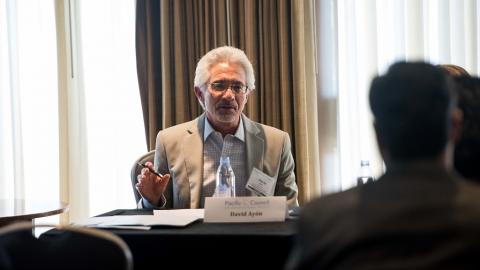
Ayón pointed out that there is a lot of uncertainty about Mexican politics in general, not just the outcome of next year’s election. 

"Even before there was a ‘Trump factor,’ there were already other factors in place," he said. "Mexico underwent political reform in 2014. The members of the legislature elected next year will be able to run for reelection for the first time in modern Mexican history. And not everything is up for election next year, but almost everything is, including over 2,700 offices. Also, this may be a unique mobilization of an electorate in world history, where the machinery of the state will be utilized to mobilize people. There are things that could completely change the way we understand the dynamic of Mexican politics in just a few months."

He also pointed out that the Mexican people are ready for a change as well, as there is a sense that Mexico has experienced three failed presidencies in a row.

Finding common ground in U.S.-Russia relations

Moderated by Ms. Ann M. Simmons, global development writer and editor at the Los Angeles Times, this panel featured Dr. Sharyl Cross, director of St. Edward’s University’s Kozmetsky Center, and Dr. Yuval Weber, visiting assistant professor at the Daniel Morgan Graduate School of National Security. Cross and Weber both serve at the Wilson Center’s Kennan Institute as a global policy scholar and a global fellow, respectively.

In the past few years, Russia’s renewed assertiveness on the international stage has manifested in bellicose political rhetoric, military aggression, and even territorial conquest. Some of Russia’s actions, such as annexing Crimea and entering the war in Syria, have exacerbated tensions with Western countries. 
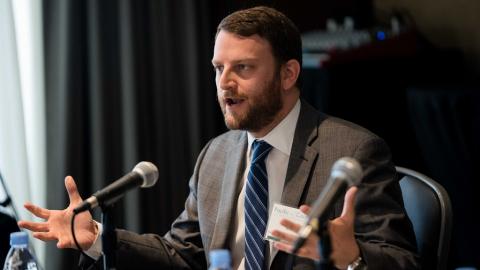
Weber pointed out that Russia, under Vladimir Putin’s leadership, is trying to regain the superpower status it had under the Soviet Union.

"Russia knows that whoever is the U.S. president after Trump will bring the hammer down on them," he said.

Cross argued that a robust management of U.S.-Russia relations is needed in order to avoid deepening distrust and conflict. She encouraged the two countries to focus on areas where they can collaborate and cooperate.

"The United States and Russia must seek to re-establish rules for interaction between the two states."

Sharyl Cross

"Restoring trust is hard," she said. "The United States and Russia must seek to re-establish rules for interaction between the two states."

Ahead of Members Weekend, Cross wrote a three-part series in the Pacific Council’s Newsroom about Russia’s challenge to the liberal world order. Click here to read parts OneTwo, and Three.

Tackling the cybersecurity problem

Moderated by Mr. Karlo Barrios Marcelo, program and development manager of the Mayor’s Fund for Los Angeles, this panel featured Mr. Ernie Liu, director of global security consulting services at FireEye's Mandiant, and Dr. Caolionn O’Connell, physical scientist and associate director of the Arroyo Center’s Forces and Logistics Program at the RAND Corpoation.

In March 2017, the Pentagon warned that China and Russia pose the most significant threat to America’s cybersecurity. Critical American infrastructure, including the nation’s electric grid, will remain vulnerable to catastrophic cyber-attacks from Russia and China for at least the next decade. In response to this ongoing threat, the U.S. Defense Department’s Defense Science Board has concluded that these vulnerabilities must be mitigated by urgently developing new cyber deterrence capabilities, including offensive cyber weapons designed to inflict damage on our adversaries and their leaders.

"It will take global cooperation to tackle the cybersecurity problem."

Ernie Liu

"It will take global cooperation to tackle the cybersecurity problem," said Liu. "It’s an asymmetric playing field. You don’t need a lot to be able to cause great damage. A group like ISIL, that has no fear of repercussion, can basically operate with impunity if they develop their capabilities."

O’Connell said that many people do not realize how easy it is for hackers to access and exploit digital weaknesses.

"There’s a lot of uncertainty," she said. "I would like to think that attacking our energy infrastructure is not high on the list of a potential adversary, but even more interesting to me is when our weapons systems start to get attacked. If those are capable of being taken offline, I don’t know what that means for warfare and how that would fundamentally change how we would approach war. It’s an unnerving future."
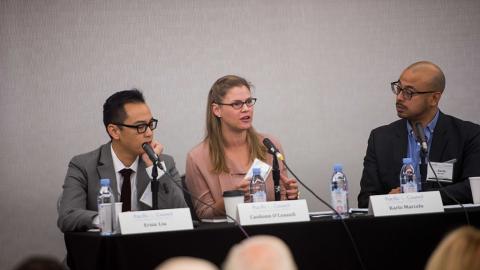
She pointed out that there are different levels of cyber threats, from kitty hackers to the dark web to niche firms to state-sponsored cyber warfare. 

"What’s happening in the real word, we see in the cyber world," said Liu. "From a U.S. perspective, the major players are Russia, China, Iran, and North Korea."

Gutting of the State Department

Moderated by Mr. David Helfenbein, senior vice president of Main & Rose, this panel featured Ms. Elisa Massimino, president and CEO of Human Rights First, and Ms. Karen Richardson, former deputy assistant secretary in the U.S. State Department’s Bureau of Public Affairs.

The Trump administration has proposed steep budget cuts of just over 30 percent to the State Department’s annual budget. Morale is low at the department as career diplomats resign and the administration shrinks the payroll or declines to fill key positions, including ambassadorships.

"My main concern with the proposed cuts is that they would make fostering American leadership on human rights immeasurably more difficult," said Massimino. "The leadership by the United States is not only essential for advancing human rights around the world, but it’s also vital for global stability and therefore vital for our own security here at home. And we can’t lead without a strong State Department."
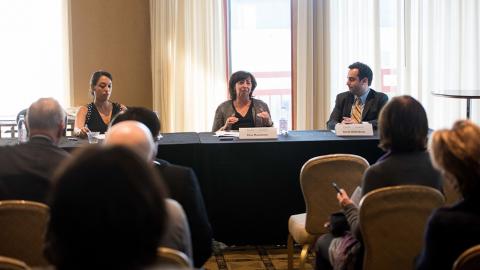
She added that if the United States leaves a vacuum in terms of international leadership—by ceasing humanitarian assistance, brokering peace agreements, maintaining alliances, and contributing to multilateral institutions—another power that does not align with U.S. values will fill it.

"We heard from General Robert Brown, coming straight from the military, saying military force has to be the last resort," she said. "So the first, second, third, and all the things in between, that’s stuff that the State Department does. The military agrees the United States needs a well-funded State Department. If your overriding goal was to undercut American leadership on human rights, for sheer efficiency you couldn’t do much better than gutting the State Department."

Richardson agreed that cutting the budget for global health, development, and international organizations hurts the United States’ national security strategy.

"Educating more Americans about the benefits of diplomacy is one of the best ways to respond to the Trump administration’s State Department cuts."

Karen Richardson

"Rebuilding the diplomatic infrastructure of the State Department will take a while," said Richardson. "Recruitment of new talent is at stake. Educating more Americans about the benefits of diplomacy is one of the best ways to respond to the Trump administration’s State Department cuts."

Ahead of Members Weekend, Massimino wrote an article for the Pacific Council’s Newsroom on diplomacy, development, and Trump’s "America First" budget. Click here to read the article.

Beyond the Paris Climate Accord

Moderated by Mr. Ivan Penn, writer at the Los Angeles Times, this panel featured Ms. Suedeen G. Kelly, partner at Jenner & Block, Mr. Edward Muller, member of Transocean Ltd.’s Health, Safety, and Environment Committee, and Dr. Peter R. Hartley, the George and Cynthia Mitchell chair in sustainable development at Rice University.

Despite President Trump’s announcement of his intention to withdraw the United States from the 2015 Paris Accord in June, the agreement continues to represent historic action on the part of the global community to fight climate change. However, developing clean energy technology will be vital to ensure that the signatory countries are able to meet the ambitious reduction targets they set out for themselves.

Kelly said she does not believe the sky is falling in just because the Trump administration is withdrawing the United States from the Paris Accord.

"Because the Paris Accord is non-binding, whether we’re part of it or not isn’t as important as what were we going to do to implement it, and are we still going to do that?"

Suedeen Kelly

"Because the Paris Accord is non-binding, whether we’re part of it or not isn’t as important as what were we going to do to implement it, and are we still going to do that?" said Kelly. "The Obama administration was looking to implement it in large part with the Clean Power Plan, a regulatory approach to the electric sector to mandate effectively the retirement of coal. The Trump administration is not supportive of that."

Kelly pointed out that U.S. electric and gas markets can solve the challenge of carbon emissions because coal and oil are uneconomic. On its own, Kelly said, coal is losing market share, it’s not able to recover its costs in the market, and it’s retiring rapidly.

Muller argued that the uncertainties of politics around energy impact the economics of the industry.

"In a very capital intensive industry such as energy, when the political process keeps changing the rules, the ability to invest wisely is effected," said Muller. "Renewables, which look like they are part of the future, they require subsidies because fossil fuels are cheaper. California is spending more on climate issues than it spends for the University of California system. The cost, on average, per household in California for addressing climate issues is about $3,000 a year. Is that bad? Not necessarily. It might be a good thing. But is it understood by the public? Not at all. For someone who has been involved in deploying capital, this is worrisome because political subsidies change."
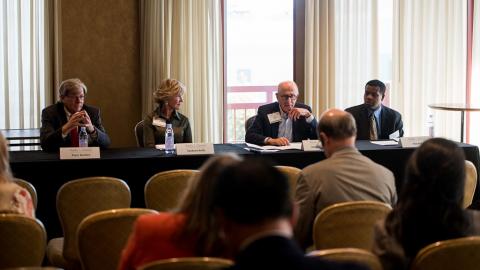
Hartley pointed out that high gas prices in the early 2000s in the United States stimulated much of the investment and development in new technology. Low-priced natural gas, which he said is by far the cleanest burning fossil fuel, has now replaced a lot of coal.

"Making natural gas more available internationally will have a tremendous impact on pollution," he said, adding that the United States is now poised to be one of the main exporters of natural gas.

Seeing through the narratives of nationalist populism

Moderated by former U.S. Ambassador to Hungary Colleen Bell, this panel featured Dr. Mabel Berezin, professor and director of undergraduate studies at Harvard University, and Mr. Ehsan Zaffar, senior advisor at the U.S. Department of Homeland Security (who was speaking in his personal capacity).

Once viewed as a fringe phenomenon during the advent of globalization, populism has rebounded across numerous developed Western nations over the past few years. From the Brexit vote in Britain and the election of Donald Trump in the United States to the rise of far-right and anti-immigrant political parties like Alternative für Deutschland in Germany and elsewhere, populist movements have rattled the political establishment in the West and the liberal world order that has existed since the end of World War II.

Berezin said people have to be careful when they talk about nationalist populism so they don’t fall into narrative traps.
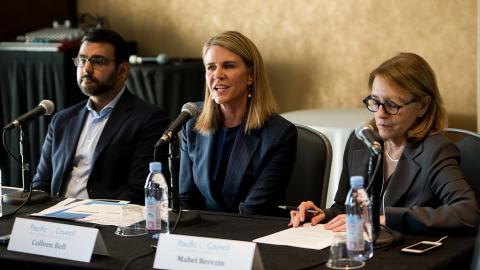
"We have to keep in mind that when we talk about right-wing populism, we’re basically talking about citizens making electoral choices," she said. "Nationalist populism has been very hard to ignore lately. The events of 2016 generate competing narratives among commentators, academics, and policymakers. These included a ‘newness’ narrative and an ‘end of populism’ narrative, but nationalist populism is not new and was certainly not defeated last spring during the French presidential election. These narratives are unhelpful going forward. They create a false sense of resolution when in fact populism’s roots are deeper and are important to understand, especially when trying to come up with solutions."

Zaffar said in conversations he’s had with many supporters of nationalist populism, there was a "deep, abiding sense of cultural dislocation and anxiety. This represents itself in the narrative that immigrants are bad or are taking away jobs. Their primary value is not multiculturalism, but rather economic survival."

The high-profile personalities who typically lead these populist movements are good at figuring out what scares people, Zaffar added, and using language that provides a quick and simple solution.

"What a charismatic, populist leader does, at the very least, is make his followers feel less afraid or alone or disconnected, and that’s why you see people behave irrationally and against their political and economic interests."

Ehsan Zaffar

"What a charismatic leader does, at the very least, is make his followers feel less afraid or alone or disconnected, and that’s why you see people behave irrationally and against their political and economic interests, because it’s more of an emotional motivation rather than a rational or logical motivation," he said.

Ahead of Members Weekend, Zaffar wrote an article for the Pacific Council’s Newsroom calling for a progressive populism. Click here to read the article.

How climate change compounds the refugee crisis

Moderated by Mr. Seth Stodder, former assistant secretary at the U.S. Department of Homeland Security, this panel featured Dr. Alex Julca, economic affairs officer in the UN Department of Economic and Social Affairs’ Development Policy Analysis Division, Dr. Karla Heidelberg, professor of biological sciences and environmental studies in the USC Dornsife College of Letters, Arts, and Sciences, and Dr. Robert J. Lempert, director of the Frederick S. Pardee Center for Longer Range Global Policy and the Future Human Condition at the RAND Corporation.

Migration due to climate change is quickly becoming a reality for coastal communities and island nations as sea levels continue to rise. Despite this reality, the international legal system has been slow to catch up—"climate refugees" (those who cross borders due to environmental factors) are not protected as those who cross borders due to persecution and war.

"Climate change is causing and will continue causing instability in the developing world," said Stodder. "We have international legal policies to account for war and economic migrants, but not for climate refugees."

"In the challenging scenarios, where economic growth is not what we want it to be, there are roughly 100 million people who are going to be in extreme poverty who would not have been without climate change."

Robert Lempert

Lempert said the numbers of potential climate refugees could be staggering.

"In the challenging scenarios, where economic growth is not what we want it to be and climate change is really severe over the next couple decades, there are roughly 100 million people who are going to be in extreme poverty who would not have been without climate change," he said. "But developing nations do have an advantage because they’re building things anew, so they can do it right."

That said, Julca pointed out that the refugee crisis—compounded by climate change—is a problem for both developed and developing countries. He said that when it comes to climate change’s impact on the refugee crisis, it is important to keep in mind the origins and destinations of refugees as well as whether they have high or low skills.

"About 85 percent of migration from Africa is not to Europe or the United States, it is within the African continent," said Julca. "As for the skills of refugees, high income countries need both high and low skilled migrants, not only high skilled."

"Climate does change how people migrate and move around the world. That contributes to political instability."

Karla Heidelberg

Heidelberg stressed the need for experts today to teach and train the next generation about both the science and policy aspects of this issue.

"Climate does change how people migrate and move around the world," said Heidelberg. "We think of those as direct things, like a hurricane or tornado that displaces people, but what we’re not as good at seeing are the slower changes. For example, the slow desertification of areas that in the past were not deserts and now they are, so there’s crop failures, food security issues, and that contributes to political instability."

The panel agreed that the leadership of nations today are not prepared for issues of climate change that will disrupt the world, and that they must start thinking long-term.

____________________

Justin Chapman is the Communications Associate at the Pacific Council on International Policy.

Read more about this year's conference at the Members Weekend 2017 website. Watch videos and read summaries of Representative Karen Bass' keynote address, the plenary on the future of automation, Jerry Green's remarks on the Iran deal, the debate about President Obama's foreign policy, and an interview with General Robert B. Brown. Check out photos from the conference on our Flickr page.

Members Weekend is the West Coast’s premier forum on global affairs, convening business, civic, government, and academic leaders to exchange ideas and collaborate on pressing global issues. Take a closer look at this year's event, and read all Members Weekend analysis now in our Newsroom.

Workers Need New Skills to Avoid Automation’s Impact on Jobs

OCTOBER 30, 2017
By: Justin Chapman, Pacific Council

Automation is both a curse and a blessing, but there are many existing solutions to the inevitable impact on the labor market, Dr. Andrea Belz and Mr. Art Bilger told Pacific Council members during the "Future of Automation: The Next Industrial Revolution" panel discussion at Members Weekend 2017.

Belz is the vice dean of the USC Viterbi School of Engineering. Bilger is the founder and CEO of Working Nation. The discussion was moderated by Dr. Vandana Mangal, the founding executive director of the Easton Technology Management Center.

As the "automation revolution" continues to drive down production costs, streamline supply chains, and simplify operational processes, it simultaneously poses this daunting question: how will the rise of automation and artificial intelligence affect our labor market and the global economy? While some fear the worst when it comes to the potential loss of jobs and the impact that will have on the economy, others see opportunity and new possibilities.

This dynamic is not new; movements like the Luddites in Britain in the early 19th century revolted against increased industrialization and new technologies. But the speed at which change is now happening across major industries such as energy and transportation—including the development of clean energy, electric, self-driving cars, and artificial intelligence—has the potential to radically disrupt and transform society in an unprecedentedly short period of time.

Watch Working Nation’s video on the looming U.S. unemployment crisis, "Slope of the Curve":

Bilger stressed the need for retraining and reeducation programs for those whose jobs will be affected by automation.

"The slope of the curve in terms of changes in jobs over time has never been so steep," Bilger said. "We have to figure out ways to accelerate the process of retraining and reeducating those whose jobs will automate. It’s one thing to change K-12 curriculum, but reeducating those over 48 years old is a challenge. There are so many solutions for automation being worked on, they just don’t have good visibility."

Belz argued that math skills in particular need to be better developed in the coming generations.

"Unlike illiteracy, innumeracy is still acceptable for those entering the workforce," she said. "This will need to change. It is remarkable how difficult it is to fill engineering and technical jobs. If you look at the numbers during the Great Recession, there really wasn’t much of a recession in higher level categories of engineering, physics, etc. There are so many unfilled jobs, certainly here in Los Angeles today at a number of companies of all sizes. Every company today is a technology company. People opening restaurants are making sure they have opportunities for people to order through websites, etc. It’s not a universal problem that automation is wiping out jobs. If anything, it’s going to create entirely new jobs that didn’t exist before."

"We have this contradiction in that everyone walks around with more technology in their pocket than was used to fly to the moon in the 60s. Everyone is comfortable with technology, but they don’t see that as a skillset that they can transfer to their workplace."

Andrea Belz

Bilger agreed, adding that there are millions of unfilled jobs today across the country that generally require some level of technical experience. However, he said a large-scale reeducation process will not be easy.

"If someone didn’t have a really rewarding educational experience to begin with, the idea of now 28 years later going back into a classroom isn’t appealing," he said. "A lot of it has to do with the mentality set out at early ages about the idea of lifelong learning. Even for those of us who are well educated and have a terrific job today, five to 10 years from now it’s going to change dramatically and you’re going to have to be open minded in terms of reeducating and reskilling."

Belz said that the idea that there are so many people who may not be able to make the kinds of employment transitions that will be necessary is troubling.

"On the other hand, I also fundamentally believe in the power of technology as a transformative force," she added, "but it is certainly going to cause significant disruption inside of these different populations. We have this contradiction of a labor shortage and high unemployment. We have this other contradiction in that everyone walks around with more technology in their pocket than was used to fly to the moon in the 60s. Everyone is comfortable with technology, but they don’t see that as a skillset that they can transfer to their workplace. The more we make it clear where there is overlap, the better."

"There are a tremendous number of solutions [to the problems created by automation] that already exist. I’m actually hopeful, given what I’ve seen out there."

Art Bilger

Bilger ended on a positive note, pointing out the many individuals and organizations who are actively working on solutions to the problems that automation is causing and will cause in the labor market and other aspects of society.

"There are a tremendous number of solutions that already exist," he said. "I’m actually hopeful, given what I’ve seen out there."

____________________

Justin Chapman is the Communications Associate at the Pacific Council on International Policy.

Read more about this year's conference at the Members Weekend 2017 website. Watch videos and read summaries of Representative Karen Bass' keynote address, Jerry Green's remarks on the Iran deal, the debate about President Obama's foreign policy, an interview with General Robert B. Brown, and insights from other Members Weekend discussions. Check out photos from the conference on our Flickr page.

Members Weekend is the West Coast’s premier forum on global affairs, convening business, civic, government, and academic leaders to exchange ideas and collaborate on pressing global issues. Take a closer look at this year’s event, and read all Members Weekend analysis now in our Newsroom.

The views and opinions expressed here are those of the speakers and do not necessarily reflect the official policy or position of the Pacific Council.

Representative Karen Bass: Africa is a Land of Opportunity

OCTOBER 25, 2017

By: Justin Chapman, Pacific Council

The U.S. government and U.S. companies need to step up their economic activity on the continent of Africa as a way of strengthening the capacity of Africans to resolve long-standing issues on their own, said Representative Karen Bass (D-CA) during her keynote discussion at Members Weekend 2017.

"There is so much frustration and criticism about China’s involvement in Africa," she said. "We need to stop criticizing China’s involvement in Africa and step up our own. If Africans had a choice between China and the United States, they would choose the United States, but if the United States is not there, what are Africans supposed to do?"

Watch the entire conversation and read key highlights below:

"In Congress, Africa is actually a bipartisan issue," said Bass. "I work really well with my Republican colleagues on Africa. Even so, my colleagues don’t know much about Africa. Our perception of Africa is that it’s a continent of conflict, chaos, constant crisis, corruption, incompetence, and one that always needs our charity. One of the reasons I’m in Congress is to work to change our perception of the continent."

When it comes to Africa, Bass pointed out that the United States is behind the rest of the world.

"The rest of the world knows that Africa is a land of opportunity," she said. "The rest of the world knows how big Africa is; many Americans don’t realize that. You can fit the United States inside Africa three times. There are 54 countries in Africa. We tend to focus on the ones that are problematic, but we don’t realize that the majority of the continent is actually peaceful. The continent is poor. There are structural problems that need to be resolved. Much of the continent suffers from the vestiges of colonialism. But China, Russia, India, and Brazil are all very clear about the opportunities that the continent provides."

"The model is building the infrastructure and capacity of Africans so they can do things for themselves."

Karen Bass

On the security issues facing Africa, Bass said that the United States needs to start looking at them a little differently.

"Some of the issues are ideological, such as Boko Haram, a group that wants to take us back to the 10th century," she said. "But a lot of the young people that get involved in groups like Boko Haram are doing so for non-ideological reasons. You have to address the root causes of why there are these security issues in the first place. Africa is an overwhelmingly young continent. If we don’t figure out how to address the root causes and the economic situation, then it does lay the groundwork for terrorist organizations to do recruitment."

On the issue of U.S. foreign aid, Bass said that the United States should continue to provide funding, but in a different way.

"The model is building the infrastructure and capacity of Africans so they can do things for themselves," she said. "One of the ways our resources should be used is to help organizations like the African Union and the regional economic communities strengthen their own capacity."

Bass was interviewed by Mr. Grant Harris, CEO of Harris Africa Partners LLC and a former special assistant to the president and senior director for African affairs at the White House. Read his recent report, Why Africa Matters to U.S. National Security.

____________________

Justin Chapman is the Communications Associate at the Pacific Council on International Policy.

Read more about this year's conference at the Members Weekend 2017 website. Watch videos and read summaries of the plenary on the future of automation, Jerry Green's remarks on the Iran deal, the debate about President Obama's foreign policy, an interview with General Robert B. Brown, and insights from other Members Weekend discussions. Check out photos from the conference on our Flickr page.

Members Weekend is the West Coast’s premier forum on global affairs, convening business, civic, government, and academic leaders to exchange ideas and collaborate on pressing global issues. Take a closer look at this year’s event, and read all Members Weekend analysis now in our Newsroom.

The views and opinions expressed here are those of the speakers and do not necessarily reflect the official policy or position of the Pacific Council.