
Bombay Beach Biennale | Apocalyptic Art [or] Something Out of Nothing
The renegade art festival known as the Bombay Beach Biennale continues to expand while revitalizing the desert town and calling attention to the ecological crisis that is the Salton Sea.
By Justin Chapman, Culture Honey Magazine, 5/9/2023 (Photos by Mercedes Blackehart)
Some call it the anti-Burning Man. Whereas Black Rock City packs up after it’s all over, the Bombay Beach Biennale is all about creating permanent art and transforming what was once considered an apocalyptic wasteland.
The Bombay Beach Biennale is a unique, renegade art festival held annually in a dilapidated, unincorporated, former resort town in the desert east of Los Angeles. The Biennale, which is revitalizing the area and calling attention to the ecological disaster that is the Salton Sea, was co-founded in 2015 by Tao Ruspoli, an Italian prince and filmmaker, Stefan Ashkenazy, owner of the Petit Ermitage Hotel, and Lily Johnson-White, a public art producer of the Johnson & Johnson family. This year, the Biennale took place March 31 to April 2.
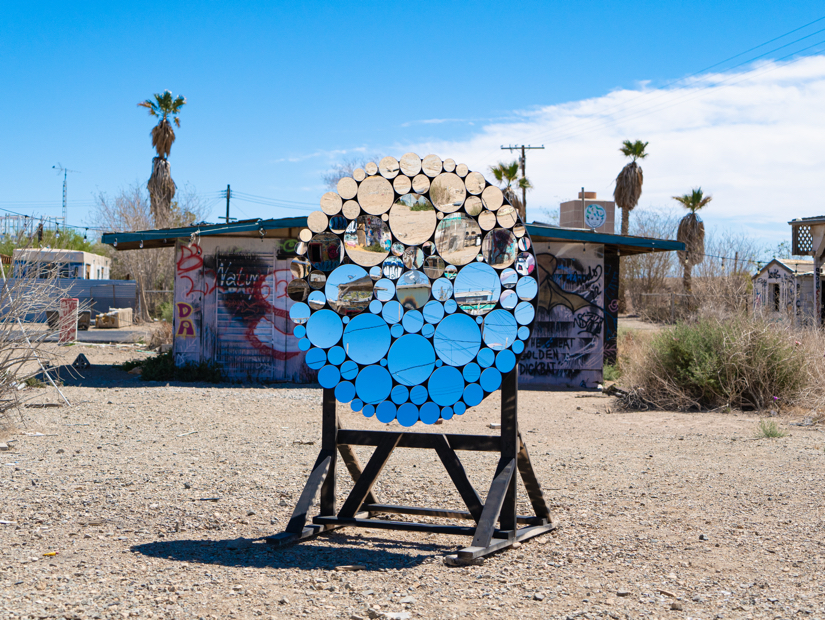
Bombay Beach Biennale | Apocalyptic Art [or] Something Out of Nothing, Photo by Mercedes Blackehart
Under the cruel sun in the California badlands in the state’s poorest county—Imperial—and just an hour’s drive north from the Mexican border, the Salton Sea is a desolate, otherworldly rift lake that formed in 1905 when the Colorado River overflowed. Before the Biennale, Bombay Beach was a relic of a bygone era when celebrities vacayed there in the 1950s and 60s, including Frank Sinatra, Bing Crosby, Sonny Bono, Desi Arnaz, and the Beach Boys.
In 1980, the sea took a turn for the worse.
Agricultural runoff from the surrounding industrial farms and increasing salinity have polluted the water, making life untenable. The resulting smell is a delectable aroma of sulfur and dead fish and birds.
Bombay Beach is a perfect, one-square-mile grid, comprised of avenues A to I and streets 1st to 5th. At 223 feet below sea level, it is the lowest community in the United States—literally and perhaps figuratively. Although it may seem like it at first glance, Bombay Beach is not a ghost town. It’s home to some 200 residents, although there still are many empty houses and trailers.
Surreal estate
Because of the Biennale artists, Bombay Beach now features among the ruins the eponymously named Opera House, Country Club, International Space Station, Drive-In Movie Theater with a junkyard of rusting cars—all tongue-in-cheek takes on urban staples you wouldn’t expect to see in the middle of the desert. There’s also an Archaeological Dig and a fake Sotheby’s office with outrageously priced real estate listings for rundown Bombay Beach properties.
“The Biennale has become an accidentally life-defining commitment by an accidentally formed body of water, in a town filled with fascinating contradictions, and a place where the less sense something makes, the more sense it makes,” Ruspoli, 47, wrote on Instagram.
Kim Stringfellow’s book Greetings from the Salton Sea, with its rotting Airstream on the cover, first brought the area to Ruspoli’s attention in 2007.
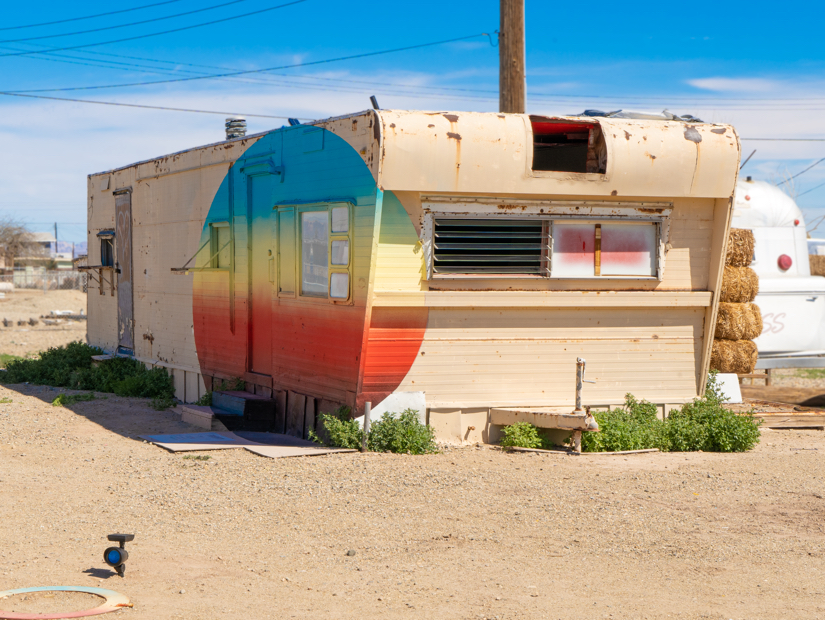
Bombay Beach Biennale | Apocalyptic Art [or] Something Out of Nothing, Photo by Mercedes Blackehart
“I’ve always loved Americana and the desert and marginalized things happening on the margins of society,” he said. “I was shocked that I’d never heard of the Salton Sea even though I grew up in LA and it’s the largest body of water in California. No one else I talked to knew it existed. It’s insane. I was like, ‘I’ve got to see this.’ I drove the perimeter of the lake. The whole thing is so weird. The moment you get to North Shore and see the International Banana Museum, you realize you’re in a different type of place than the rest of the United States, which is so homogenized. I was immediately enthralled.”
Ruspoli is the son of Italian Prince Alessandro “Dado” Ruspoli. Since 1776, his family has owned the Palazzo Ruspoli in Rome, a 16th century Renaissance-style aristocratic palace. Tao Ruspoli was born in Bangkok, raised in Rome and LA, studied philosophy at UC Berkeley, and was once married to actress and director Olivia Wilde. Buying a house in Bombay Beach had been a dream of his for years, but Wilde hadn’t been on board.
“When I proposed it to my wife, she was like, ‘Are you crazy? Why would you do that?’ I was like, ‘You can buy a house for less than your Jetta.’ Then we got divorced in 2011 and the first thing I did was buy a house in Bombay Beach [for $20,000],” he said. “Literally the ink wasn’t dry on the divorce papers. I call it a venture in Dadaist real estate investing, or surreal estate.”
Known as the Bombay Beach Institute of Particle Physics, Metaphysics & International Relations, his compound has become the central hub of the Biennale.
There are several galleries and works of art scattered across the property, including a community garden with occasional bunnies, ducks, peacocks, and chickens and a one-room building called No Shoes, where a screening and panel discussion of Ruspoli’s 2008 documentary “Being in the World” was held at this year’s Biennale. With everyone taking off their shoes as they enter, the room brings everyone down to the same, human level and opens a space for deep, philosophical discussions.
Back in the early 2010s, however, when he invited friends to visit Bombay Beach, everyone was scared to stay overnight. It was still rundown, with nothing permanent to represent all the creativity the place inspired.
A ‘unique’ and ‘blank’ canvas
Ruspoli, Ashkenazy and Johnson-White launched their art festival in 2016 and named it after the Venice Biennale cultural exhibition in Italy, “the most important, most high-falutin art festival in the world,” Ruspoli said, adding that “Bombay Beach Biennale has a wonderful alliteration to it. It started out as kind of a joke. We didn’t know if it was going to work or if anyone would show up. Much to our surprise and delight, a lot of people came. The desert is attractive to artists because it’s a blank canvas and there’s space and light in which to create, but at the same time you have something significant there that can respond.”
![Bombay Beach Biennale | Apocalyptic Art [or] Something Out of Nothing, Photo by Mercedes Blackehart](https://www.culturehoney.com/wp-content/uploads/2023/05/ss3.jpg)
Tao Ruspoli Co-Founder of the Bombay Beach Biennale, Photo by Mercedes Blackehart
For their first event, they hosted a philosophy conference with the theme of “Decay” because of Bombay Beach’s strong sense of abandonment. Serious philosophers such as Mark Wrathall of Oxford, Geoff Dyer of USC, Robert Pippin of the University of Chicago, and others riffed on temporality, ruptured time, why decay is so compelling, and why people visit ruins.
“One of the philosophers said ruins represent a future that didn’t happen, otherwise they wouldn’t be ruins,” Ruspoli said. “There was a direction time was going, then it diverted from that expectation. So the next year [2017] we did the theme ‘The Way the Future Used to Be,’ which was a meditation on the Salton Sea. If you watch those old videos from the ‘50s, there was all this hope.”
In 2018, the theme was “God’s Silence” and 2019’s was “Postmodernism Week.”
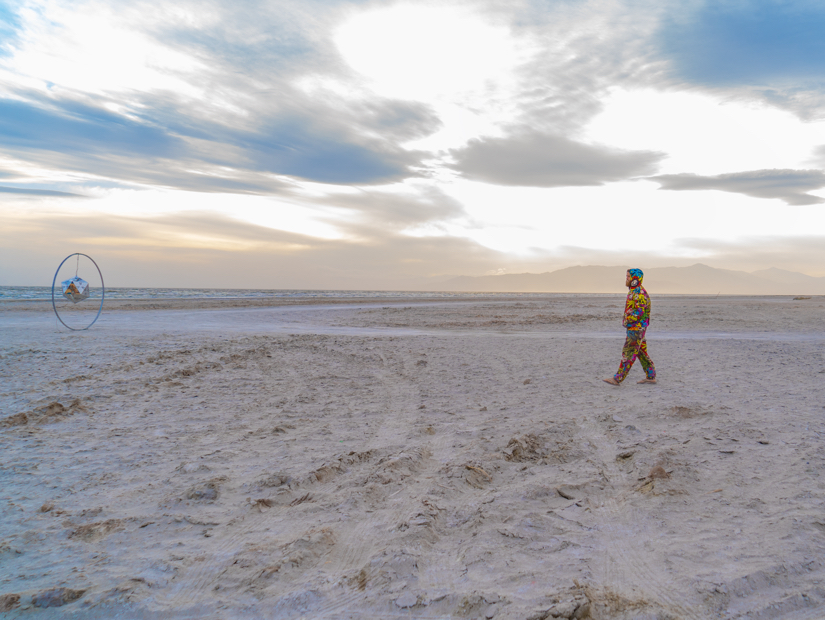
Bombay Beach Biennale | Apocalyptic Art [or] Something Out of Nothing, Photo by Mercedes Blackehart
“Modernism Week in Palm Springs is this very earnest celebration of American design and furniture and the white picket fence modernist ideal that Palm Springs and the desert represented, and then you go to Bombay Beach and you get the exact opposite of that, or the dark side of that,” Ruspoli said. “Postmodernism is the idea that the foundations of truth and of Western civilization aren’t actually there; everything’s foundationless, a construct. Bombay Beach is a physical manifestation of the decay of the ideals of Western civilization. As artists and philosophers, that’s really compelling material to work with.”
The Biennale and a planned inaugural Bombay Beach Lit Fest were both canceled in 2020 due to COVID-19. In 2021, the theme of a scaled down Biennale was “More Minimalism.” That year, rather than a single weekend, artists lived in the community full time over the winter season.
In 2022, the Biennale became “a renegade, DIY, grassroots, bottom-up version of what had previously been something more structured, top-down, and hierarchical,” reads the Biennale’s Fundraising by Fractured Atlas webpage. That year’s apt theme was “Questioning Hierarchy.”
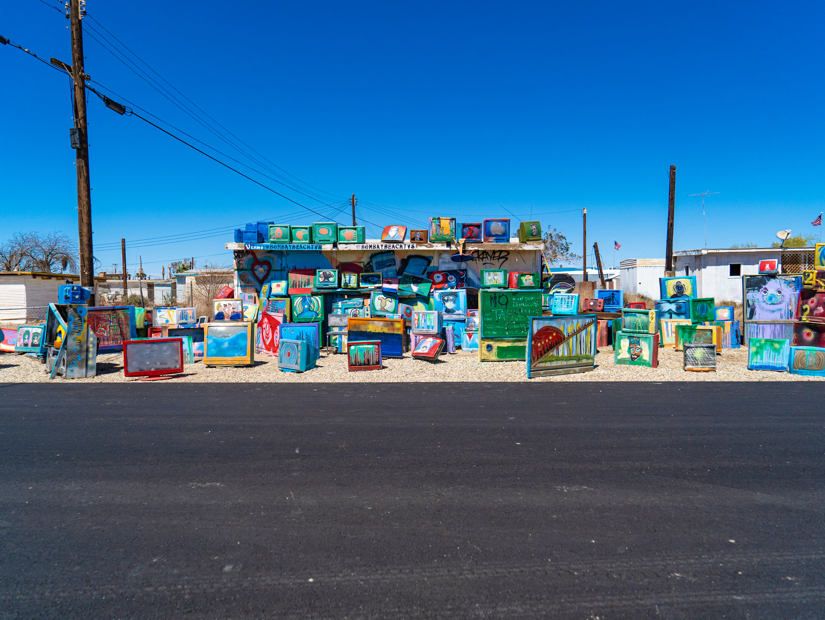
Bombay Beach Biennale | Apocalyptic Art [or] Something Out of Nothing, Photo by Mercedes Blackehart
This year’s Biennale featured the theme of “Chaos Theory.” Also this year, the Lit Fest was back and took place on the same weekend as the Biennale. That meant the weekend was packed with events—readings, panels, performances, screenings, workshops, galleries, exhibits, music, and talks on art, philosophy, poetry, and more—so anyone couldn’t attend them all.
In recent years, the Biennale has expanded to encompass an entire season from January 1 to early April, concluding with the final weekend event, the dates of which are not made public but spread by word of mouth. In earlier years, it was invite-only. One year, the website said it would be in April, when really it was held in March. Now, the Biennale has grown as more people have discovered it. Still, it remains entirely free, unlike Burning Man.
“The Biennale transforms the abandoned housing, vacant lots, and decaying shoreline of the Salton Sea into a unique canvas for creative expression, social practice, and critical thought,” reads the Fundraising webpage.
‘The wild west’
But just because the town has been revitalized doesn’t mean there’s no more tragedy. Bombay Beach has a high mortality rate for such a small community. On July 26, 2021, a beloved Biennale artist named Steven “Shig” Shigley shot himself near a pair of metal gates called the Portal on Ruspoli’s Institute compound. Shig did much of the metal work in Bombay Beach, such as the Tesseract, a 10×10 foot 4-dimensional steel cube.
This year’s Biennale featured a memorial procession to honor Shig and others the town recently lost. As the sun set on Saturday, dozens of people held candles, a few held large portraits of the departed, and everyone marched behind a bagpipe player across the raised berm that surrounds the town and out to the beach littered with fish bones where Ruspoli and others built two large metal pyramids as a memorial to Shig. There, a woman read poetry behind a veil as two horses ran in circles around Shig’s pyramids, which emitted red smoke.
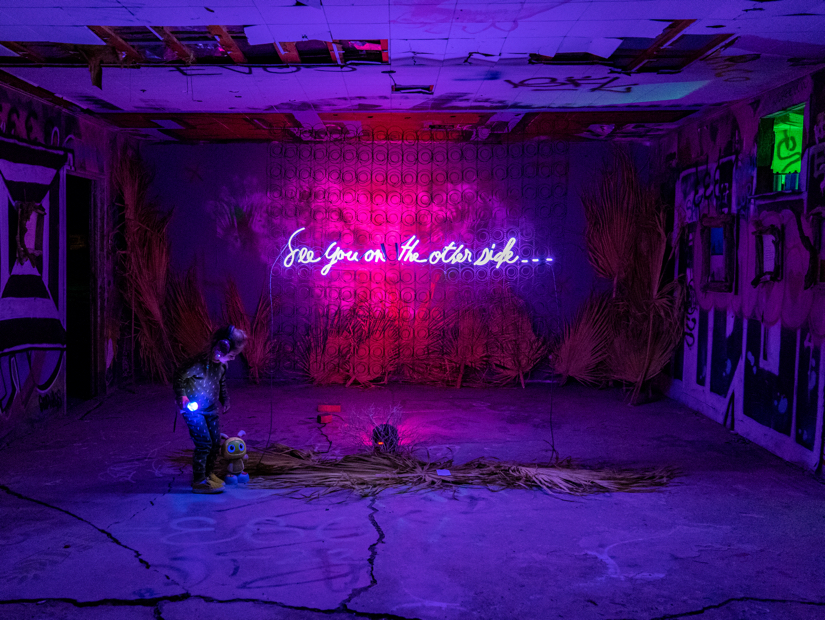
Before the night’s dance parties got underway in various locations around town, including at the new Sub Club, a subterranean dance floor dug out of the beach with walls plastered with AI-generated, Soviet-style propaganda posters promoting the Biennale, the capstone opera and ballet performance took place at the Bombay Beach Opera House—some might say the Biennale’s headlining event.
Bombay Beach Biennale | Apocalyptic Art [or] Something Out of Nothing, Photo by Mercedes Blackehart
Before he died, Shig told me that the appeal of Bombay Beach is the peace and quiet (when the Biennale’s not in town), as well as the freedom to do what he wants as an artist.
“I moved to the desert to escape the city,” he said.
He added that the Biennale has become more than just a fun weekend; it’s a year-round community.
“The weather gets brutal [in the summer]; only the hardcore can do it year-round here,” he said. “After the excitement of the Biennale, you see what it’s really like and what it takes to be here. It’s kind of the wild west down here, seriously. Leading up to the Biennale, the energy here is very exciting. It’s crazy.”
He pointed out that while the locals who lived in Bombay Beach before the Biennale began were wary of these artists descending on their quiet town at first, most of them have come around to see the benefits of the festival and the increase of tourism dollars it brings every year to the handful of businesses in town, such as the Ski Inn and American Legion.
Another resident, Sonia Herbert, who owns the Ski Inn, told Imperial Valley Alive! Magazine that the artists have “invested in the community, put Bombay on the map. This movement, these artists, are the best thing to happen to our town.”
And it is indeed a movement. Shig said the Biennale won’t be slowing down any time soon, but will only grow.
“The lid has been blown off it,” he said in 2019. “There were 150 installations this year, more than last year. I’m still coming across things I haven’t seen.”
Discouraging ‘normal’
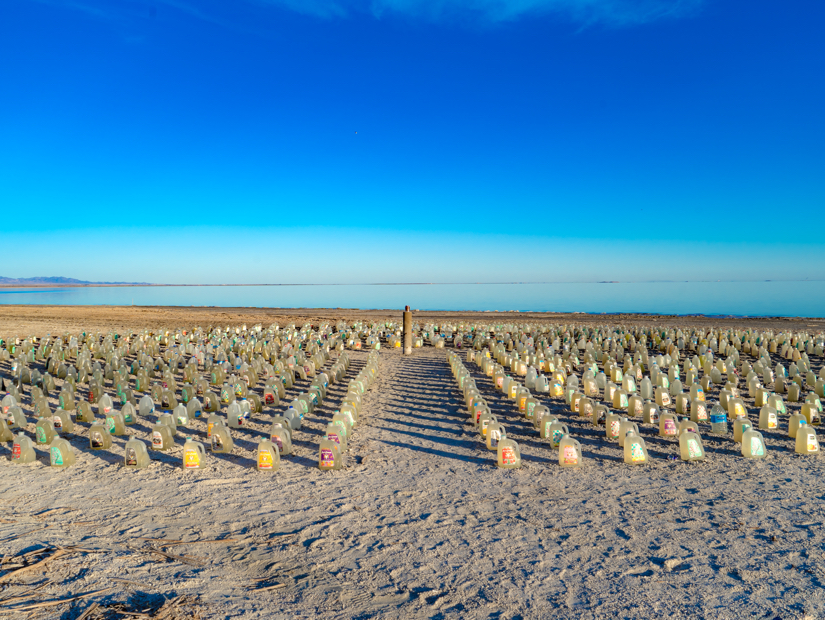
As the Biennale expands, organizers continue to try to raise awareness of the environmental challenges facing the Salton Sea area. One of the major art installations this year was “One Pound of Almonds” by Frauke Huber and Uwe Martin, featuring 1,230 gallons of water in plastic jugs on the beach circling a one-pound jar of almonds on a pillar and highlighting just how much water it takes to grow that small amount.
Bombay Beach Biennale | Apocalyptic Art [or] Something Out of Nothing, Photo by Mercedes Blackehart
“Obviously, we can’t fix [the Salton Sea] as artists; we would need major government support,” Ruspoli said. “All we can do is say, ‘Hey, here it is.’ There are solutions, it’s just they all cost a lot of money.”
As for the future of the Biennale, the Fundraising webpage states that the team aspires to “operate year-round to deepen our engagement with the local community. Future goals include launching an official artist residency program, creating community land trusts to fight the impending forces of gentrification, bringing more BIPOC and queer voices into the space, and working on a strategy of care and inclusion to diversify the demographics of the Biennale.”
Whatever the Biennale becomes, Ruspoli hopes it always remains free and attracts people who think outside the box.
“The worst thing that could happen is for Bombay Beach to become middle class or suburban in any way,” he said. “My dad was friends with Salvador Dali, and he used to always say, ‘I only want to hang out with aristocrats, anarchists, and hippies, because all of those represent an attack on the bourgeois, which is the middle class, which has as its purpose to be against imagination, because it’s all about creating a life that doesn’t have any surprises in it.’ We want to embrace that ethos in Bombay Beach and discourage anything ‘normal.’ Artists should always be jarring people’s expectations.”
Bombay Beach Biennale | Apocalyptic Art [or] Something Out of Nothing
While there are some temporary art installations, Ruspoli said they will also strive to make the art permanent so future generations can enjoy it.
“There are a few exceptions,” he said, “but we really discourage impermanence, even though everything is impermanent in the end.”
LONGER VERSION
By Justin Chapman
Some call it the anti-Burning Man. It’s certainly Burning Man-esque, but don’t call it that. It’s its own thing. Whereas Burning Man packs up after it’s all over, the Bombay Beach Biennale is all about creating permanent art and transforming what was once considered an apocalyptic wasteland.
The Bombay Beach Biennale is a unique, renegade art festival held annually in a dilapidated, unincorporated, former resort town in the desert east of Los Angeles. The Biennale, which is revitalizing the area and calling attention to the ecological disaster that is the Salton Sea, was co-founded in 2015 by Tao Ruspoli, an Italian prince and filmmaker, Stefan Ashkenazy, owner of the Petit Ermitage Hotel, and Lily Johnson-White, a public art producer of the Johnson & Johnson family. This year, the Biennale took place March 31 to April 2.
Under the cruel sun in the California badlands in the state’s poorest county—Imperial—and just an hour’s drive north from the Mexican border, the Salton Sea is a desolate, otherworldly rift lake that formed in 1905 after massive flooding in the Colorado River broke through an irrigation canal headwork and flowed into the Salton Basin.
The lake is shallow, saline, and endorheic (does not flow to the ocean). Agricultural runoff from the surrounding industrial farms have polluted the water. That combined with the intolerable increase of its salinity has made life untenable here. The smell is certainly overwhelming: a delectable aroma of sulfur and dead fish and birds.
Before the Biennale, Bombay Beach was a relic of a bygone era when Hollywood celebrities vacayed there in the 1950s and 60s, including Frank Sinatra, Bing Crosby, Sonny Bono, Desi Arnaz, the Beach Boys, and the like. In 1980, the sea took a turn for the worse. Bombay Beach is a perfect, one-square mile grid, comprised of avenues A to I and streets 1st to 5th. At 223 feet below sea level, it is the lowest community in the United States—literally and perhaps figuratively. Although it may seem like it at first glance, Bombay Beach is not a ghost town. It’s home to some 200 residents, although there still are many empty houses and trailers.
Robert Truax, who designed the rocket cycle that failed to propel Evel Knievel across Snake River Canyon in 1974, wrote in his autobiography American Rocketman that when he was in the Navy he tested rockets and flew planes over the Salton Sea and dropped test bombs into the water. According to the Desert Sun, in 1944-45, Army Air Force pilots flew over the Salton Sea to practice dropping the atomic bombs on Japan by “dispatching dummy bombs filled with concrete and practicing the maneuvers that enabled them to escape the blast. Among the targets used for practice were four 60-by-60-foot wooden structures, built on pilings and rigged out in the sea.” The desert nearby is also a military bombing range, in front of the Chocolate Mountains. Hence the name Bombay.
The Biennale is in good company. There are a number of interesting things happening out in the desert on the edge of civilization, particularly near the Salton Sea. For example, nearby are Slab City, a nomadic art community, and Slowjamastan, one of the world’s newest micronations.
Surreal estate
Because of the Biennale artists, Bombay Beach now features the eponymously named Opera House, Country Club, International Space Station, Archaeological Dig, Drive-In Movie Theater with a junkyard of rusting cars—all tongue-in-cheek takes on urban staples you wouldn’t expect to see in the middle of the desert. There’s also a fake Sotheby’s office with outrageously priced real estate listings for rundown Bombay Beach properties. Galleries include Foundation Foundation by Greg Haberny, Angler Grove by Randy Polumbo, Temple to the Scientific Method, and many others.
“The Bombay Beach Biennale has become an accidentally life-defining commitment by an accidentally formed body of water, in a town filled with fascinating contradictions, and a place where the less sense something makes, the more sense it makes,” Ruspoli, 47, wrote on Instagram.
Ruspoli is the son of an Italian prince, Prince Alessandro “Dado” Ruspoli. Since 1776, his family has owned the Palazzo Ruspoli in Rome, a 16th century Renaissance-style aristocratic palace. Tao Ruspoli was born in Bangkok, raised in Rome and LA, graduated from UC Berkeley in 1998 with a philosophy degree, and was once married to actress and director Olivia Wilde (before Jason Sudeikis). In 2007, Wilde told People Magazine they got married inside a school bus when she was 18.
“Young love—you never really do understand it,” she said. “I was very lucky I met this person. We eloped, then had weddings at my parents’ Virginia farmhouse and the garden of his family’s castle outside Rome. There were stilt walkers, drummers, flag bearers; it was surreal and beautiful and amazing, like a fairy tale. Everyone expected it to fail, but it’s been five years.”
It lasted eight. At 27, Wilde filed for divorce on March 3, 2011, citing irreconcilable differences, and it was finalized on September 29.
“The trauma of the whole thing has been humbling,” Wilde told Marie Claire in July of that year. “And for the first time, I’m a little bit wobbly.”
Right after the divorce, Ruspoli bought his first property in Bombay Beach for $20,000. It had been a dream of his for years, but Wilde hadn’t been on board.
“When I proposed it to my wife, she was like, ‘Are you crazy? Why would you do that?’ I was like, ‘You can buy a house for less than your Jetta.’ Then I got divorced in 2011 and the first thing I did was buy a house in Bombay Beach. Literally the ink wasn’t dry on the divorce papers,” he said. “I call it a venture in dadaist real estate investing, or surreal estate.”
Known as the Bombay Beach Institute of Particle Physics, Metaphysics & International Relations, his compound has become the central hub of the Biennale. There are several galleries and works of art scattered across the property, including a community garden with occasional bunnies, ducks, peacocks, and chickens and a one-room building called No Shoes, where a screening and panel discussion of Ruspoli’s 2008 documentary “Being in the World” was held at this year’s Biennale. With everyone taking off their shoes as they enter, the room brings everyone down to the same, human level and opens a space for deep, philosophical discussions.
‘The perfect squareness of it’
Kim Stringfellow’s 2005 book Greetings from the Salton Sea: Folly and Intervention in the Southern California Landscape, 1905-2005, with its rotting Airstream on the cover, first brought the area to Ruspoli’s attention in 2007.
“I’ve always loved Americana and the desert and marginalized things happening on the margins of society,” he said. “I was really shocked that I’d never heard of the Salton Sea even though I grew up in LA and it’s the largest body of water in California. No one else I talked to knew it existed. It’s insane. I was like, ‘I’ve got to see this.’ I drove around the perimeter of the lake. The whole thing is so weird. The moment you get to North Shore and you see the International Banana Museum, you realize you’re in a different type of place than the rest of the United States, which is so homogenized and all the differences have just been leveled. I was immediately enthralled.
“You’re driving and you think there’s nothing, and then you see the sign ‘Bombay Beach.’ It’s like, ‘What the fuck? Why is this called Bombay Beach, first of all?’ And then you pull into town and it’s this perfect grid as if you’re in Manhattan, even though you’re in the middle of the desert. I’ve never seen any other desert community laid out in a perfect square. The artist in me—and I love math and geometry, too—I just loved the perfect squareness of it.”
He started inviting friends to visit, but everyone was scared to stay overnight. There weren’t very many places to stay anyway.
“There’d be people shooting music videos, there’d be hipsters shooting fashion shoots and everything, but there was nothing in the town to show all the creativity that the place inspired,” he said. “Nothing permanent.”
Ruspoli, Ashkenazy, and Johnson-White launched the Biennale art festival and named it after the Venice Biennale cultural exhibition in Italy, “the most important, most high falutin’ art festival in the world,” Ruspoli said, adding that “Bombay Beach Biennale has a wonderful alliteration to it. It started out as kind of a joke. We didn’t know if it was going to work or if anything would happen or if anyone would show up. Much to our surprise and delight, a lot of people came. The desert is attractive to artists because it’s a bit of a blank canvas and there’s space and light in which to create, but at the same time you have something significant there that can respond.”
A ‘unique’ and ‘blank’ canvas
In the desert in general and Bombay Beach, specifically, there was a strong sense of abandonment. For their first event in 2016, they hosted a philosophy conference with the theme of “Decay.” Serious philosophers such as Mark Wrathall of Oxford, Geoff Dyers of USC, Robert Pitka of the University of Chicago, and others riffed on temporality, ruptured time, why decay is so compelling, and why people visit ruins.
“The most interesting thought that one of the philosophers brought up was, ruins represent a future that didn’t happen, because otherwise they wouldn’t be ruins,” Ruspoli said. “There was a direction that time was going, and then it diverted from that expectation. So we’re attracted to that because we get to see a future that wasn’t. So the next year [2017] we did the theme ‘The Way the Future Used to Be,’ which became an interesting meditation on the Salton Sea. If you watch those old videos from the ‘50s, there was all this hope.”
In 2018, the theme was “God’s Silence” and 2019 was “Postmodernism Week.”
“Modernism Week in Palm Springs is this very earnest celebration of American design and furniture and the white picket fence modernist ideal that Palm Springs and the desert represented, and then you go to Bombay Beach and you get the exact opposite of that, or you get the dark side of that,” Ruspoli said. “Postmodernism is the idea that the foundations of truth and of Western civilization aren’t actually there; everything’s foundationless, a construct.
“In Bombay Beach, you get this physical manifestation of the decay of the ideals of Western civilization. The arrogance of people coming to the desert, thinking, ‘We can have a sea in the desert and put fish and go boating,’ and it was so much hubris. And then you see what happens. There’s a wonderful side of American exceptionalism and hope and optimism and the idea that anything’s possible. But sometimes, if it goes too far, you get what happens in Bombay Beach. As artists and philosophers, that’s really compelling material to work with.”
There was no Biennale in 2020 due to COVID-19. A planned inaugural Bombay Beach Lit Fest was also canceled along with every other event in the world in March 2020 as the pandemic swallowed society whole.
In 2021, the theme of a scaled down Biennale was “More Minimalism.” That year, rather than a single weekend, artists lived in the community full time over the winter season.
In 2022, the Biennale became “a renegade, DIY, grassroots, bottom-up version of what had previously been something more structured, top-down, and hierarchical,” reads the Biennale’s Fundraising by Fractured Atlas webpage. That year’s apt theme was “Questioning Hierarchy.”
This year’s Biennale featured the theme of “Chaos Theory.” Also this year, the Lit Fest was back and took place on the same weekend as the Biennale. That meant the weekend was packed with events—readings, panels, performances, screenings, workshops, galleries, exhibits, music, and talks on art, philosophy, poetry, and more—so many one couldn’t attend them all.
In recent years, the Biennale has expanded to encompass an entire season from January 1 to early April, concluding with the final weekend event, the dates of which are not made public but spread by word of mouth. In earlier years, it was invite-only. One year, the website said it would be in April, when really it was held in March. Now, the Biennale has grown as more people have discovered it. Still, it remains entirely free, unlike Burning Man.
“While in season, the Bombay Beach Biennale transforms the abandoned housing, vacant lots, and decaying shoreline of the Salton Sea into a unique canvas for creative expression, social practice, and critical thought,” reads the Fundraising webpage.
‘The wild west’
But just because the town has been revitalized doesn’t mean there’s no more tragedy. Ruspoli pointed out that Bombay Beach has a high mortality rate for such a small community. On July 26, 2021, a beloved Biennale artist since 2018 named Steven “Shig” Shigley shot himself near a pair of metal gates called the Portal on Ruspoli’s Institute compound. Shig did much of the metal work in Bombay Beach, such as the Tesseract, a 10x10 foot 4-dimensional steel cube.
This year’s Biennale featured a special memorial procession to honor those the town had lost over the past year or two, including Shig. As the sun began to set on Saturday, dozens of people held candles and a few held large portraits of the fallen and everyone followed a bagpipe player and marched across the raised berm that surrounds the town and out to the beach littered with fish bones where Ruspoli and others built two metal pyramids as a memorial to Shig.
There, a woman read poetry behind a veil as two horses ran in circles around Shig’s pyramids—both almost trampling over the gathered crowd as red smoke erupted from the pyramidions, spooking the horses. Before the night’s dance parties got underway in various locations around town, including at the new Sub Club, a subterranean dance floor recently dug out from the beach floor with walls plastered with AI-generated, Soviet-style propaganda posters promoting the Biennale, the capstone opera and ballet performance took place at the Bombay Beach Opera House—some might say the Biennale’s headlining event.
Before he died, Shig told me that the appeal of Bombay Beach is the peace and quiet (when the Biennale’s not in town), as well as the freedom to do what he wants as an artist.
“I moved to the desert to escape the city,” he said.
He added that Biennale has become more than just a fun weekend, but more of a year round community.
“The weather gets brutal [in the summer]; only the hardcore can do it year round here,” he said. “After the excitement of the Biennale, you see what it’s really like and what it takes to be here. It’s kind of the wild west down here, seriously. Leading up to the Biennale, the energy here is very exciting. It’s crazy.”
He pointed out that while the Bombay Beach locals who lived there before the Biennale began were wary of these artists and hipsters descending on their quiet, rundown town at first, most of them have come around to see the benefits of the festival and the increase of tourism dollars it brings every year to the handful of businesses in town, such as the Ski Inn and American Legion.
Ruspoli acknowledged that some residents weren’t happy in the beginning, but said they were a tiny—albeit loud—minority. Out of 15 locals journalist Rory Carroll of The Guardian interviewed a few years ago, only one was opposed to the influx of artists because “they paint the houses these ridiculous colors.” So Ruspoli dedicated the Zig Zag House to him, painting it with 26 different colors.
“I was inspired by his comment in The Guardian,” Ruspoli said.
Another resident, Sonia Herbert, who owns the Ski Inn, told Imperial Valley Alive! Magazine that the artists have “invested in the community, put Bombay on the map. This movement, these artists, are the best thing to happen to our town.”
And it is indeed a movement. Shig said the Biennale won’t be slowing down any time soon, but will only grow bigger.
“The lid has been blown off it,” he said in 2019. “There were 150 installations this year, more than last year. I’m still coming across things I haven’t seen.”
Discouraging ‘normal’
Ruspoli, who used to live in Venice, California, and now lives in Yucca Valley when not living in Bombay Beach itself, said it takes hundreds of people to pull off the Biennale, working together in a non-hierarchical, unstructured team. There are no sponsors, but it still costs money to put on, including to make the art. This year, the Biennale and Lit Fest core organizing teams included Dulcinée DeGuere, Jamie Dunphy, Meredith Winner, Regina Fields, Gina Frangello, Robert Roberge, Leanne Phillips, and many others.
The team continues to try to raise awareness of the environmental challenges facing the Salton Sea area. One of the major art installations this year was “One Pound of Almonds” by Frauke Huber and Uwe Martin, featuring 1,230 gallons of water in plastic jugs on the beach circling a one-pound jar of almonds on a pillar and highlighting just how much water it takes to grow that small amount.
“There are a million things that can and should be done,” Ruspoli said. “The best plan is bringing in salt water from the Sea of Cortez. Obama put $100 million in the stimulus for the Salton Sea, but the thing is you don’t need $100 million, you need $5 billion. I gave a tour the other day to Congresswoman Jackie Speier and one of the Burning Man board members. We are bringing attention. Obviously, we can’t fix it as artists; we would need major government support. All we can do is say, ‘Hey, here it is.’ There are solutions, it’s just they all cost a lot of money.”
As for the future of the Biennale, the Fundraising webpage stated that the team aspires to “operate year-round to deepen our engagement with the local community. Future goals include launching an official artist residency program, creating community land trusts to fight the impending forces of gentrification, bringing more BIPOC and queer voices into the space, and working on a strategy of care and inclusion to diversify the demographics of the Biennale.”
Whatever the Biennale becomes, Ruspoli hopes it always remains free and continues to attract people who think outside of the box.
“The worst thing that could happen is for Bombay Beach to become middle class or suburban in any way,” he said. “My dad was friends with Salvador Dali, and he used to always say, ‘I only want to hang out with aristocrats and anarchists and hippies, because all of those represent an attack on the bourgeois, which is the middle class, which has as its purpose to be against imagination, because it’s all about creating a life that doesn’t have any surprises in it.’ We want to embrace that ethos in Bombay Beach and discourage anything ‘normal.’ Artists should always be jarring people’s expectations.”
While there are some temporary art installations, Ruspoli said they strive to make the art permanent so future generations can enjoy it. That said, the creators of the iconic swingset out in the water of the Salton Sea set it on fire with a flamethrower after this year’s Biennale, precisely because it had become iconic. It was perhaps the most photographed and Instagrammed item in all of Bombay Beach.
“There are a few exceptions,” he said, “but we really discourage impermanence, even though everything is impermanent in the end.”


