Pritzker: Rules-Based Trade Benefits U.S., Global Economy

OCTOBER 19, 2016
By: Justin Chapman, Pacific Council

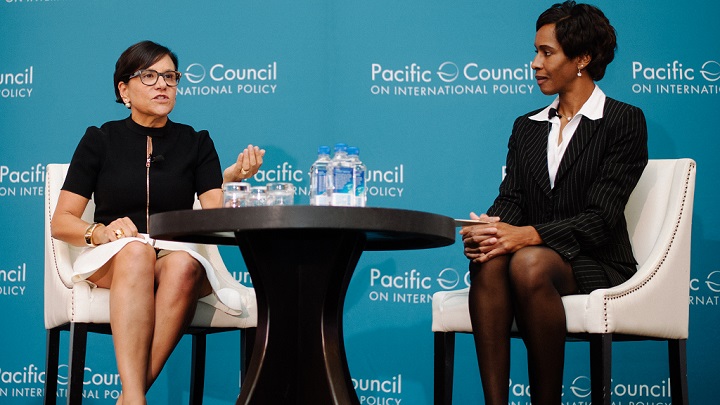
Rules-based trade – such as the Trans-Pacific Partnership (TPP) – makes U.S. workers more competitive in the global economy, U.S. Secretary of Commerce Penny Pritzker told Pacific Council members during Members Weekend 2016. The discussion covered several topics including anxieties about globalization, the refugee crisis, competition with China, the lasting effects of the North American Free Trade Agreement (NAFTA), and more.

The interview was moderated by Ms. Ann M. Simmons, global development writer and editor at the Los Angeles Times.

Secretary Pritzker said the United States is entering its eighth year of expansion and listed several positive steps the U.S. economy has taken: real GDP has grown about 2.1 percent on average since 2009; 156,000 jobs were created in September 2016; hourly earnings are up about 2.8 percent in 2016; and real median household income is up over five percent between 2014-15.

However, she said overall growth remains relatively slow – 1.4 percent in the United States last quarter – because of economic slowdown around the world, including in China and the United Kingdom. The International Monetary Fund is predicting 3.4 percent global growth in 2017.

Secretary Pritzker said the United States needs to be more proactive as a country in terms of helping not only the U.S. economy but also the global economy.

"That’s why we’ve been so aggressive with not only TPP and rules-based trade, but trying to attract foreign direct investment," she said. “The United States has really led the TPP negotiation and insisted that we have high labor and environmental standards. Rules-based trade is what we’re trying to accomplish."

Secretary Pritzker touted both the economic and national security benefits to TPP, including access to new markets, free flow of information on the internet, the reduction and elimination of 18,000 tariffs, clearing bureaucratic red tape, and making it more competitive for American labor by raising labor standards in other countries.

"Rules-based trade is what we’re trying to accomplish."


U.S. Secretary of Commerce Penny Pritzker

"The greater the U.S. presence in the Asia-Pacific region the more impetus the United States has to be patrolling the seas or to be protecting territorial integrity. And by knitting our economies and our peoples together there’s less likely to be extremism against the United States."

Secretary Pritzker said she doesn’t think the anxiety in the United States is caused by free trade, which supports 11.6 million jobs, but rather by globalization, automation, and digitization. To alleviate those anxieties, she believes the Obama administration needs to further explain the economic and national security benefits of TPP.

"The Obama administration is absolutely committed to passing TPP in the lame duck period," she said.

If TPP is not passed, she warned, China will step in to make agreements with those countries in the Asia-Pacific. China already has a trade deal competing with TPP called the Regional Comprehensive Economic Partnership (RCEP), which Secretary Pritzker said doesn’t have the same high standards as TPP.

"Imagine you’re a leader in one of those countries, and you’ve convinced your populace that TPP is a good idea and gone ahead and proceeded," she said. "Now the United States can’t follow through for political purposes or whatever. We’ve heard several of the leaders in the Asia-Pacific region say quite explicitly, ‘Look, if you’re not in the game, we’re going to have to look to others that we can rely on who are in the Asia-Pacific region.’"

"Cybersecurity is the only domain where we ask private companies to defend themselves against foreign countries."


U.S. Secretary of Commerce Penny Pritzker

Secretary Pritzker spoke about the complex relationship between the United States and China, citing areas of both tension – such as the South China Sea, intellectual property protection, cybersecurity, state-owned enterprise reform, and excess steel production – and cooperation – such as the Paris agreement on climate change.

"Given that China is the number two largest economy in the world, we have to have sustained commercial engagement," she replied when Simmons asked her how the United States can strengthen its relationship with China. "We can’t ignore China; it’s not in anyone’s best interest both from a commercial standpoint and obviously from a geopolitical standpoint."

Secretary Pritzker also discussed the U.S. Department of Commerce’s efforts internationally through "commercial diplomacy," which she defined as "harnessing the United States’ unmatched commercial presence and power around the world to work together with foreign governments to change policy." The approach has been used in Africa, Tunisia, Ukraine, and Asia with positive results.

On cybersecurity:

Secretary Pritzker said the U.S. regulatory and legislative structure is not set up to address the dynamic challenges of cyber security.
"This is a very serious challenge, and not something the government or the private sector can handle by themselves,” she said. "Cybersecurity is the only domain where we ask private companies to defend themselves against foreign countries. That’s a problem. Government should have a solemn obligation to protect our people against systemic threats to our economic and national security. That’s a fundamental premise of government."

She added that the United States needs to consider new approaches and methods to combat cyber security threats to American businesses in particular.

On the refugee crisis:

In September, Secretary Pritzker hosted the "President’s Call to Action Refugee Roundtable," a gathering of business leaders discussing how the private sector can help address the refugee crisis. Following President Obama’s call to action in June, 51 companies made commitments to aid refugees in the United States and around the world, including creating temporary housing to host refugee families, starting a microloan program to help refugees start businesses, donating mental health support and healthcare products to doctors treating refugees, and providing resources that will support education and opportunities for refugee youth resettled in the United States.

"Companies such as Airbnb, Chobani, and Western Union didn’t just put up money, they also leveraged their corporate assets," said Secretary Pritzker. "There was a wide variety of companies that participated and made pledges to support the refugee population. One thing that’s been really heartening in this administration is the amount of partnership from corporate America that we’ve seen in issues like the refugee crisis and so many different areas."

Secretary Pritzker admired what she called German Chancellor Angela Merkel’s boldness in taking in one million refugees.

"Politically, that’s very hard to do, but it’s probably more consistent morally with who we think we are than the number of refugees we’re actually taking," she said.

____________________

Justin Chapman is the Communications Associate at the Pacific Council on International Policy.

Before Members Weekend, Secretary Pritzker contributed an op-ed on why the time is now to pass the Trans-Pacific Partnership. Read it here.

Ash Carter: U.S. to “Sharpen Military Edge” in Asia-Pacific

OCTOBER 4, 2016
By: Justin Chapman, Pacific Council

The United States will continue to "sharpen [its] military edge" in the Asia-Pacific in the face of regional threats, U.S. Defense Secretary Ashton B. Carter told U.S. Navy sailors, Pacific Council members, and others in a speech last week onboard the aircraft carrier USS Carl Vinson in San Diego. 

"This region, with half of humanity, half of the world’s economy, is the single most consequential region for America’s future," said Carter, adding that the United States has committed to homeporting 60 percent of its naval and overseas air assets in the Asia-Pacific by 2020. "Indeed, the rebalance to the Asia-Pacific, which President Obama announced five years ago, is a critical national commitment. It includes diplomatic, economic, and military components all to ensure – at a time of dramatic political, economic, and security change in the region – that the Asia-Pacific remains a place where every nation can rise and prosper."

Carter emphasized the importance of U.S. alliances with countries such as Japan, Australia, New Zealand, Vietnam, South Korea, Singapore, Thailand, and the Philippines, to maintain peace and stability in the region. Despite recent hostile comments made by Philippine President Rodrigo Duterte, Carter called the relationship between the United States and the Philippines "ironclad."

The day before Carter’s speech, Duterte said the upcoming military games between the United States and the Philippines would be the last ever conducted. In September, Duterte also demanded that U.S. troops leave the southern Philippine island of Mindanao. In recent weeks Duterte has refereed to President Obama and other U.S. officials by offensive names.

"We're managing historic change in the Asia-Pacific, where China is rising, which is fine, but sometimes behaving aggressively, which is not."

- U.S. Defense Secretary Ashton B. Carter

Carter also discussed the threats posed by China and North Korea. 

"We’re managing historic change in the Asia-Pacific, where China is rising, which is fine, but sometimes behaving aggressively, which is not," he said. "Indeed, we’re also strengthening our deterrent and defense forces in the face of North Korea’s continued nuclear and missile provocations."

New satellite imagery of a North Korean shipyard shows what experts say could be construction of a nuclear submarine with the capability to launch long-range ballistic missiles. In September, North Korea successfully carried out its fifth and biggest nuclear test.

"North Korea, with its nuclear saber-rattling, continues to threaten our allies and heighten tensions in the region," said Carter. "Our alliance with the Republic of Korea continues to evolve, to assure deterrence on the Korean peninsula, including through the joint decision earlier this year to deploy the THAAD ballistic missile defense system to the Republic of Korea to help defend against North Korean threats there."

Carter said that the U.S. Department of Defense is taking steps to modernize its relationship with China by strengthening communications between the two militaries.

"We’ve recently concluded two confidence-building measures, one on maritime rules of behavior and another on crisis communications," he said. "We also regularly participate together in multilateral exercises, such as RIMPAC, that demonstrate the value of working together to address security issues. And our two militaries also hold regular dialogues and high-level consultations that seek to minimize misunderstanding."

Carter added that the United States still has serious concerns with China’s recent actions in the South China Sea and in cyberspace. Several nations claim territory in the South China Sea, where China has been building artificial islands and military outposts and conducting naval patrols. In July, an international tribunal in The Hague ruled against China’s territorial claims. Chinese officials said the decision was invalid.

"The Asia-Pacific remains a place where every nation can rise and prosper."

- U.S. Defense Secretary Ashton B. Carter

"Beijing sometimes appears to want to pick and choose which principles it wants to benefit from and which it prefers to try to undercut," said Carter. "For example, the universal right to freedom of navigation that allows China’s ships and aircraft to transit safely and peacefully is the same right that Beijing criticizes other countries for exercising in the region. But principles are not like that. They apply to everyone, and to every nation, equally."

Carter also used the opportunity to tout the benefits of the Trans-Pacific Partnership (TPP) trade deal.

"The rebalance [to the Asia-Pacific] is an investment in the region’s future – it will help the Asia-Pacific unlock its tremendous promise and to build a brighter future," he said. "And that’s good for the United States. For example, the United States wants to reinforce the open and inclusive economic approach that we all know can continue to benefit the region. That’s why one of the most important non-military initiatives of the rebalance is the TPP, which will bind the United States more closely together with 11 other economies, guarantee a high-quality, high-standard trade system, and support more U.S. exports and higher-paying American jobs. For those reasons, and its strategic value, TPP is an opportunity the region and the United States cannot afford to miss."

Following his speech, Secretary Carter flew to Hawaii to host a meeting on the USS Missouri with defense ministers of the Association of Southeast Asian Nations (ASEAN), including Philippine Defense Secretary Delfin Lorenzana.

____________________

Justin Chapman is the Communications Associate at the Pacific Council on International Policy.

See more photos from Secretary Carter's address, and read his full remarks here


Ambassador to lead Annenberg trust

By Justin Chapman, The Daily Trojan, 9/29/2016

Following a nearly yearlong, nationwide search, Ambassador David Lane has been chosen as the next president of the Annenberg Foundation Trust at Sunnylands. Lane previously served as U.S. Ambassador to the United Nations Agencies in Rome. He succeeds USC Annenberg professor Geoffrey Cowan, who stepped down in June after serving six years as the inaugural president of Sunnylands.

“Sunnylands has the potential to bring people together across ideological boundaries,” Lane said. “People are willing to let down their guard, put aside some of their assumptions and biases and be more open. The goal is to link the great experts and evidence and research that’s out there and help ensure that it’s being translated into policy.”

Sunnylands is the sprawling, 200-acre desert estate in Rancho Mirage, California, which served as the winter home of Ambassador Walter Annenberg and his wife Leonore, after whom the USC Annenberg School for Communication and Journalism is named. Following their deaths in 2002 and 2009, respectively, the estate’s board of trustees established the Annenberg Retreat at Sunnylands, a retreat center for government officials and private sector experts. Dubbed “Camp David of the West” by Cowan, and in the spirit of the Annenbergs’ vision for the estate, Sunnylands has hosted several high-profile meetings, including a 2013 summit between President Barack Obama and Chinese President Xi Jinping, a 2014 meeting with Obama and King Abdullah II of Jordan and the 2016 U.S.-ASEAN Leaders Summit featuring Obama and leaders from 10 nations. Countless retreats featuring Supreme Court justices, congressional leaders, filmmakers, musicians, artists and experts in various industries have also taken place there.

USC has maintained a relationship with Sunnylands through Cowan, Annenberg, the School of Cinematic Arts and other USC-Sunnylands hybrid employees such as Geoffrey Baum, who served as managing director of the USC Annenberg Center on Communication Leadership & Policy for many years and currently serves as the chief communications and marketing officer at Sunnylands. Lane said he will maintain that institutional relationship.

“We will continue to collaborate with the various Annenberg institutions, as they make a natural fit,” Lane said. “It’s less that anything formal is necessary, but more that there’s already a rhythm of collaboration with USC that has certainly served Sunnylands well and, I assume, has served USC well.”

Lane said he wants to continue Sunnylands’ reputation as a place to bring people together, particularly congressional leaders.

“It’s no surprise there hasn’t been a great congressional convening over the last few years, because that piece of our government especially has been so broken in terms of bipartisan cooperation,” Lane said. “These may be famous last words, but I at least intend to try to do something there. We can start with some initiatives where there’s bipartisan support and try to model what cooperation looks like.”

As ambassador, Lane led strategy-setting and governance of six multilateral agencies focused on food security, agricultural development, poverty alleviation, development finance and rule of law promotion. He advocated for inclusion of a “justice and accountable governance” provision in the UN’s recently adopted Sustainable Development Goals aimed at fighting poverty, inequality and climate change through 2030. Before being appointed ambassador, Lane served in the White House as assistant to the president and counselor to the chief of staff. Before that, he was president and CEO of the ONE Campaign, the non-partisan organization co-founded by singer Bono to fight extreme poverty and preventable diseases.

“David Lane was an exceptional ambassador to the UN Agencies in Rome,” said José Graziano da Silva, director-general of the UN Food and Agriculture Organization, in a statement. “His optimism regarding our ability to reach common objectives on eradicating hunger, reducing poverty and sustainably managing our planet’s resources was a compelling influence among member countries. This helped greatly in building consensus and confronting our shared challenges.”

From 2001 to 2007, Lane led public policy and advocacy efforts at the Bill & Melinda Gates Foundation. During the Clinton administration, he served as chief of staff to the Secretary of Commerce and executive director of the National Economic Council.

“David is a bridge builder,” Melinda Gates said in a statement. “He brings people together to find policy solutions to some of the world’s biggest challenges. He knows the policy backwards and forwards, but he’s also creative about getting things done.”


Ya’alon: Israel’s “Realistic Defense Policies” Pay Dividends

SEPTEMBER 28, 2016
By: Justin Chapman, Pacific Council

The Israel-Palestine conflict should be managed, not solved, Moshe Ya’alon told Pacific Council members during a discussion about modern Israeli defense policy and U.S.-Israel relations. The discussion was moderated by Jessica Yellin, former chief White House correspondent for CNN. Ya’alon served as Israel’s defense minister from 2012 to 2016.

"In a sober and realistic way Israel manages to enjoy a relatively calm security situation," said Ya’alon. "Against all odds we have peace and quiet on the Israeli side of Golan Heights, along the border with Egypt, and along the border of the Gaza Strip as a result of realistic defense policies."


According to Ya’alon, an element of Israel’s "realistic" defense strategy is giving up on the belief that a two-state solution is possible.

"Calling for full separation under the slogan ‘two states for two peoples’ — [Palestinian President] Abu Mazen is not even ready to say two peoples. He denies the existence of the Jewish people," he explained. "My proposal is to manage the situation, not solve it, from the bottom up. Let’s improve the economy, the infrastructure, and security."

Yellin pointed out that "there are people in Israel who are concerned that the failure to reach an agreement and achieve some sort of peace with the Palestinians is a mortal threat to the survival of Israel."

Ya’alon said he did not agree with that viewpoint. "I’m not afraid of this idea that if we don’t solve the problem it will be sad for Israel," he said.

"My proposal is to manage the situation, not solve it, from the bottom up. Let’s improve the economy, the infrastructure, and security."

- Moshe Ya'alon

He added that, in his view, the conflict stems from the Palestinians’ intention to eliminate the state of Israel as a Jewish state.

"What is this conflict all about? I originally thought it was a territorial issue," he said. "As I sanctified life more than land, I wanted to give up land in order to have peace and tranquility, to save lives. But looking back, if I have to describe in a nutshell what this conflict is all about, it’s not about occupation since 1967; it’s about occupation since 1948. It’s about our very existence. It’s about [the Palestinians’] reluctance to recognize our right to exist as a nation state of the Jewish people. Their objective is not to build a Palestinian state along 1967 lines. It’s to eliminate the state of Israel as a Jewish state."

Ya’alon also claimed that Palestinian textbooks and television programs aimed at children teach them to hate Israel from a young age.

"I have kids and grandkids and I teach them to sanctify life rather than death," he said. "We do not educate our young generation, generally speaking, that the Palestinians don’t have rights. We don’t educate them to hate Arabs, although we have problems. I don’t ignore it. On the Palestinian side, they promote death and hatred. I’m talking about the official educational curriculum and official media."

On U.S.-Israel relations

Although Israel’s relationship with the United States has historically been symbiotic, it has been shaky at times during the Obama administration. In September, however, the United States agreed to provide Israel $38 billion in military aid over the next decade, the largest the United States has ever given any country, according to the Washington Post.

"We have a strategic relationship between the United States and Israel," said Ya’alon. "It’s a cornerstone of our national security. As defense minister I can testify that we enjoy a deep, intimate, and very good relationship between the Pentagon and Ministry of Defense, and we are grateful for it. But we have reservations. We have disputes on what should be done in the region, in Egypt, in Syria, and so forth. One of the main disputes is about the Israeli-Palestinian conflict."

Ya’alon also said that it was a mistake for the United States to try to democratize the Middle East.

"We believe in democracy, but I don’t believe it’s going to happen in the coming future because of certain fundamental elements which we ignore as western people," he asserted. "In our society, as an example, we sanctify life. So how can you talk about human rights or women’s rights in a society that doesn’t appreciate human life?"

On the Iran nuclear deal

The nuclear deal with Iran was condemned by Israeli Prime Minister Benjamin Netanyahu and other Israeli leaders at a time when terrorist attacks are on the rise in the Middle East and Europe. Ya’alon said the only good thing about the deal is that it delays Iran’s nuclear capabilities.

"The deal as a whole is very bad news," he said. "The Iranians succeeded in this deal to keep all their indigenous capabilities to produce a bomb. They cannot do it now or they’ll violate the deal, but within nine to 14 years they can do it without violating the deal. They won’t be restricted in their efforts to produce a bomb. We have to deal with this situation now."

"The military option is a last resort [to stop Iran's nuclear program]...but at the end of the day, Israel should be ready to defend itself by itself."

- Moshe Ya'alon

Ya’alon said that because Iran is the biggest threat to Israel, they must not be allowed to have a nuclear weapon. When asked if he thinks a military invasion and occupation of Iran should be considered, he argued Iran’s nuclear ambitions should be stopped by one way or another.

"The military option is a last resort," he said. "I have a lot of experience regarding wars, and as a result of it I aspire for peace. You use military power when other alternatives have been exhausted. That’s why I call for coordination and cooperation now in order to prevent a nuclear Iran. But at the end of the day, Israel should be ready to defend itself by itself, whether it is regarding Iran or other parties in the region aspiring to have nonconventional capabilities with the intention to wipe Israel off the map of the earth."

____________________

Justin Chapman is the Communications Associate at the Pacific Council on International Policy.

The views and opinions expressed here are those of Mr. Ya'alon and do not reflect the official policy or position of the Pacific Council.

For South Africa’s Economic Future, All Eyes on 2017

SEPTEMBER 21, 2016
By: Justin Chapman, Pacific Council

The next year will be critical for South Africa’s political and economic future, Mr. Grant T. Harris told Pacific Council members during the fifth and final installment of the BRICS Summer Teleconference Series. The discussion was moderated by Dr. Gerald J. Bender, Professor Emeritus of International Relations at the University of Southern California.

Harris is the Chief Executive Officer of Harris Africa Partners LLC, which advises companies and organizations on strategy, policy, and mitigating risk with respect to doing business in Africa. He previously served as Special Assistant to the President and Senior Director for African Affairs at the White House from 2011 to 2015.

South Africa’s economy is experiencing its slowest growth rate since the 2008 financial crisis. "Too slow," according to the International Monetary Fund, to "improve living standards in a country where a third of the population is excluded from the economy." South Africa's unemployment rate has increased to 26.7 percent in 2016, the highest in eight years.

"South Africa is not doing well economically," said Harris. "It hasn’t fully recovered from the aftershock of the financial crisis of 2008. Predictions say economic growth will be at a rate lower than population growth in 2017 and 2018. That means on a per capita basis South Africa is expected to get poorer over the next couple of years."

Harris pointed out that people had high expectations in 1994 when Nelson Mandela was elected president that South Africa would dominate the rest of the continent politically, economically, diplomatically, and militarily. But since then other countries such as Kenya and Nigeria have assumed leadership roles in some of these areas.

"South Africa is expected to get poorer over the next couple of years."

- Grant T. Harris

"There is a traditional notion that South Africa is the first stop for investors that are wary of and unfamiliar with African markets, but in reality, it’s a much more complex picture," explained Harris. "There are major corporations like GE and others that are placing their regional hubs in Kenya and in other countries. There’s a lot of investor interest in East Africa."

The political situation in South Africa is also in disarray following the ruling party’s worst performance in local elections in August since they came to power in 1994.

"The ANC received 54 percent, compared to 60 and 70 percent they’d been getting," said Harris. "The lesson they draw from this is really going to impact the economic approach of the country."

Harris said that President Zuma is called a lame duck by many even though he has three years left in his term because of the various scandals he is embroiled in. The country’s highest court ruled earlier this year that Zuma violated the constitution by defying an order to repay $542,000 in public funds he used to renovate his personal house with non-security related upgrades, such as a swimming pool and amphitheater. He paid back the funds this month.

"Recent polls say 57 percent of South Africans think the ANC has lost its moral compass."

- Grant T. Harris

"That’s not his only scandal," said Harris. "In April, he barely survived an impeachment vote, and a high court before that ruled that 783 accounts of corruption, fraud, money laundering, and tax evasion leveled against him should not have been dropped in 2009 right before he became president. He has said the ANC is going to rule ‘until Jesus comes back,’ but recent polls say 57 percent of South Africans think the ANC has lost its moral compass."

Harris also talked about how and why South Africa came to be included in the BRICS.

"The ‘BRICS’ used to be the ‘BRICs’ with a lower case ‘s,’" he explained. "South Africa was added in 2011. In many people’s minds, that was an addition to overcome what might otherwise be an embarrassing implication that Africa is somehow economically irrelevant. At the time, South Africa’s economy was only a quarter of the size of the smallest BRIC country, India, and its population was only a third of the least populated country, Russia."

Harris pointed out that Jim O’Neill, who originally coined the term "BRICs" in 2001 as an economist at Goldman Sachs, said in 2010, "For South Africa to be treated as part of BRIC doesn’t make any sense to me. But South Africa as a representative of the African continent is a different story."

Listen to the full conversation below:


____________________

Justin Chapman is the Communications Associate at the Pacific Council on International Policy.

Read summaries of the other four teleconferences in the Pacific Council’s BRICS Summer Teleconference Series: on BrazilRussiaIndia, and China.


Alumnus empowers disenfranchised voters

By Justin Chapman, The Daily Trojan, 9/19/2016

During this election season, some people are disappointed with the choices for president, to the point where they may choose not to vote at all. But there is another option — sharing your vote with someone who can’t.

Vote Allies, founded by USC alumnus Brett Shears, partners those eligible to vote with those who are ineligible to vote, such as non-citizens and those on parole. The pairs discuss politics together, and the eligible voter then casts his or her vote for whoever the ineligible voter would like to vote for.

“If you’re disenfranchised because of a felony conviction, or you’re on parole, or you’re a non-citizen or you’re under 18 and you really want to be involved in this election, we can partner you with someone and try to replicate this voter experience, so you can be involved in your own way,” said Shears, who graduated in 2015 with a master’s degree in public policy from the Sol Price School of Public Policy.

Shears has long been interested in voting rights issues, having served as the at-large representative for the city of Los Angeles’ North Area Neighborhood Development Council and as vice chair of the South Los Angeles Alliance of Neighborhood Councils, both of which advocate for local issues to the L.A. City Council.

“I shared my vote with Francisco Medina, who was appointed as a city commissioner in Huntington Park as an undocumented resident,” Shears said. “To me, he embodied that spirit of a non-citizen who’s all in for his community, who would love to vote, who influences people in his own way. We really need to recognize and validate the contribution of people like him.”

California’s June 7 primary was the first election Vote Allies was active in. Shears said that while about 60 people signed up through voteallies.org, he was only able to pair 24 people together because the number of eligible voters outweighed ineligible voters by a ratio of about 5:2.

He said others may have participated in the same idea outside of his project.

There are 78 people signed up to participate with Vote Allies in the Nov. 8 election, but Shears said the numbers still skew about 5:2.

“We have more people who are willing to share their vote than there are disenfranchised people signing up who want to opt-in to the process,” Shears said. “It’s hard to say what the source of that is, but there’s probably a legitimate fear about not wanting to get in trouble, not wanting to do anything to rock the boat. It’s just a responsibility that people aren’t willing to take on.”

Susan Goelz, business analyst and program assistant for the USC Annenberg Center on Communication Leadership & Policy, is a registered Republican who plans to share her vote in the upcoming election, preferably with a student who cannot yet vote due to their age.

“I have voted in every presidential election since I could vote,” Goelz wrote in an email to the Daily Trojan. “Now, I cannot in good conscience vote for either Hillary Clinton or Donald Trump. So instead of not voting, I feel the best thing for me to do rather than not vote is to give my vote to someone who feels strongly and really wants to vote, so I will ‘share’ my ballot with a person who currently does not have the ability to vote in this election.”

Voter disenfranchisement laws vary widely from state to state. In Florida, the formerly incarcerated almost never get their right to vote back, and in Vermont, officials deliver ballots to inmates behind bars. California is somewhere in the middle in terms of strictness, in which those who are currently incarcerated or on parole cannot vote.

“The lesson is no two states are identical, so there’s always going to be confusion about who can and can’t vote,” Shears said. “There are about 80,000 people who are on parole in California who cannot vote because of a felony conviction.”

The number of undocumented immigrants and minors drives the total number of people who can’t vote much higher than that. While largely symbolic because the project operates at such a small scale in its current pilot phase, Shears said the whole point of Vote Allies is to start a dialogue about voting rights and to give a voice to the voiceless in American society.

The deadline to sign up to participate in the Nov. 8 election with Vote Allies is Oct. 25. Learn more at voteallies.org.


Humanist Chaplain guides non-religious USC students

By Justin Chapman, 9/8/2016, Daily Trojan

The USC campus boasts more than 80 religious organizations for students, with chaplains to supervise nearly all of them, but only one caters to the ever-growing community of nonbelievers.

The Secular Student Fellowship of USC, which meets at 7 p.m. every Monday in room 203B at the University Religious Center, is a “friendly, diverse community of undergraduates and graduate students engaged in an ongoing conversation about how to apply reason and science to live better lives and build better societies,” according to its page on the Office of Religious Life’s website. The group’s adviser is Bart Campolo, USC’s first Humanist Chaplain, a volunteer position he created two years ago.

In his role as Humanist Chaplain, Campolo counsels students who don’t believe in God. He is on campus most days of the week, in his office at URC 203A. On any given day he interacts with about three or four students.

“I’m like the rabbi/priest/minister/imam to all the students who don’t believe in God,” Campolo said. “If someone’s dad gets diagnosed with cancer and they’re trying to make sense of it, or someone’s having a hard time making friends on campus, or a senior doesn’t know what they’re going to do after they graduate, they come talk to me.”

Campolo, 53, is the son of famous evangelical preacher Tony Campolo, who served as former President Bill Clinton’s spiritual adviser. Bart Campolo himself spent many years as a public and influential evangelical Christian leader, but began having doubts about his own faith. After suffering a concussion from a bike accident, he decided at age 51 that he no longer believed in God. He has since devoted himself to secular humanism, which he defines as “creating a community where people pursue love and goodness collectively on the basis of reason.”

“My position is supervised by the dean of religious life because he wants me here,” Campolo said. “The dean understands that I’m trying to help students answer some of life’s ultimate questions using science and reason instead of supernaturalism, but that I’m still a religious leader. I’m still pursuing: ‘Where do we come from? What happens when we die? What’s the basis of good and evil? What makes something right or wrong? How do you make the most of this life? How do you deal with your finitude in the midst of a huge universe?’”

A recent Pew Research Center study found that more Americans than ever are increasingly becoming less religious, especially millennials. While no data currently exists for how many people on campus are religious versus nonreligious according to the Office of Religious Life, Campolo said his anecdotal experience tells him that about half of the students he talks to around campus don’t identify with a religion or don’t believe in God.

“How many people here believe in a magical god who actually intervenes in the lives of human beings? I’m going to guess about 40 to 50 percent,” Campolo said. “USC tends to skew more towards the religious, and yet, the faculty is a whole other story. Very few professors are people of faith, and yet very many of them are professors because they want to contribute to the advancement of life.”

Campolo said that his goal on campus is not to criticize religions or religious people, but rather to create a positive community for those who don’t happen to believe in God.

“A lot of atheist groups I researched had very negative agendas,” said Campolo. “They were like, ‘Let’s talk about another reason it’s stupid to believe in God,’ or ‘Let’s really focus on the separation of church and state because I’m sick of ‘In God we trust’ on the currency.’ You can’t build a movement around all this negative stuff. Ridiculing religion only gets people to double down. Maybe it’d be better if we go build a community where people could pursue love and goodness in a rational way and don’t have to believe in anything.”

Now in his third year as Humanist Chaplain, Campolo has found that many students are discovering and valuing his services.

“USC is a big, busy place,” Campolo said. “A lot of people don’t feel like they have a lot of friends on campus. They don’t feel connected. They don’t feel like anybody really cares.”

That’s why Campolo and his wife started hosting dinners for the secular community on campus in the URC dining room every other Sunday, a tradition that continues this semester.

“Since ‘non-religious’ is the fastest growing demographic in the United States, we think it’s important that a community like this exists to bring us together to pursue goodness without a god, which for many people is a novel concept,” said Katie Bolton, a junior majoring in environmental studies and NGOs and social change who serves as one of the leaders of the Secular Student Fellowship. “Bart is a true pioneer of this movement; he is able to inspire people like few others. I hope that more people will have the chance to know him like I do, because he has something to offer everyone. He just beams goodness to all who cross his path.”

Fellow SSF leader Joseph Krieger, a junior majoring in mechanical engineering, said having a Humanist Chaplain and a secular student organization on campus is “a huge comfort.”

“There are so many people on campus who don’t believe in a god, but want to have conversations about how to make the world a better place, either through improving interpersonal relationships or supporting causes that we believe in,” Krieger said. “Bart’s intuition, foresight and understanding of how people think make him a master of relationships.”

Campolo is also working with Irshad Manji, a senior fellow at the USC Annenberg Center on Communication Leadership & Policy, to create a chapter of her Moral Courage Project on campus.

Filmmaker John Wright is currently wrapping up a documentary about Campolo’s relationship with his father Tony following the revelation that he was no longer a Christian. The film, With Whom I Am Well Pleased, is expected to be released by the end of the year. The two Campolos are also working on a book together based on the same idea, due out early next year.

“All these religions have endured for thousands of years, not because their narratives make any sense at all, because they don’t, but because they get together every week, they have cool rituals, they sing really well and they take care of each other,” Campolo said. “They endure despite their crazy narratives, not because of them. Secular humanists have a much better narrative, and every fact that gets discovered affirms that narrative. But we’ve got to build a better community.”