Pitch Perfect

Soccer’s popularity grows locally with 3,000 players recreationally competing in the Pasadena Adult Soccer League

By Justin Chapman, Pasadena Weekly, 3/5/2015

“We’re not trying to make our league so competitive. We just want people to play soccer because it’s soccer, it’s a great sport.”

Up until the 2014 World Cup in Brazil, soccer was nowhere near as popular in the United States as it is in most every other country in the world.

And while still not as ubiquitous here as in, say, the United Kingdom or Africa or South America, interest in soccer is on the rise — especially locally, where 3,000 players recreationally compete in the Pasadena Adult Soccer League.

One reason for the increase in popularity was the impressive performance by the US team in the World Cup, according to Christophe “Frenchy” Giovannelli and Sherisse Tuck, the South Pasadena couple who run the Pasadena league. They said participation increased last summer because of the World Cup.

“You have so many sports to choose from in America: football, basketball, baseball,” said 46-year-old Tuck, who has been running the league since 1998. “But soccer is getting bigger [in San Gabriel Valley]. The World Cup showed everybody that this is a sport.”

“The World Cup has a big effect,” said 43-year-old Giovannelli, who was born in France and came to the United States in 2002. “The US team did a good job. Everybody was very excited about it. This year all the restaurants and bars were showing the games, and it wasn’t like that during the last World Cup. They should have a World Cup every year.”

Soccer’s local popularity began its upswing in 1994 when Brazil and Italy duked it out during that year’s final World Cup match at the Rose Bowl. Brazil won 3-2 on penalties.

Another reason soccer is gaining prevalence in the San Gabriel Valley is the American Youth Soccer League (AYSO), established in 1964 in a garage in Torrance. The youth league now runs programs in nearly 900 communities across the country and has over six million alumni. 

“AYSO is huge around here,” said Giovannelli. “Those players, if they don’t make a club or a professional team, they still want to play soccer (when they get older). It’s a dream people have had since they were kids, since they played in AYSO. If they stopped playing at some point, but now they want to play soccer and want to enjoy it again, and they know they’re not going to play in a club, the only way to play is on a recreational league.”

Demand for the Pasadena Adult Soccer League is huge. It is difficult to get on a team, though Tuck and Giovannelli help players out when they can. The league’s growth is only hampered by the number of fields that are available for game play. But it took Tuck 10 years to grow the league, which is contracted by the city of Pasadena, to what it is today.

Beginning in 1972, there was a women’s soccer league in Pasadena. In 1998, nobody wanted to run it anymore, so Tuck stepped up.

“There were just a couple hundred people in the league back then and games were just on Sunday,” she said. “We started adding beginner’s leagues and men’s leagues, and in 2008 I started the Pasadena league. The city wanted someone to take over a league they had, so I turned in a proposal and they accepted it. We started with 12 teams and it grew from there.”

Now the league has 3,000 players from Glendale to Duarte and games are played every day of the week, year-round. The league also holds special tournaments on Thanksgiving weekend, during the World Cup and in May. The Mayday Melee Tournament is a fundraiser, while the Thanksgiving Turkey Shoot Tournament is more of a social potluck.

Tuck and Giovannelli said the league is a great social outlet. In fact, two players who met on a soccer team two-and-a-half years ago, Sarah Thalmann and Alejandro Moratorio, are now engaged to be wed in June. The Pasadena residents met on a team called Babe-raham Lincolns. Thalmann, 35, is an eighth-grade teacher at Marshall Fundamental High School in Pasadena. Moratorio, 37, works at LA Networks in Sherman Oaks. They both play on triple A division teams.

“I like that I could play virtually every day of the week if I wanted to, and I have,” said Thalmann. “The league has grown quite a bit in the last decade, but it continues to be well-organized. I also like that there are so many different levels. I’m definitely not going to want to play in the A divisions forever, and it’s great to know that I can continue to play as I get older.”

Moratorio has played in the league a total of six years, with a break in between to play in a more competitive men’s league, Los Angeles Super Metro.

“I’m very proud to be one of the first few hundred people who joined this league, and to see how tremendously it’s progressed,” said Moratorio, “from relatively few options in terms of days and fields to games being played on every day of the week, and on some great fields. The greater Pasadena area is extremely lucky to have this league. It’s a wonderful, safe place to play soccer and see friends on a regular basis.”

Sierra Madre resident Erik Pierstorff, 40, played soccer as a kid until he was 32 and just picked it up again last summer. He agreed that joining the league was a good way to meet new people, though he would like to see an easier way for free agents to locate a team.

“That is its biggest weakness from my perspective,” he said.

For regular seasons, players can choose between Men’s Only (11 players versus 11 players), Women’s Only (11v11), Men’s Over 30 (7v7), Men’s Over 35 (7v7), Women’s Over 30 (7v7) and Coed (7v7). The 7v7 leagues have some slightly different rules, including no offsides and no sliding. The league is divided up into four skill divisions: A, B, C and D. Teams choose which division they feel they are qualified for. It costs $675 for a team to sign up for each season, which lasts about eight to 10 weeks. That team cost is split up among its players, who are also required to purchase a $25 player ID card for each calendar year.

“Unless I know a team and its players, I won’t put them on Men’s A,” said Giovannelli. “They have to play on Men’s B first, because by experience you’ll have a team who think they can go on Men’s A, but that ends up not being the case, and that’s not fun for anybody. We keep an eye on it, because we don’t want a B team playing on a D team, or vice versa.”

Teams don’t have to necessarily place first in their league to move up, however.

“Some teams want to move up, but most teams don’t want to move up — it’s funny,” said Tuck. “They’ll win three seasons in a row and say, ‘We want to stay here.’”

The league’s referees are paid and highly qualified. Some of them are refs for FIFA. Others referee games for Major League Soccer. One of the refs will be one of four American referees for the next World Cup. The league also has a few high-profile players as well, including one woman who played on a professional team in Switzerland, another who played in the Women’s World Cup, a former player for Chelsea Football Club and the French and Dutch national teams, Cobi Jones of LA Galaxy and actor Matthew Lillard.

“We’re not trying to make our league so competitive. We just want people to play soccer because it’s soccer, it’s a great sport,” said Tuck. “We want to get people to play who have never played, who are in their 50s or 60s. We want them to come try soccer out.”

Although they have a small staff of two other employees, managing the league is a full-time job for both Tuck and Giovannelli. Fortunately for them, soccer is their passion. Indeed, for many people, soccer is an identity sport. It’s part of who they are as human beings, and serves as a fun way to fulfill their own self-expression.

For more information, visit adultsoccerleague.com.


California and China, a model for collaboration on climate change

International leaders should build on the success of the partnership between Chinese provinces and the state of California in combating climate change, according to a new report co-authored by CCLP senior fellow Orville Schell, the Annenberg Foundation Trust at Sunnylands, and the Asia Society.

“The latest agreement in November 2014 between the United States and China to reduce carbon emissions will help set a new course in the effort for greater international cooperation on climate change, but states, provinces, and municipalities also have a vital role to play,” reads the report, titled A Vital Partnership: California and China Collaborating on Clean Energy and Combating Climate Change.

The report was released by Schell and Geoffrey Cowan, president of the Annenberg Foundation Trust at Sunnylands, on March 4 at an Asia Society event in San Francisco. Gov. Jerry Brown and Nobel laureate and former U.S. Secretary of Energy Steven Chu also participated in the discussion.

“In the end if the U.S. and China do come together in a meaningful way to deal with climate change, it is not going to exclusively be between Washington and Beijing,” said Schell. “In fact that may be the least important link. Where the rubber will really meet the road is with states and municipalities dealing directly, so that the solution ends up being more of a patchwork, kind of a mosaic, rather than some big grand design where the presidents wave a wand in Washington and Beijing and bring about a solution. I don’t think it’ll happen that way. But it can happen piece by piece by piece.”

The authors of the report hope that the “unique interaction between California and China will help inspire new forms of constructive subnational efforts to address our critical transnational problems.” The report summarizes the ongoing efforts between California and China that are part of a significant effort to jointly address the challenge of global climate change at the subnational level.

“Both California and China are reaping benefits from their collaborations,” said Cowan. “Not only are these partnerships uncovering solutions to protect the air, water, and ecosystems within each country, but they are also catalyzing increased trade and investment in clean technology in both countries.”


Lessons learned in wild Africa

By Sammy Wu, Pasadena City College Courier, 2/26/2015

Justin Chapman, alumni of Pasadena City College and University of California, Berkeley, has many accomplishments under his belt.

At age 19, he began writing for the Pasadena Weekly, and from there, went on to publish news-breaking stories for over 20 leading publications, including LA Weekly, Berkeley Political Review, and Patch.com. At 19 years old, he was also the youngest elected member to serve on the Altadena Town Council, beating out the 57-year-old vice chairman of the council by earning 63 percent of the vote.

Now with the release of his book, Saturnalia: Traveling from Cape Town to Kampala in Search of an African Utopia, he can add author to his resume.

The book centers on his three-month excursion across Africa in Spring 2012 from Cape Town, South Africa, to Mityana, Uganda. During the journey, he barely avoided being institutionalized in a mental hospital, stayed in a poor township that valued art-making, was almost killed in a car accident, wandered about the mythical Zanzibar island, watched a witchcraft healing ceremony, and relapsed into his heroin addiction, all while hunting for compelling stories and finding love in the most unexpected of places.

The book, which is intended as a travel diary and an anthropological journal, grew out of a series of blog posts collectively called “Saturnalia: A Trek Through the Lands of Lawlessness.” The posts were infused with intense and often overwhelming emotions because Chapman would write his experiences as they were happening to him. He said many people were moved by his stories and waiting to see what would happen next. Such reaction was what motivated him to turn the blog into a paperback book.

The process of writing the book was difficult and time-consuming, for contrary to what Chapman initially thought, it took much more than just simply copying and pasting. Yet, the process was also cathartic because he learned a lot about himself—his limitations and his strengths.

And now he hopes that he could somehow inspire other readers, particularly those from this generation, about the undiscovered gems of Africa, as well as the lessons he learned along the way.

“I hope that the book will open people’s eyes to the real Africa, beyond what is depicted in television documentaries and fleeting media accounts of atrocities and struggles,” said Chapman. “The stories Saturnalia contains and the conclusions it draws are important and should not be passed over or forgotten.”

“This book can be beneficial and influence in positive ways the relationship people in the rest of the world have with Africa. There are remarkable changes going on in Africa and people should know about them,” he added.

The book has already garnered positive reviews from a myriad of renowned writers.

“Chapman’s vivid prose turns every paragraph into a photograph of a strange, dangerous but alluring land. As his characters indulge themselves with sometimes reckless abandon, the author communicates a sense of adventure for adventure’s sake and draws the reader into riding along without hesitation,” said Joe Piasecki, editor of The Argonaut and former Los Angeles Times reporter.

Irvine Welsh, author of Trainspotting, Skagboys, and The Sex Lives of Siamese Twins, called the book “the perfect metaphor for contemporary American youth, painfully trying to work through its own baggage, and openly and sincerely seeking to engage with the world beyond the USA’s established physical and cultural borders.”

Chapman originally planned on staying in Africa to become a diplomat for the U.S. Foreign Service in Africa. He even took an exam for a placement in the department, and he passed the first round, which only 3,000 of the 20,000 applicants pass annually. He did not pass the second round of exams, but he wanted to try again had he not met and fell in love with his fiancée, Mercedes Blackehart, upon coming back to America.

He now resides in Pasadena, California, with Mercedes and their dog Fiona, cats Mason and Dixon, and tortoise Stockton. He is the secretary for three board of directors: ACLU Pasadena/ Foothills chapter, Men Educating Men About Health, and West Pasadena Resident’s Association. In addition, he is the Project Fellow at the USC Annenberg Center for Communication Leadership and Policy.

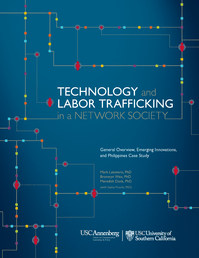
Isolation from technology and social networks increases risk of labor trafficking, USC study finds

Migrant workers who are isolated from technology and social networks are more vulnerable to human trafficking, forced labor, and exploitation. These and other findings are detailed in a powerful new report, Technology and Labor Trafficking in a Network Society, released today by the Center for Communication Leadership & Policy (CCLP) at the University of Southern California’s Annenberg School for Communication & Journalism. This project was made possible by a grant from Humanity United, a U.S.-based foundation dedicated to building peace and advancing human freedom.

The report includes the story of a young woman from the Philippines who was stranded in Malaysia after being misled by a deceptive labor recruiter. Despite having a mobile phone she did not want to call her family and make them worry. While being transported to an unknown destination by her brokers, she was apprehended by police. Interrogated and imprisoned, she hid her phone and called a friend for help. After a month the Philippine government finally intervened. As it turned out, the woman’s phone served to connect and disconnect her with unscrupulous recruiters, as well as support.

Researchers also found that the confiscation of cell phones, restriction of Internet use, and deception in online recruiting can be indicators of labor trafficking – a form of modern day slavery. As one of the survivors of labor trafficking interviewed for the report revealed: “The [employment] agencies are very strict on mobile phones. When you reach the agencies…in the country destination overseas, they will get your phone.”

At the same time, the researchers found that technology provides a critical infrastructure for positive change.

“Mobile and internet technologies can be leveraged to assist workers and migrants to connect with crucial social networks of support, family, friends, and information,” explains Mark Latonero, Ph.D., principal investigator and chief author of the report.

Based on analysis of supply chains, online recruitment, disaster response, and a Philippines case study, the report details ways in which the responsible uses of technology can assist governments, businesses, NGOs, and migrant workers in preventing and mitigating the effects of labor trafficking.

“The issue of labor trafficking is starting to get the attention that it deserves,” says CCLP director Geoffrey Cowan. “This report builds upon the work on technology and human trafficking we started five years ago and will help the public and policy makers better understand the role technology plays as both a problem and solution.”

Some findings and recommendations in the report include:

  • Laws and policies should ensure workers have free access to communication technology and social networks.
  • Data analytics can be used to monitor and identify exploitation and trafficking in global supply chains.
  • Online technologies that are useful for maintaining social connectivity are also used to exploit. The divulging of personal information such as cell phone and passport numbers on social media profiles allows illegal recruiters to exploit job seekers.
  • Disaster and humanitarian response technologies represent a new avenue for trafficking intervention.

“Technology can play an important role in both perpetuating and addressing labor trafficking. Yet, little evidence-based research has been done on the relationship between the two,” says Ed Marcum, vice president of investments at Humanity United. “This report allows us to better understand its use and dynamics in order to more effectively develop and scale solutions.”

In the Philippines, researchers interviewed numerous stakeholders including survivors of labor trafficking. The report notes technology skills training and the facilitation of peer-to-peer communication as promising strategies to combat labor trafficking.

Taking stock of the complexity and challenges of the issue, the report lays the groundwork for both research and action, providing analysis, recommendations, and guiding principles for governments, NGOs, the private sector, and researchers.

For more information, visit the Technology and Human Trafficking Initiative website.


On Friday, March 27, between 7 and 8 a.m. Justin will be interviewed about Saturnalia on Crown City News Sunrise, a live morning TV show on KPAS. He will also participate in the show's "Morning Buzz" segment discussing the important local, state, national, and international issues of the day.

CCN Sunrise runs on the Arroyo Channel 32 in Pasadena on AT&T Uverse and online at www.crowncitynews.com.

Here's a link with information about the show:
crowncitynews.com/ccnsunrise

The Good Fight

Remembering the life and times of lifelong progressive activist Marvin Schachter

By Andre Coleman and Justin Chapman, Pasadena Weekly, 2/19/2015

Longtime political activist and Pasadena Weekly co-founder Marvin Schachter died early Tuesday morning after being hospitalized with a heart infection at Kaiser Permanente Hospital on Sunset Boulevard in Los Angeles. 


Schachter, 90, was involved in one way or another with nearly every major progressive cause since the mid-20th-century — from ending segregation and the Vietnam War to supporting disarmament, equal rights for women and minorities and opposing commercial use of nuclear power as well as American military involvement in Central America, most recently protesting against the ongoing wars in Afghanistan and the Middle East. 


At the local level, Schachter, who also regularly wrote columns for the newspaper he helped start more than 30 years ago, devoted much of his time to ensuring senior citizens were cared for, chairing the Pasadena Senior Advocacy Council since 1995 and serving as president of the Advisory Council of the Los Angeles County Area Agency on Aging. He also served on the California Commission on Aging and worked as a delegate to the White House Conference on Aging. He was also a Menorah Housing Foundation vice president.


Schachter is survived by his wife, Esther, daughters Amanda and Pam, and two grandchildren, Max and Emma Rothschild. Family members said plans for a memorial service were not finalized as of Tuesday. 


“He was a remarkable person, and an even more remarkable father and grandfather,” Amanda and Pam said in a joint statement to the Pasadena Weekly. “We loved him even more than he loved us.” 

News of Schachter’s death early Tuesday morning left community members in mourning. 


ACLU Pasadena/Foothills Chapter President Dick Price called Schachter “an amazing guy” and a good friend to many people.


“The last time we saw him he was driving his car to a panel session about fighting government surveillance — tootling down the road to keep Big Brother out of our business. He was doing what he loved to do, right into his 90s,” said Price, who along with Sharon Kyle publishes the online magazine LA Progressive.

“I came to know Marvin because of his commitment to civil liberties — a commitment we shared,” said Kyle, who is also an ACLU Pasadena/Foothills Branch board member. Schachter was a lifetime member of the ACLU of Southern California Board of Directors.


“Always generous with his time and just as generous with his stories, his presence at any meeting almost surely meant that a pearl of wisdom would be offered,” Kyle said. “I will really miss Marvin and am proud to call him friend.”


Local political leaders and others were saddened to hear of Schachter’s passing.


“Pasadena owes much to Marvin Schachter, who was part of the progressive soul of the city and a true guardian of our civil liberties,” said Democratic Congressman Adam Schiff. “Marvin was always willing to stand up and fight the good fight — from battling anti-Semitism and ageism to the preservation of Social Security and Medicare. Marvin was always energetic, passionate and thoughtful and brought a world of experience to bear on any issue. He enjoyed universal respect and admiration and will be deeply missed.”


“When you look at who has been a leader in aging issues, the name Marvin Schachter is at the top of the list,” said Democratic Assemblyman Chris Holden of Pasadena. “Every time I think of senior housing, I think of Marv. He put the issue on the table for policymakers to address in a serious way. He inspired people all over the state to get involved and stand up for what they believe in. Even as he approached his ninth decade, he continued to fight and that has made all the difference. He was a wonderful human being and will be sorely missed.”


In recent years, Schachter suffered from hearing loss, but still maintained his zest for social and political engagement.“In the last year or so he became very hard of hearing, and as an inveterate attendee at hundreds of meetings of seniors affairs, of civil liberties, and others, he could barely follow the meetings,” said Kris Ockershauser of the ACLU Pasadena/Foothills Branch. “Yet he continued to attend and speak to the issues. I felt it must have been a melancholy time for Marvin, with a lifetime of experience in activism and so much to say on contemporary issues, to understand that his gathering deafness would someday bring an end to it.”


Pasadena Weekly columnist and author Ellen Snortland described Schachter as a friend to all.


“Marvin Schachter was more than a personal friend to me and to many of us in Southern California,” Snortland said. “He was a friend to humankind and to the vision of what is possible when people pull for one another. Marvin had the big picture; that until all of us had justice, no one really has it. He saw us as a huge human family and he did everything he could do to make us all better.”


In October, the ACLU Pasadena/Foothills Chapter honored Schachter at their annual Garden Party with a Pioneer of Social Justice Award. In November, the ACLU of Southern California honored Schachter, along with Democratic US Sen. Elizabeth Warren of Massachusetts, at the organization’s annual Bill of Rights Dinner.


According to a 2014 story in PW, Schachter’s road to Pasadena and political activism began as a result of an FBI surveillance file prepared on him over his leftist activities when he was a college student in the 1940s. That revelation to his bosses in the 1950s cost him a sales job in Chicago. Schachter instead took an even more lucrative position in clothing sales, which led him and his family to California.


“It was totally accidental, thanks to the FBI,” Schachter said.


The youngest of four children, Schachter grew up in Brooklyn during the Great Depression. He said the tough times of the ’30s were influential years for him in determining the direction of his life. His father was in the retail fur trade and was unemployed much of the time. But even harder times were coming as fascism began rising around the world, with war erupting in Spain and Adolf Hitler seizing power in Germany. Several members of Schachter’s family died in the Holocaust.  


Schachter was drafted into the Army in February 1943 and served in military intelligence until his discharge in February 1946. After leaving the service, he followed in the footsteps of his older brothers and attended Brooklyn College, working for civil rights long before that cause came to national attention. During that time, he was active in the American Student Union, a national left-wing organization of college students best known for its protests against militarism. Although he was in high school when he first joined in 1940, Schachter became a member of the ASU’s national board at the age of 15, which led to the FBI opening a file on him.


By the late 1960s, Schachter was in Pasadena and supporting efforts to bring racial equality to local schools. 


“Pasadena has a real heritage,” Schachter once said of the city in the early 1960s, when the John Birch Society enjoyed a wide following, the American Nazi Party had set up shop in nearby El Monte and the Southern-based White Citizens Council, a group somewhat overlapping with the Ku Klux Klan, tried to establish a foothold in the San Gabriel Valley.


Schachter supported a successful federal lawsuit filed by Jim and Bobbie Spangler, along with Skipper and Pat Rostker and Wilton and Dorothy Clarke, against the Pasadena Unified School District, aimed at forcing desegregation of local schools.


“The story of Pasadena is one of a city that was liberal in some ways, but it’s also one of a city run by white businessmen with a large disenfranchised minority community,” Schachter once remarked. As a result, Schachter told the Weekly, “Pasadena was a bastion of white supremacy.” 


“Marvin Schachter was a clarion voice for peace, justice and equality,” said Mayor Bill Bogaard. “He advocated for seniors, the poor, and for persons needing housing and health services. His death seems extremely sudden to me because, notwithstanding his advanced age, he was still active in pursuing important social values. We will miss his inspiration to make the world a better place.”


Robert Nelson, a retired JPL scientist and a longtime member of the ACLU, said Schachter will be remembered as a “master teacher.”


“He was the ‘go-to guy’ for younger people to seek out when we needed advice in the struggle for peace, justice, dignity and decency,” said Nelson. “He leaves behind at least four generations of successors who were the beneficiaries of his wisdom. His lessons were well received by so many because they were taught with such a profound spirit of kindness. He was the closest we will ever get to having a ‘philosopher king.’”


Former PW Deputy Editor Joe Piasecki said Schachter had a profound effect on him as a journalist.


“Marvin’s political savvy was surpassed only by the empathy and compassion through which he viewed politics,” said Piasecki, who is now managing editor of The Argonaut, a sister newspaper of PW. “He was not only my conscience, but the conscience of Pasadena as a whole. The world is a better place because of Marvin, but I’m not sure what we’ll do without him.”


PW Editor Kevin Uhrich and PW Arts Writer Carl Kozlowski contributed to this report.


Swimming in words

Pasadena Central Library hosts Author’s Fair Saturday

By Ellen Snortland, Pasadena Weekly, 2/19/2015

Walk into my home in Altadena that I share with my husband, and — if you’re a neat freak — prepare for a screeching desire to scream and then flee. In almost every room you’ll find books everywhere, with many stacked in precarious piles; there is the scent of paper, leather bindings and candles. For bibliophiles? Ahhh … you are home. Put up your feet and spend a few decades. I’ll bring you a cup of tea.

Many of us are becoming antique in our love of physical books. But what we’ve also got going is a love of e-readers, because we can walk around with a device that only weighs 10 ounces, yet can contain as many books as we have in the entire house with room to spare! It is the best and worst of times for reading and writing geeks.

Nature dictates readers as well as writers adapt and learn how to do the best we can to survive in a technological revolution. As we dive deeper into the digital age, there’s a balancing act many of us do between convenience and conventional ways. It’s convenient for readers to shop online. It’s author suicide to not be on Amazon or have some kind of online presence. On the other hand, there’s really nothing like having an author read directly from her or his work in person, with real blood and bones, pen and ink, brick and mortar all in one place.

And that place is a real, honest-to-goodness library or book store. I’m urging you to put down this newspaper (or the book you’re already reading), and get your butts in gear to show up and support Vroman’s Bookstore in Pasadena, our most famous ferociously independent bookstore.  In addition, you’ll want to visit Altadena’s own lovely and eclectic store Hoopla! where local authors are routinely celebrated. And let’s not forget about the Pasadena and Altadena Public Libraries and their myriad and distinctive branches that appeal to all readers, even those just learning how.

On Saturday, in what is the second of a now-annual event, the Pasadena Public Library is sponsoring
Author Fair. The fair features many familiar San Gabriel Valley authors in and out of the Pasadena Weekly’s line-up, including me and Justin Chapman, along with other familiar authors like Anne Louise Bannon, Elizabeth Pomeroy, Petrea Burchard and way too many others to mention in this small space.

We’ll be selling, signing and speaking. Thus you have all the materials together in one place; the fluids and material essentials of our intellectual lives in this community: flesh and blood (the authors), brick and mortar (the library) and pen and ink, or fingertips and keyboards. These are the liquids and solids of our collective work toward understanding human beings and our experience together.

OK, I know I’m geeky. But really, what else is writing and reading other than the attempt to glean what it is like over there, in that other body or universe inhabited by other people?

In my writing, I attempt to point at and illuminate the darker realms of violence that we all encounter and what to do about it. Yes, we all experience and process violence, whether it’s a direct threat from a stranger, an abusive boss we are afraid of, or vicariously through the paralysis we feel when our child comes home to say she or he is being bullied at school. My latest book, The Safety Godmothers, is funny and practical; it provides real-world answers to highly relatable and ordinary boundary violations, which includes verbal, emotional and physical self-defense success stories.

Chapman, my colleague at the Weekly, writes about his journey from Cape Town, South Africa, to Uganda in his newly released Saturnalia. It is an emotional, geographical and spiritual journey that is hair-raising and hysterical, sometimes within the same paragraph.

Lest you think, “Wait a minute … this is blatant self-promotion,” let me clear that up for you. Why yes, Dear Reader, you’re darn tootin’ it is! Think about the books that became the commercial successes we all love. Do you have any idea the type of resources that big publishers use to promote their already successful authors? A big fish (and wonderful) author like J.K. Rowling has a huge PR fleet behind her; she doesn’t need to self-promote. So we smaller fry — whether self-published or with small independent publishers — need to promote ourselves or our words will never reach you. Never.

So bring the kids! Exult in the gorgeousness of the Pasadena Central Library, while bathing in the sensual experience of being with books. There’ll be coffee and pastries available at the Espress Yourself Coffee Bar. The authors will be live and possibly nude! Just kidding. We will be clothed, but you have to admit it got your attention.

Make it a new habit with your family to attend this event each year.

Author Fair is from 10 a.m. to 2 p.m. Saturday at the Pasadena Central Library, 285 E. Walnut St., Pasadena; http://tinyurl.com/PasAuthFair.  SAVE THE DATE! Lisa Gaeta and I will be having a special reading and author signing event for “The Safety Godmothers” at 7 p.m. March 9 at Vroman’s Bookstore, 695 E. Colorado Blvd., Pasadena. Call (626) 449-5320, write email@vromansbookstore.com, or visit vromansbookstore.com for more information.