Policymakers and industry leaders take steps to improve cell phone capabilities during emergencies

Mobile phones today offer enormous potential in regards to public safety and emergency preparedness, but current infrastructure and systems present substantial challenges as well. The Annenberg Foundation Trust at Sunnylands and the USC Annenberg Center on Communication Leadership & Policy have launched an initiative to research these issues, explore solutions and define minimum capabilities of cell phones for health care, public safety and other public services.

On Sunday and Monday, 20 high-level government officials, top mobile technology industry professionals, public advocates and entrepreneurs attended an event hosted by CCLP in Washington, DC. The event, entitled “Mobile Phones for Public Safety and Emergency Preparedness,” was the second meeting on the subject as part of the Mobile Phones for Public Service initiative.

The meeting was organized by Sunnylands president and CCLP director Geoffrey Cowan and senior fellow Adam Clayton Powell III. Attendees included Google vice president and “father of the Internet” Vint Cerf, Federal Communications Commissioner Mignon Clyburn and representatives from T-MobileEmmis CommunicationsMobile CommonsAMG CommunicationsRand CorporationNational Institute of JusticeFood and Drug Administration and Sprint Nextel.
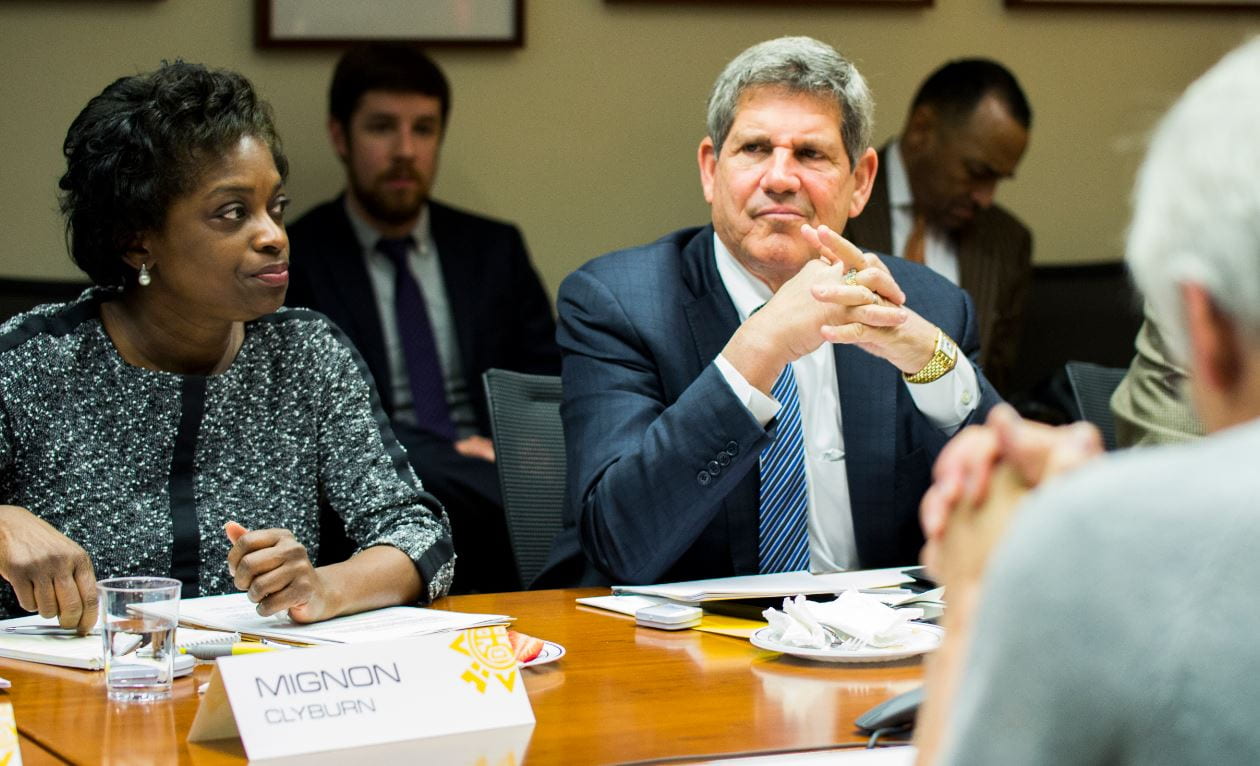
Clyburn and Smulyan.jpg
Mignon Clyburn and Jeff Smulyan

“These CCLP meetings show how industry, government, entrepreneurs and researchers can come together to reach consensus on improving public services — in this case, using cell phones as platforms for public safety and emergency preparedness,” said Powell.

The group focused on four primary issues: the Wireless Emergency Alert system (WEA); Next Generation 9-1-1 (NG911); FM radio chip activation; and the FCC’s Lifeline program, and developed a series of next steps and action items.
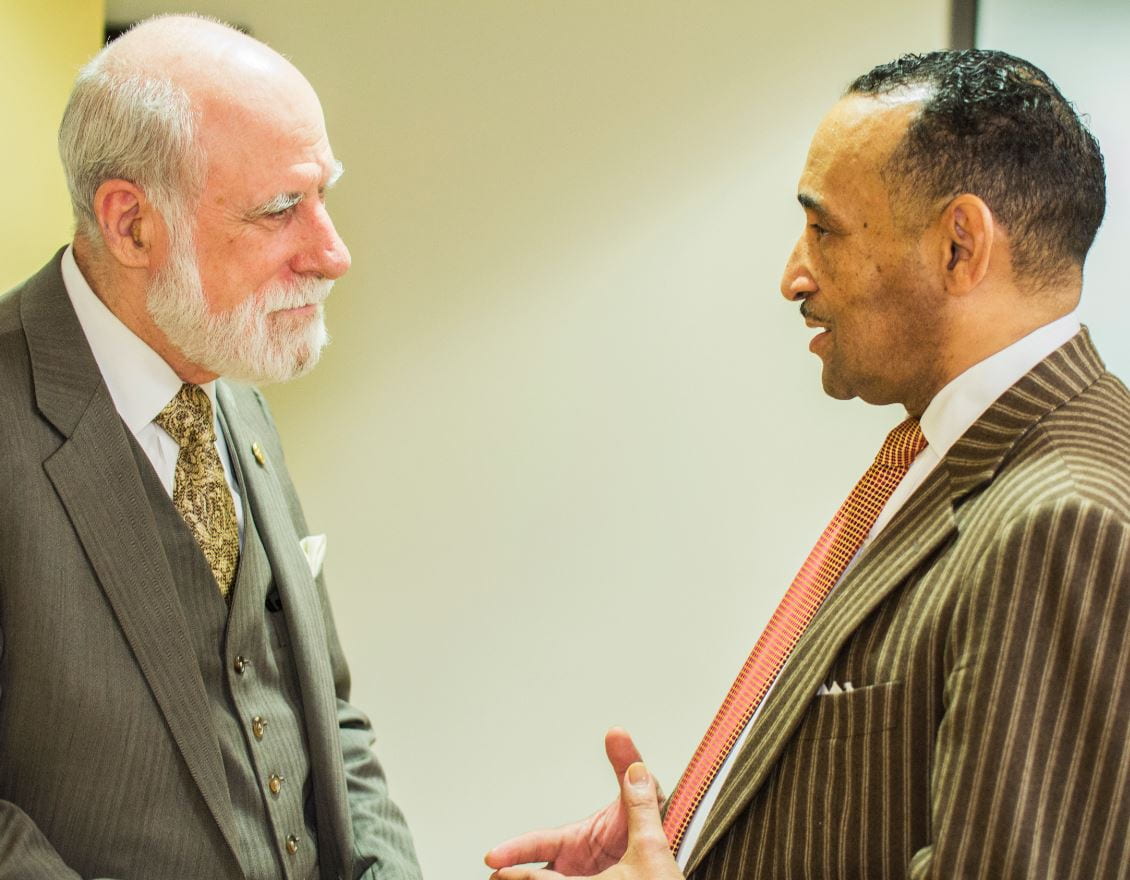
Cerf and Pendleton.jpg
Vint Cerf and George Pendleton

Expanding WEA
Dr. Daniel Gonzales, senior physical scientist at the Rand Corporation, presented on findings of the WEA Mobile Penetration Study, as well as ongoing research for the Department of Homeland Security. The group discussed cooperation between government and private industry on improving alerts-testing, geo-targeting, message length and other issues. They also discussed what it would take to get to universal WEA capability and how to get mobile virtual network operators (MVNOs) on board with WEA.

Locating 9-1-1 calls from cell phones
Next Generation 9-1-1 is an initiative aimed at updating the 9-1-1 service infrastructure. At the event, the group examined the challenge of locating people after they’ve dialed 9-1-1, as most calls are now made on mobile phones rather than easily locatable landlines. In April, the Washington Post reported that “an alarming proportion of 9-1-1 calls go unfulfilled because wireless technology fails to help locate victims in time.” Many industry and government researchers are already working to address this challenge, and their work was analyzed at the CCLP meeting.

Activating the FM radio in your phone
Almost all US smartphones have FM radio chips, but most carriers don’t activate them. That is starting to change: Jeff Smulyan, CEO of Emmis Broadcasting, showed meeting participants a new, free app that his company has helped to develop that will unlock FM receivers on many Android cell phones, allowing them to receive limited radio listening for free. Backed by a “billion-dollar” ad campaign, the app will be rolled out publicly next month. Read more in Powell’s article on NextRadio here.

Radio chips are particularly important in times of natural disaster, such as the recent blizzard and state of emergency on the East Coast, hurricanes, earthquakes, fires and terrorist attacks. The group talked about a possible compromise: getting mobile service carriers to agree on activating the radio chips in emergency situations. Craig Fugate, administrator of the Federal Emergency Management Administration, recently identified how important this is.

Reforming Lifeline
Lifeline is a government benefit program that provides discounts on monthly telephone service for eligible low-income subscribers to help ensure they can connect to basic services. Lifeline is supported by the federal Universal Service Fund (USF), which was created by Congress in 1934. Millions of Americans receive the subsidized mobile phone service, which is politically vulnerable because it’s seen by some as a form of welfare.

CCLP is drafting a report on the Lifeline program for the FCC that may include recommendations for improving public safety.

The mobile carriers that participate in Lifeline vary widely by state, and some carriers (including AT&TVerizon, and T-Mobile) only provide voice service through Lifeline subsidies, while Sprint – through a program with Virgin Mobile and Assurance Wireless – provides more flexible Lifeline plans that do appear to provide a texting and data option. One question addressed at the event was whether text messages and/or data are essential for public safety and emergency preparedness, and whether Lifeline providers should be encouraged to provide such services with their plans.
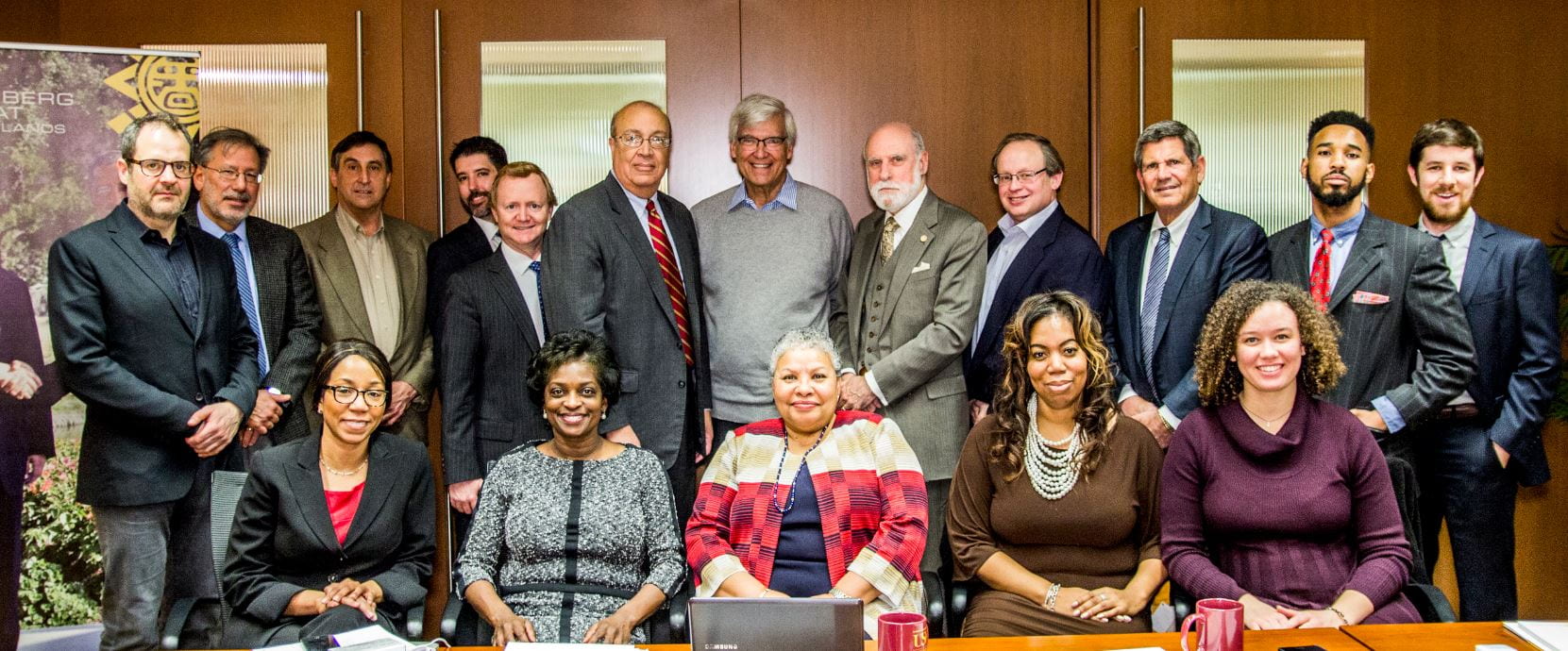
Group photo.jpg

CCLP research fellows Skye Featherstone and Ev Boyle conducted interviews with participants at the event. These interviews will be the basis for a short video to highlight key issues discussed as relevant to the meeting.
Senior fellow publishing new book on California as she wraps up CIR project on armed security guards

narda.jpg

As project editor on a two-month long assignment with the Center for Investigative Reporting, CCLP senior fellow Narda Zacchino oversaw reporter Shoshana Walter’s and others’ six part series “Hired Guns.” The team reported on armed security guards across the country who endanger public safety through a haphazard system of lax laws, minimal oversight and almost no accountability. The project includes a graphic novel and an interactive map.

Zacchino and Walter are hoping that the series will raise awareness about this issue and change policies across the country. CNN teamed up with CIR and featured two segments on the story, which will be sent to hundreds of key legislators in policy making positions.

“There is a bill in Congress now, by Pat Toomey of Pennsylvania, that would make FBI background checks available to security companies that want them,” said Zacchino. “Right now that’s not the case. We hope our series will enlighten people about the extent of the problem in the security industry and will get that bill passed. Certainly more needs to be done.”

Zacchino has also written a new book about California, which she has been working on for several years. The book will finally be published this year by Thomas Dunn Books, an imprint of St. Martin’s Press.

The untitled book, now in the final editing stages, demonstrates that “government” and “regulation” are not dirty words, and that “freedom from environmental and workplace regulation and from taxes to benefit the wealthy class is not conducive to progress as a nation, or democracy for that matter.”

The book’s thesis stems from the “debate over the neoliberal model of Texas and Kansas, which endorses privatization, deregulation, reductions in government spending, eschewing subsidies, having minimal government ‘interference’ in business and a tax system that favors the wealthy, versus the pragmatic liberal model of Jerry Brown’s California: raising taxes on those with incomes over $250,000 to help fund education, shifting money toward the schools of poor children, making alliances with other states and countries to counter climate change, rejecting military solutions to the problems posed by illegal immigration, raising the minimum wage and strengthening workers’ rights.”

Zacchino served as a top editor at the Los Angeles Times and San Francisco Chronicle. She has co-authored three books and co-founded Time Capsule Press, whose inaugural book, The LA Lakers: 50 Amazing Years in the City of Angels, was published in October 2009. She is an editorial and business consultant at the daily news website Truthdig. As a senior fellow, Zacchino works on programs exploring the role of media in democracy with a focus on state government financial crises.

Hundreds gather in Annenberg Hall to watch President Obama’s penultimate State of the Union address

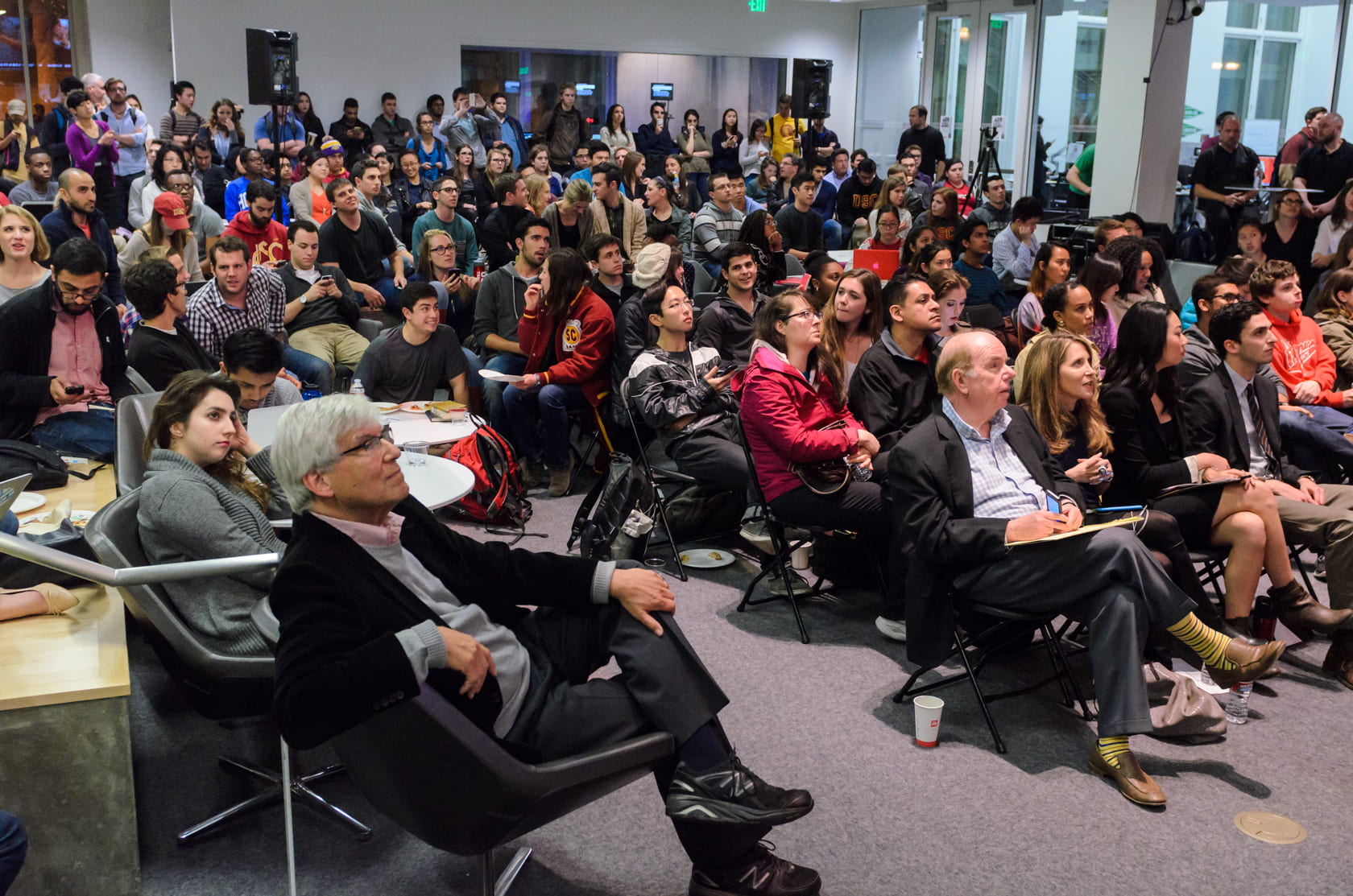
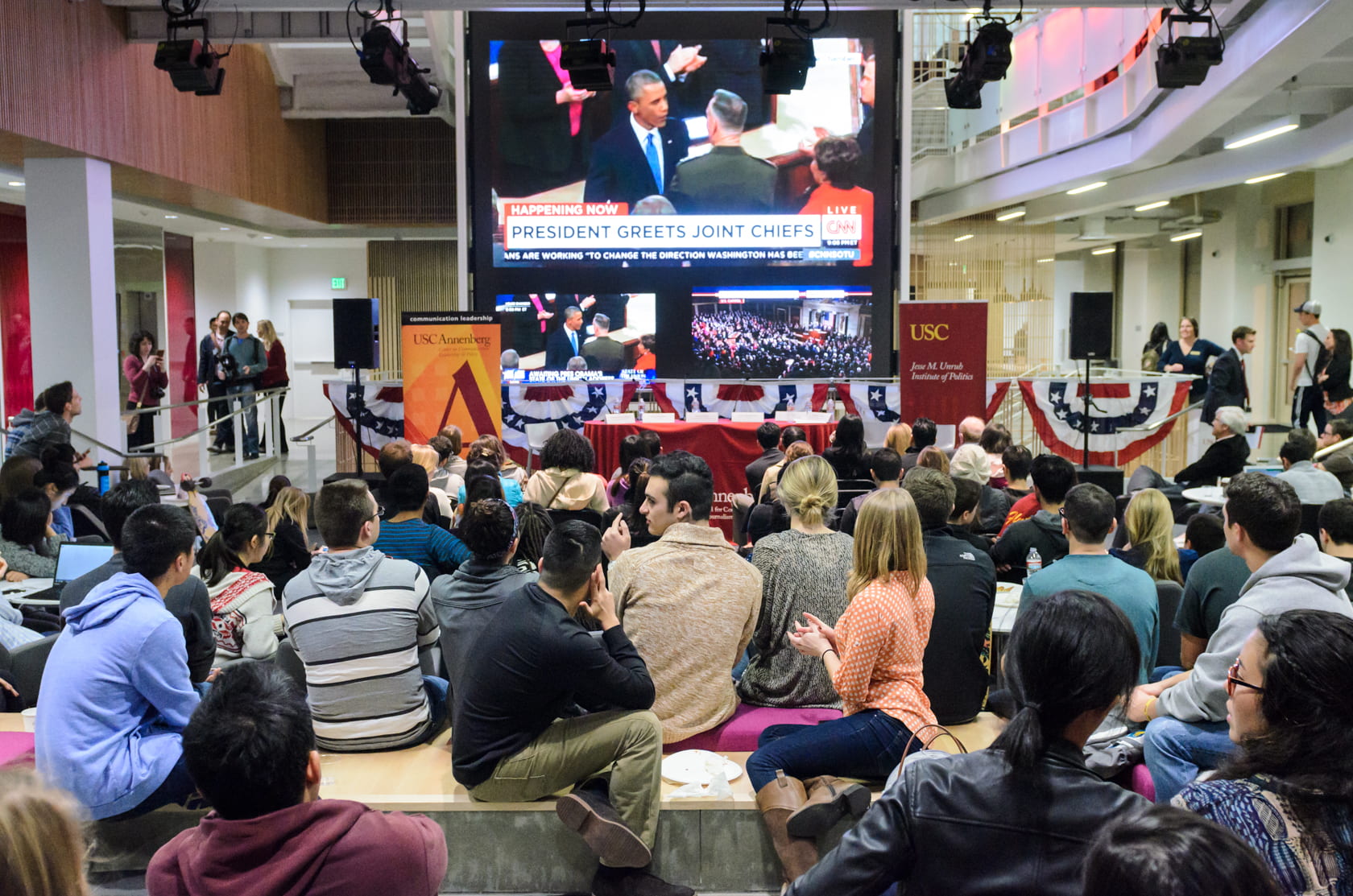
On Tuesday night about 250 people packed the new Wallis Annenberg Hall to watch President Obama’s sixth State of the Union address, the Republican response by Sen. Joni Ernst and a panel discussion that included two CCLP senior fellows. The event, which according to CCLP senior fellow Dan Schnur had the largest on-campus turnout for a political event since the 2012 election night viewing, was co-sponsored by USC Annenberg School for Communication and Journalism, the Center on Communication Leadership & Policy and the Unruh Institute of Politics.

crowd 1.jpg

See more event photos in our Flickr album and watch the video by KTLA 5 News

The politically diverse audience included USC students, high school students, professors, College Democrats and College Republicans, who gathered in the Annenberg communications and journalism building to watch the speeches on a large screen in the lobby. The event was covered by KTLA, CBS, Daily Trojan and USC News.

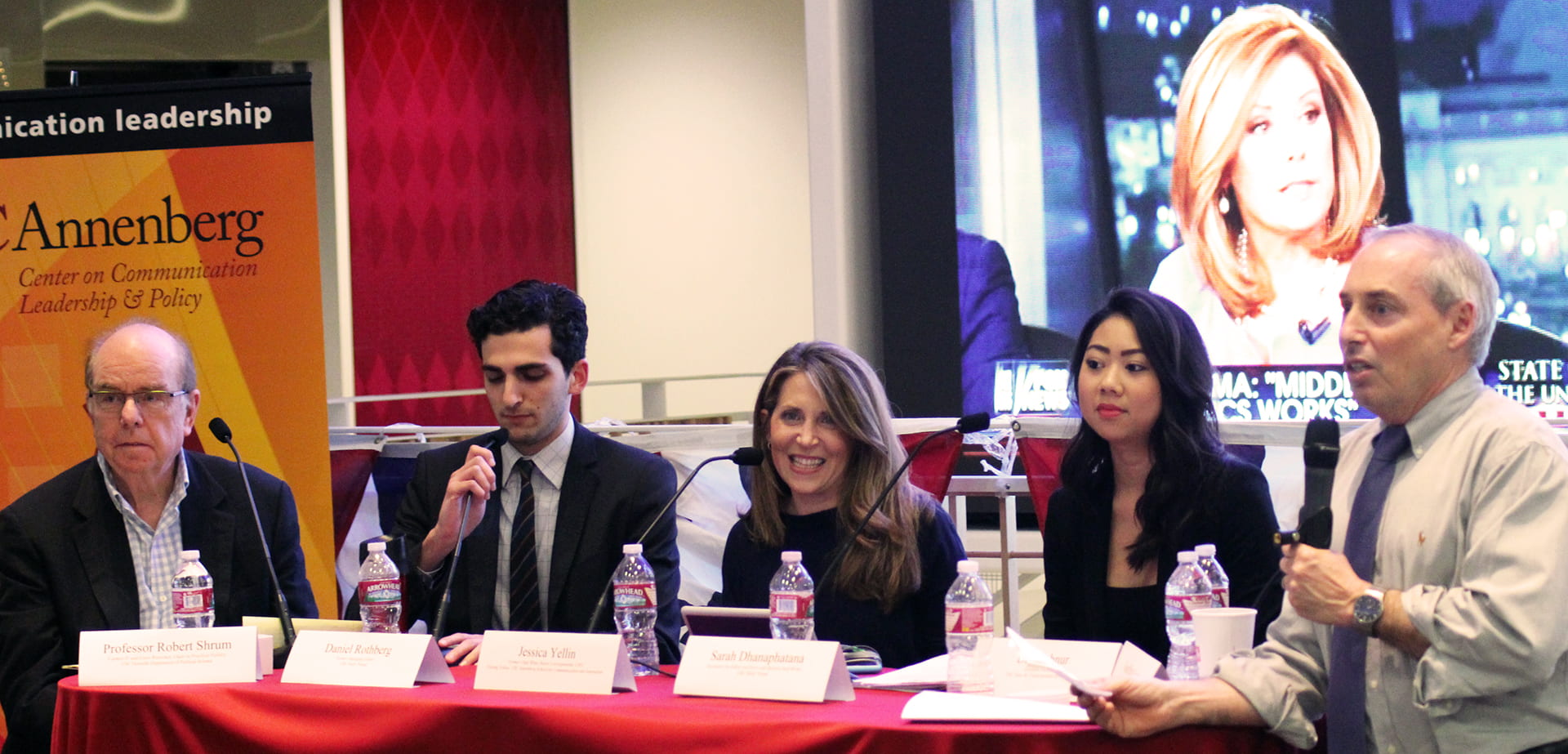
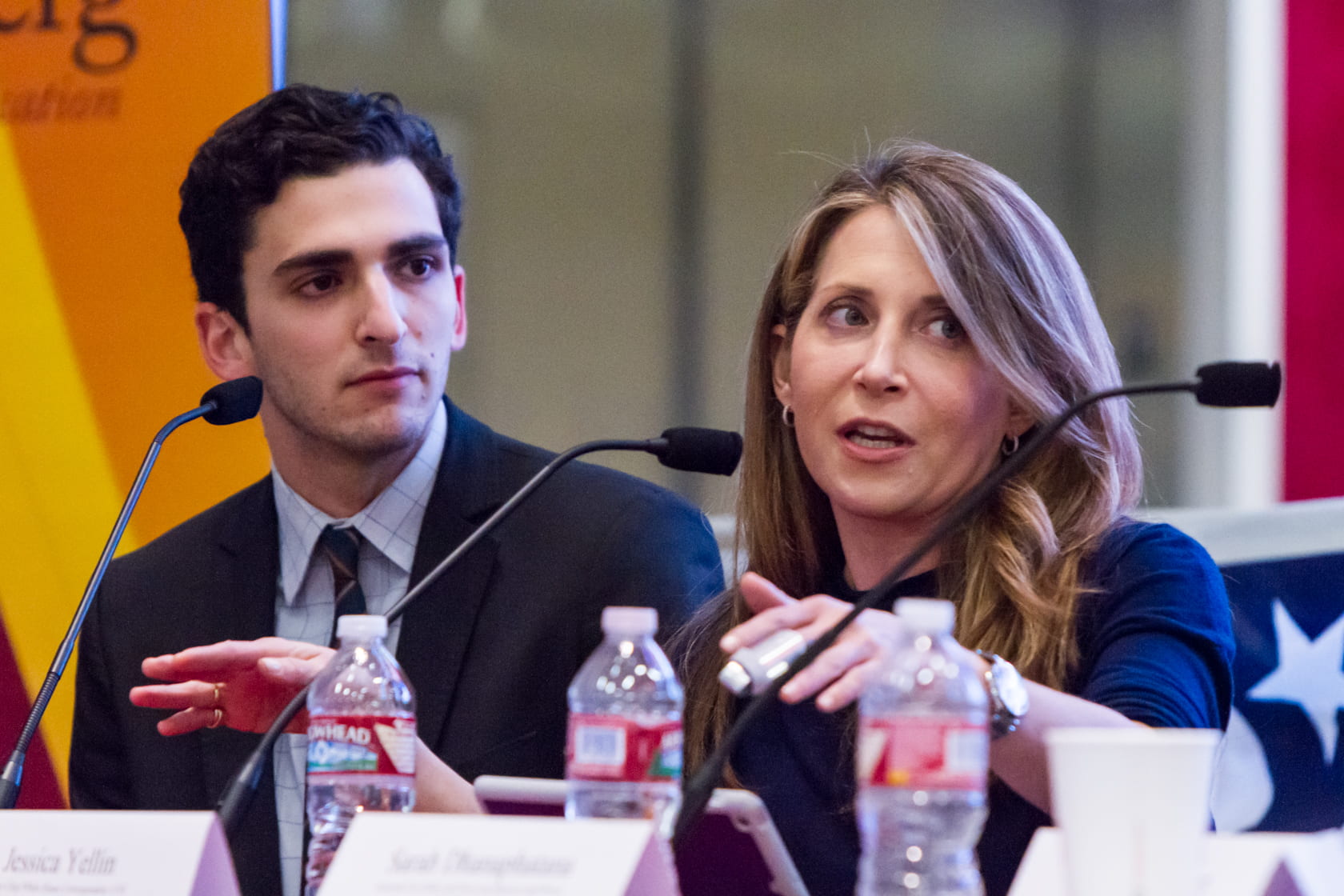
Schnur, who also serves as executive director of the Unruh Institute, moderated the panel, which included CCLP visiting fellow and former CNN White House correspondent Jessica Yellin, USC professor Bob Shrum, Daily Trojan assistant city editor Sarah Dhanaphatana and former Daily Trojan managing editor Daniel Rothberg. CCLP director Geoffrey Cowan welcomed the audience and introduced the panelists.

cowan crowd.jpg

During his second to last State of the Union address, President Obama declared that the “shadow of crisis has passed and the state of the union is strong.” He said that despite the challenges of the past 15 years it is time to “turn the page” on recession and war. He touted the recovered economy, middle class economics and other policies that have worked and “will continue to work as long as politics don’t get in the way.” His speech called for paid sick leave, a minimum wage hike, equal pay for equal work for women, an end to the Cuban embargo, authorization for use of force against ISIL, free community college and more, and both called for bipartisan cooperation and issued veto threats for bills he disagrees with.

ANNSOTU.jpg

The panel discussed how Obama delivered the speech as well as the content, with several panelists noting the president’s seemingly renewed energy and confidence despite his party’s “shellacking” at the polls in November. The panel talked about the politics of neck ties, the lack of mention of national debt, partisan gridlock, immigration, Obama’s veto threats, the role of social media, the 2016 presidential election and women’s rights.

ANNSOTU15panel1.jpg
From left to right: Bob Shrum, Daniel Rothberg, Jessica Yellin, Sarah Dhanaphatana, Dan Schnur

Several audience members asked the panelists questions, including one student who noticed that the several news outlets playing on the large screen behind the panel were not covering the women’s rights issues that Obama talked about in his speech. Yellin suggested that the lack of coverage was due to the male-dominated management of media companies, and not necessarily the media itself.

“There’s a false perception that viewers won’t care or find it interesting,” said Yellin.

yellin.jpg

Photos by CCLP web & IT coordinator Liz Krane.


Intertwined narratives tell of adventures in Africa

Reviewed by Jeff Fleischer, Foreword Reviews, 1/16/2015

Justin Chapman’s travel memoir Saturnalia tells two intertwined stories. One is the travelogue of a young American writer venturing alone through several southern African nations; the other is a memoir of a drug addict starting to relapse while abroad. The former is the stronger of the two plot lines, but both are told in conversational prose that generally works at conveying the ups and downs of the author’s untethered existence while in Africa.

Starting in Cape Town, Chapman journeys through other parts of South Africa before he visits Botswana, Zimbabwe, Zambia, and Rwanda, and stays for an extended period in Uganda. He relates experiences that will be familiar to backpackers, from the way those sharing a hostel become important friends for just a few days to how something as minor as needing to buy camera batteries can become a complex ordeal. But he also memorably tells of dealing with corrupt police who demand bribes, interacting with annoying fellow expats, and surviving genuine danger in unfamiliar environs.

One notable anecdote involves the author covering a village’s traditional investigation into charges of using witchcraft, journalistically detailing the procedure while skeptically criticizing the superstitions behind it. Another describes having a train-trip discussion about depression interrupted by a spectacular view of giraffes feeding. Chapman sometimes comes off poorly in his own narrative, seeming snarky or even petulant, but this provides a different take on a travel-narrative protagonist, and hints at a self-destructive side that gradually dominates the book.

The drug-addict storyline is always present, as Chapman speaks frankly about the Africa trip being partly a way to quit heroin. He never goes long without popping Xanax or getting high with other travelers. Because relapse seems inevitable, this aspect of the book isn’t quite as compelling as the rest. Still, Chapman is aware of the travel experiences he passes up by allotting time and resources to the quest for a fix, which adds a layer of melancholy on top of the more obvious effects of his drug habit.

Overall, Saturnalia does a nice job capturing the angst of a young writer trying to experience a different life while struggling to avoid the pull of his old one. Whether emotionally affected by a Rwandan genocide memorial or physically impacted by a sudden car crash in Zimbabwe, Chapman comes away from his African journey with some interesting stories, and he shares them in an open and often engaging manner.
There was standing room only at the launch event at Vroman's Bookstore on January 13. Special thanks to everyone who came out to support this book. Vroman's staff had to ask the publisher to go out to his car and get more books, because the 40 they ordered weren't enough! Vroman's also said it was the largest turnout they've had in quite awhile, and told Justin he could come back any time.

Art Aids Art had a table at the event selling art from the township of Khayelitsha in Cape Town, South Africa. Tom Harding spoke about that organization and how Justin came to visit them in Cape Town. Then Pasadena Weekly deputy editor Andre Coleman introduced Justin, who showed photos and told stories about his three-month trip through Africa, read a chapter from Saturnalia, and signed copies for those standing in a line that wrapped around the room.

Here are some photos of the event:


LA Progressive Live! — Quest for Self-Discovery in Africa: Watch Now

By Dick Price and Sharon Kyle, LA Progressive, JANUARY 12, 2015

The LA Progressive is streaming live!! Don’t miss its weekly broadcast—devoted to progressive politics and social justice.

Tune in today, Monday, January 12th, at 3 p.m. PST right here for the next installment of “LA Progressive LIVE!” You’ll find us streaming at www.laprogressive.com—and we’ll archive the 1-hour show.

Your hosts Dick and Sharon will be talking about our freedom of the press in light of the murders at the hands of two Muslim extremists of a dozen cartoonists, affiliated staff, guards and a visitor at the French satirical magazine Charlie Hebdo. Will this tragedy spawn further racial and religious hatred, ratchet up calls for further oppression, or will the world now have enough of such violence? Join us to discuss.

Saturnalia Justin ChapmanJoining us will be journalist Justin Chapman, who will discuss his just released book, “Saturnalia: Traveling from Cape Town to Kampala in Search of an African Utopia,” that is both a fascinating travelogue of his three-month tour through Africa, and is especially a journey of self-healing and self-discovery.

“I had no idea what cities or even countries I was going to visit, or how I’d get there,” Chapman has reported. “I figured out my trip as I went, and after a couple of weeks in Cape Town, I decided to go to Johannesburg and stayed in a hostel before heading into Zimbabwe. I mapped it out as it happened.”

Can a short, white guy from California, as Justin describes himself, kick his devils and find love in the heart of Africa? Join us to find out.

And be sure to catch Justin here: Saturnalia: Traveling from Cape Town to Kampala in Search of an African Utopia

Dick Price & Sharon Kyle

LA Progressive Editor & Publisher