
They grow up so fast, don’t they? This year, the Bombay Beach Biennale turned 10.
The Biennale is a one-of-a-kind, renegade art experience over the course of a spring weekend each year in the post-apocalyptic former resort town on the receding shores of the Salton Sea, about three hours east of LA in the unforgiving Colorado Desert. It was founded by Stefan Ashkenazy, owner of the Petit Ermitage Hotel; Lily Johnson-White, a public art producer of the Johnson & Johnson family; and Tao Ruspoli, a filmmaker, photographer, musician, and son of an Italian prince named Dado.
Bombay Beach Biennale Turns 10. Photo Credit: Mercedes Blackehart
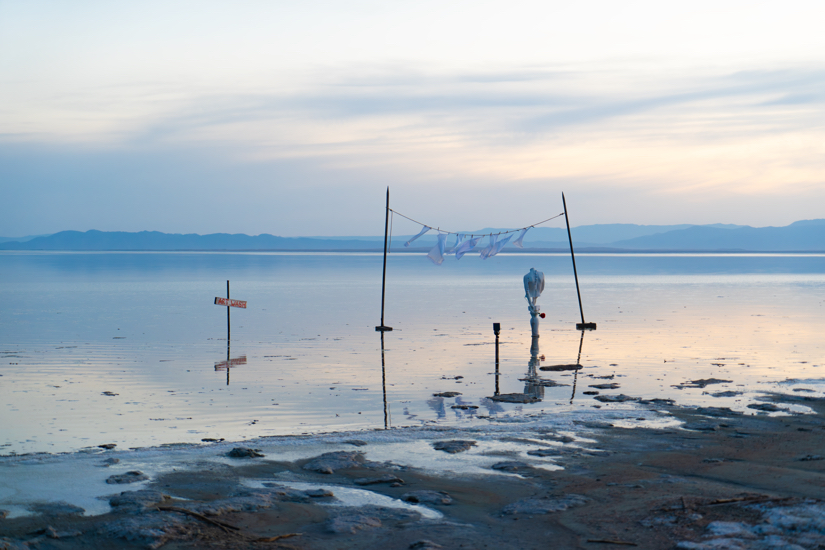
The Salton Sea is an otherworldly rift lake that formed in 1905 when the Colorado River overflowed. Before the Biennale, Bombay Beach was a relic of a bygone era when celebrities vacayed there in the 1950s and 60s, including Frank Sinatra, Bing Crosby, Sonny Bono, Desi Arnaz, and the Beach Boys. In 1980, the sea took a turn for the worse. Agricultural runoff from the surrounding industrial farms and increasing salinity have polluted the water, making life untenable. The resulting smell is a delectable aroma of sulfur and dead fish and birds.
Bombay Beach Biennale Turns 10. Photo Credit: Mercedes Blackehart
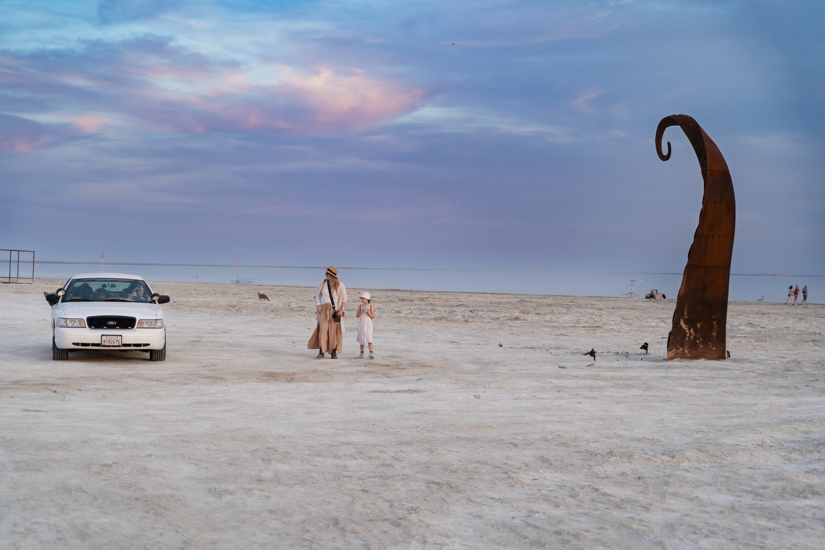
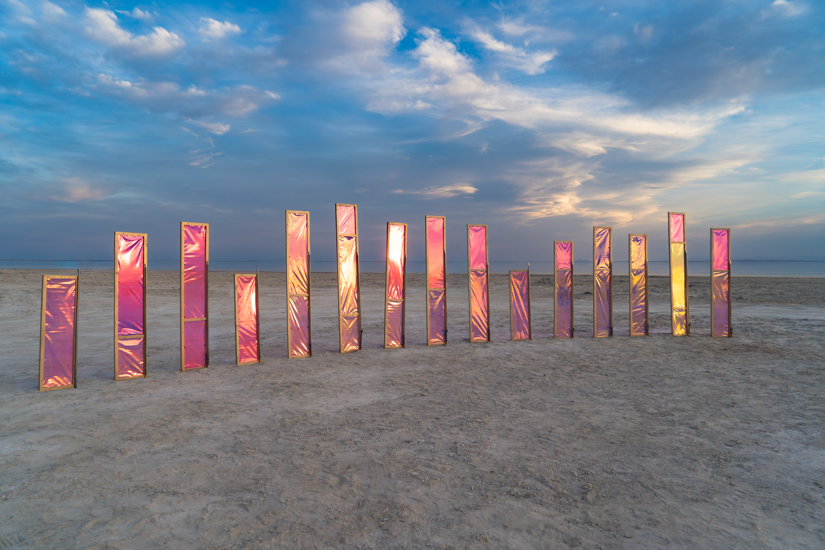
The Biennale, which has turned a desolate place into something special again, is more than an art festival. The event features DIY art exhibits, installations, galleries, philosophy talks, live music, film screenings, and more, spread out across the one-square-mile grid town and the Salton Sea playa. The experience is effectively like encountering Meow Wolf out in the real world. There’s nothing else like it. Read my story in Culture Honey Magazine to learn more about the Biennale.
This year’s Biennale, especially, felt like a collective sigh of relief among the members of the creative class who attended—a group of sane yet unconventional people in an increasingly insane world. There was so much art, so much uniqueness going on across the landscape and seascape, that one couldn’t possibly see it all in one blazing hot weekend.
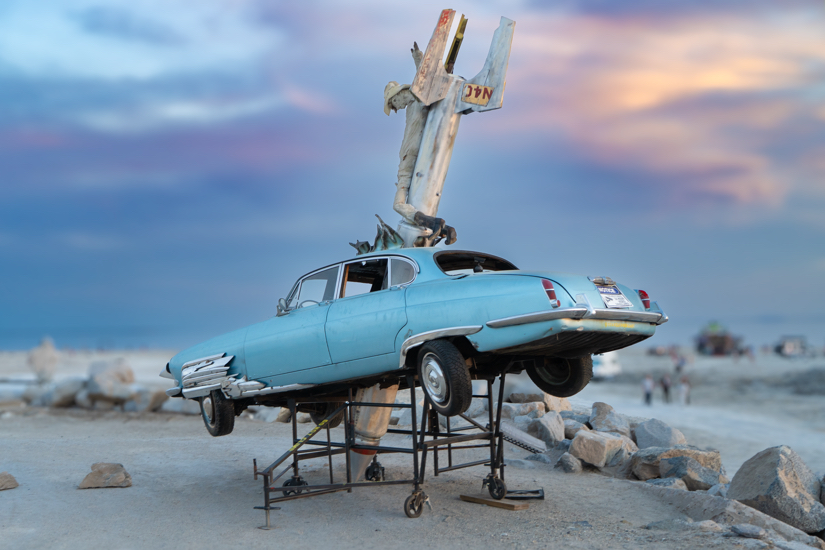
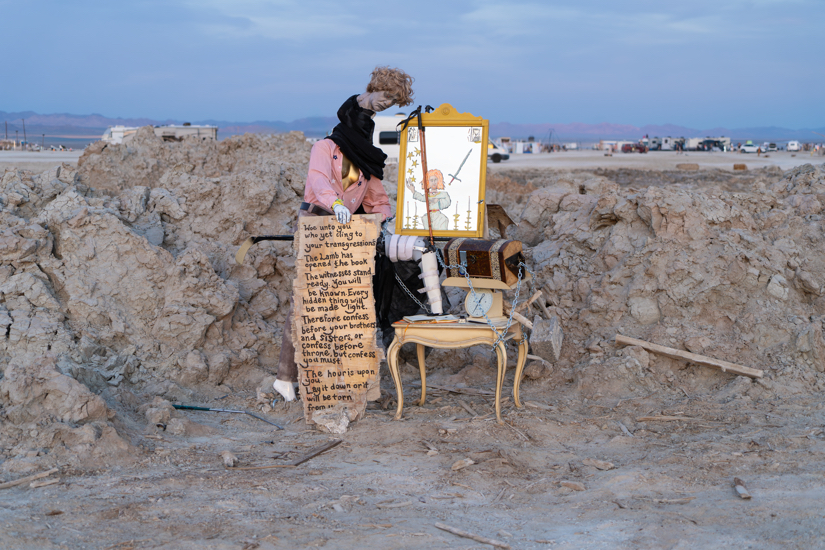
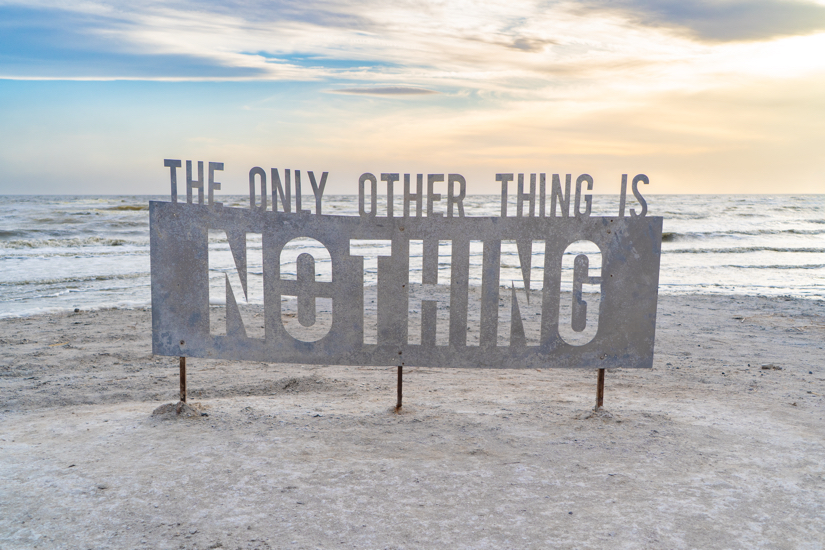
Over here was a giant Pez dispenser with a movable old man’s head on top. Over there was a shotgun wedding unfolding on a rickety dock over the polluted water. Over here was a robot covered in condoms that randomly inflated as a connected machine blew air through the robot. Over there was a simulated, guided magic carpet ride in which participants wore electronic bands on their foreheads that read their brainwaves. Over here an enormous statue of the words “FUCK YOU ELON MUSK” towered over the beach. Over there food made out of bugs was served, over here affogatos.
Alma Har’el’s deeply moving but extremely hard to find 2011 documentary, “Bombay Beach”—which was made before the artists came to town and followed the lives of several locals living in this hardscrabble environment—was screened. High art such as ballet, opera, and flamenco performances drew huge crowds, despite Timothy Chalamet’s recent derogatory comments.
And that’s just scratching the surface. You have to see it to believe it—and you have to participate to see it.
Bombay Beach Biennale Turns 10. Photo Credit: Mercedes Blackehart
‘Acceptable shades of beige’
The event is free but the dates are secret. The organizers prefer participation over spectation, long-term community builders rather than weekend art warriors. Artists who show up throughout the Biennale season from January to April learn the dates after contributing in some way to the movement.
“My favorite definition of a secret is something you tell one person at a time,” Tao said.
That season is called Acéphale, symbolized by a headless man in reference to the fact that there is no leader, per se, of the movement or the Biennale itself. Indeed, Bombay Beach is a decentralized, organic community, guided by Tao’s and his partner Dulcinée DeGuere’s Bombay Beach Institute for Industrial Espionage and Post-Apocalyptic Studies, which was recently granted 501(c)3 status.
“In an America increasingly dominated by sameness—where homeowners’ associations dictate acceptable shades of beige and corporate interests flatten cultural differences—the [Bombay Beach] Institute fights to preserve spaces where weird, wonderful things can happen,” Tao wrote in an op-ed in CounterPunch Magazine. “We aim to nurture the imaginations of those inspired to build alternatives to our current systems. As the planet warms and inequality deepens, spaces like this become not just artistically interesting but politically necessary.”
Bombay Beach Biennale Turns 10. Photo Credit: Mercedes Blackehart
The Bombay Beach Institute began years ago under a different name, the Bombay Beach Institute of Particle Physics, Metaphysics & International Relations.
“It started as just a physical location that we, partly tongue in cheek, gave a highfalutin name to, which was actually also serious, because we try and invite people from around the world and we do a philosophy conference every year, and then it became necessary to have a 501(c)3 that was more involved in Bombay Beach the entire year, not just the Biennale weekend,” Tao said.
A few years ago, Tao met Dulcinée DeGuere, a poet, filmmaker, conceptual artist, and social sculptor. She had ambitions to start a think tank and dig deeper into what the Biennale stood for. She helped bring structure to the organizational side of the operation.

Bombay Beach Biennale Turns 10. Photo Credit: Mercedes Blackehart
“I call myself the Bureaucrat of Bombay, among many other names,” she said, including Systems Architect of the Biennale and Executive Director of the Institute.
‘Strange alchemy’
Before stumbling onto the “accidentally life-defining project” that was the Biennale, Tao was a filmmaker. Tao and Dulcinée recently got engaged—perhaps a surprising turn of events for the filmmaker who made the movie “Monogamish” as a way to deal with the emotional impact of his divorce from actor/director Olivia Wilde, or perhaps not. Now he and Dulcinée split their time between Italy, Yucca Valley, and Bombay Beach.

Bombay Beach Biennale Turns 10. Photo Credit: Mercedes Blackehart
His latest film, “The Dulcinée Dialectic,” premiered last month at the American Documentary and Animation Film Festival (AmDocs) in Palm Springs. It won the Special Jury Award (in the Best Feature Doc category) and Best Post-Production Sound at the festival. Watch the post-screening Q & A with the filmmakers here.
“I’ve always made movies that are very personal and explore difficult personal issues,” Tao explained. “‘The Dulcinée Dialectic’ is a meditation on what it is to be human in the age of artificial intelligence through the eyes of Dulcinée’s mental health journey and my reckoning with my unhealthy relationship to technology.”
When Dulcinée was diagnosed with Bipolar II, a mood disorder that includes at least one episode of hypomania and one of major depression, she started documenting her own experience of the mental health world and her diagnosis. She explored what it meant and what its philosophical, social, and psychological implications were through her art.
“Bipolar is partly defined by manic episodes, and I felt like the culture and me were having a manic episode about AI,” Tao said. “There was an interesting contrast going on between this human who feels a lot and this machine that feels nothing at all. I started thinking about dialectical thinking, which is putting two things that are in total opposition next to each other and seeing what we can learn.”
The film is a moving, poignant exploration of mental health and A.I., while also being downright hilarious with some surprisingly self-critical commentary of Tao.
The making of the film was taking place around the same time as the expansion of the Bombay Beach Institute, which Dulcinée called a “laboratory for dignity, creativity, and dangerous thinking.”
“We needed a structure to be the umbrella for the philosophical, political, and community work—the Biennale was not able to carry all of that,” Tao said. “So Dulcinée and I started the Bombay Beach Institute for Industrial Espionage and Post-Apocalyptic Studies, keeping up the slightly absurd but also totally serious nomenclature.”
Dulcinée explained that the goal of the Institute is to frame what’s happening in Bombay Beach in a more expansive context than the Biennale had been able to.
Bombay Beach Biennale Turns 10. Photo Credit: Mercedes Blackehart
“The Biennale is the outward facing interview, in a sense,” she said. “We invite people to the Biennale, and those that come back wind up getting more involved in the work that expands outside of just the weekend itself. Guests and participants come and see the art and they experience a great party with some lectures and all that. But the most interesting thing that’s happening is really the movement of people who come back year after year, in addition to our guests who travel from around the entire world to come, and the really strange alchemy that’s happening because of this influx of people mixed with the people who have lived here for decades.”
‘Truckload of philosophers try to go to Mars, perish en route’
Starting with a New Year’s Eve party, the Acéphale season also features the annual conference of the American Society of Existential Phenomenologists (ASEP), a Nietzsche philosophy conference called Nietzsche in the Desert (to which Tao gave this illustrious introduction), Prom, and an occasional literary festival, among other events, culminating in the main course itself, the Bombay Beach Biennale.
ASEP, a group founded by Tao’s mentor and UC Berkeley philosophy professor, Hubert Dreyfus, happened to take place on the day we visited Bombay Beach to interview Tao and Dulcinée in early January.
After lunch and in between philosophy talks, we crammed into the bed of Tao’s truck with a group of philosophers and he drove us over the bumpy Salton dunes to Mars – Mars College, that is. The ride was rough enough that we joked about future headlines reading, “Truckload of philosophers try to go to Mars, perish en route.”
Mars College, founded by entrepreneur and technologist Freeman Murray, is a temporary, 3-month, off-grid campus community and educational experiment located about a half mile east of Bombay Beach in which students and professors explore future technology, self preservation, creative expression, and much more. The main building consists of pallet rack structures, which is built in December and deconstructed in April every year. That structure includes a lecture hall, library, gallery, café/hash bar, and classrooms in which “Martians” activate through workshops, installations, and experiences.
“They have real motherfuckers teaching real classes,” said B. Scot Rousse, a philosopher in residence at Topos Institute and a visiting scholar in philosophy at UC Berkeley.
The seasonal “pop-up” college is a separate entity from the Biennale, although the two groups share some similar philosophies and timelines.
We told the philosophers how our 7-year old daughter loved visiting Bombay Beach, even though it’s not the safest place for kids.
“Tetanus opportunities certainly abound at Bombay Beach,” one said.
“Gotta add Tetanus Opportunities to my growing list of band names,” said B., also a drummer who gave a philosophy talk at Bombay Beach’s No Shoes venue last year in which he incorporated his love of punk rock.
Stark contradictions
That philosophy plays such a major role in what the Biennale has become is part of what makes the event and the place so unique. This isn’t just a party—though it is that too. It’s a serious examination of serious issues facing the world and a hands-on experiment in making philosophical concepts tangible and applicable. It’s the Thinking Man’s Burning Man, but even that isn’t really an accurate description, as Tao understandably discourages comparisons to Burning Man.
“What attracts me and these philosophers to Bombay Beach is the idea that philosophy doesn’t have to be this purely theoretical thing that happens in the halls of academia,” Tao said. “Philosophy should be relevant to the world. And Bombay Beach is a place where a lot of the questions that humanity has become good at sweeping under the rug and that you can easily sweep under the rug in a more normal environment—they start to become really pressing and salient here.”
That includes questions such as, “’How do we create a society in a world in which the environment is collapsing, in which we have huge income inequality, in which things are falling apart or have fallen apart in very serious ways?’ It’s easier for some people to ignore that. It’s very hard to ignore that in Bombay Beach, so philosophical questions become much more relevant than they are maybe in academia, or in LA and the suburbs, or any other more ‘normal’ place. Bombay Beach is a microcosm of the world where all the problems are exaggerated.”
One glaring example is climate change. Part of the goal of the Biennale in the beginning was to call attention to the ecological disaster that is the Salton Sea. The accidental body of water—totaling about 7.5 million acre-feet—is receding at 40-120 feet per year. It is rapidly disappearing. One member of the community, William Sinclair, who goes by the moniker Irondad, runs around the Salton Sea every year to kick off the Biennale—no small feat, indeed. Each year, his route gets unfortunately shorter.
“People can think about climate change theoretically, but here in Bombay Beach, environmental catastrophe is real, and you look at it, you smell it, and it’s there,” Tao said. “It’s not subtle here. So it’s really cool to come up with new structures and ways of being together, confronting the economic and environmental and philosophical issues as real, pressing things that also have solutions here that are maybe harder to take on in the world at large. You might feel like an insignificant human by yourself, if you don’t have huge political power or billions of dollars to affect change. Here, you can come and say, ‘Okay, I’m gonna try this way of living.’”
That way of living attracts eccentrics and resilient nonconformists who are also keen on belonging to a community, thus creating a tension between individualism and collectivism. It is indeed a place of stark contradictions. But the town has banded together, evidenced by such new entities as the volunteer fire brigade and emergency response unit.
“The desert tends to attract people who might be misanthropes, who want to be away from everyone,” Tao said. “But Bombay Beach has this paradox of being in the middle of the desert but also very compact and contained within this quarter mile. I love it for all these reasons.”
Bombay Beach Biennale Turns 10. Photo Credit: Mercedes Blackehart
The last judgment
Back in January, Tao said he expected this 10th year of the Biennale to be “the best and biggest ever,” before adding cryptically, “and maybe the last, who knows?”
After all, the theme is “Year X: The Last Judgment.”
“I do think there’s a lot of excitement around the fact that it’s been 10 years, and so I feel like everybody’s more motivated than ever before,” he added. “But it’s not a growth mentality. It’s not like we have to outdo the last one, but I just think that people will bring their all. I’m excited.”
Tao and Dulcinée likened that growth mentality to a cancerous metaphor. They don’t necessarily want the Biennale to grow in attendance, for example.
“The event really benefits from intimacy,” Dulcinée said. “Our venues are quite small. The town is really small, and there’s something juicy about being in a tiny trailer with not that many people seeing a jazz band, or seeing an Oxford professor giving a lecture. The movement can grow in philosophical ways. It can grow in its audience, and it is growing. That points to the need for the Institute, alongside the community, making sure people are coming here for the right reasons and they understand the breadth of things that are happening here.”
“Unfortunately, in our capitalist society, success is only measured by growth,” Tao added. “There is a kind of evolution and horizontal growth, let’s say, that’s good. Instead of growing the size of the event, I prefer for people to become engaged in a deeper way and a more engaged way throughout the year. That’s much more interesting to us. And that’s what the Institute allows for, instead of just making a bigger party or a bigger splash, because that could actually be harmful.”
Although it’s the 10th year, that’s not to say that the Biennale has taken place every one of those 10 years. The first one kicked off in 2016. Understandably, the 2020 event was canceled due to Covid. Last year, the event was scaled back and relabeled the Convivium, which will take place every odd year while the Biennale continues every even year going forward.
Partly, that’s because the other two co-founders, Ashkenazy and Johnson-White, couldn’t attend every year. But it was also a natural scaling back in their ongoing management of growth.
They were looking for a name and a frame for the event on odd numbered years to be distinct from the Biennale. “Symposium” is too played out and too corporate, but the Latin version of symposium is “convivium,” which was a Roman banquet involving social drinking and discussion. It’s also related to conviviality, the quality of being friendly.
“But then what sealed the deal was, we found out that there’s a technical biological definition: when a subset of a species lives in such isolation that it starts to acquire traits that are specific to that location,” Tao said. “I was like, ‘Wow, that’s amazing. That’s exactly what’s happening to the weird humans who gather in Bombay Beach.’ We’re starting to develop our own traits to adapt to this place, and it does attract people who are a subset of the of the human species that’s very specific to this place.”
It’s certainly not for everyone, and “it’s wonderfully self-selecting,” Tao added. “Some people will come here and fall in love with it, and other people are like, ‘What the fuck are you talking about? Why would I want to be here?’ And so Convivium it became.”
He also pointed out that they try to keep the economic and ecological issues in mind, while also not losing sight of the idea that Bombay Beach is downright fun.
“It’s an unusual community,” Tao said. “While it’s full of all these serious issues, it’s also wonderfully fun and surreal and full of mischief and provocation. Its roots are in it being a place to escape and have fun. While being sensitive to the real issues, we still encourage people to come here and play—in the most interesting sense of the word.”
Meanwhile, the Salton Sea and the town of Bombay Beach slip further and further away from each other. The Biennale certainly has accomplished the goal of drawing more attention to this ecological disaster. But is there any saving the Salton Sea at this point?
“I’m not super hopeful,” Tao said. “What about you, Dulcinée?”
“Yeah… I wouldn’t hold my breath.”